
You’ve probably seen how chatbots answer with surprising clarity, AI models summarise reports in seconds, or digital assistants help teams coordinate daily tasks. But what’s actually happening under the hood?
It’s not a single model doing all the heavy lifting. It’s a team of AI agents, each handling a specific part of the process, such as retrieving data, planning steps, verifying results, or triggering downstream actions. However, without coordination, these agents operate in silos. Tasks get duplicated, steps are missed, and outcomes become unreliable.
That’s why agent orchestration is about structure, coordination, and purpose. It’s how different AI agents, each with a narrow skill or role, work together as a functional system to complete complex tasks. And as agents become more capable, orchestrating them isn’t just a best practice, it’s a must.
What is AI orchestration?
Agent orchestration is the process of coordinating the work of multiple AI agents to complete a task. Rather than running independently, agents operate in a structured workflow where each one plays a distinct role, such as retrieving data, injecting knowledge, making decisions, or triggering actions.
For example, consider a loan approval process in a bank.
One agent verifies a customer's uploaded documents. Another checks the credit score against internal thresholds. A third party drafts the loan agreement. A fourth sends the final confirmation email. Each agent handles a single step, but without orchestration, they'd operate in silos, unaware of context or sequence.
https://www.youtube.com/watch?v=X3XJeTApVMM
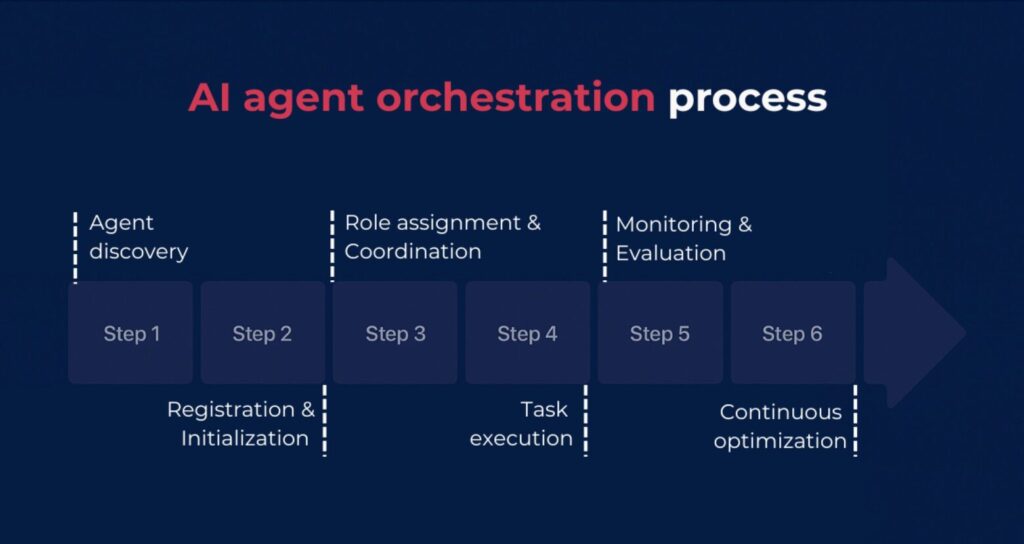
Orchestration is the logic that ensures these agents pass information from one to another, manage dependencies, and react to new conditions without human intervention. It handles the handoffs, timing, and flow of data, ensuring the process runs smoothly from start to finish.
This design also makes the system easier to debug, scale, and optimise. Each agent stays focused, and the orchestrator defines how they collaborate.
Why does this matter? Because isolated agents can only solve one piece of a problem. But most real-world problems span multiple steps and decisions. Orchestration turns a set of single-task agents into a system that thinks and acts holistically.
It enables more intelligent, multi-step workflows, improving the coordination, adaptability, and sequencing. By combining their strengths under one orchestrated plan, agents can analyse and act together, building AI systems that are more capable and reliable than any single agent on its own.

The purpose of an orchestrator agent
The orchestrator agent is the strategic hub of a multi-agent system. It doesn’t simply monitor tasks but makes judgment calls, assigns responsibilities, resolves conflicts, and ensures agents work synergistically.
Rather than a glorified scheduler, the orchestrator agent understands system-level objectives and context. It determines the order in which agents act, decides which agent is best suited to handle a particular input, and keeps the flow of information consistent across the system.
When two agents propose conflicting actions, say, one wants to discount a product to boost sales while another wants to raise prices due to inventory shortages, the orchestrator resolves the contradiction in light of company goals.

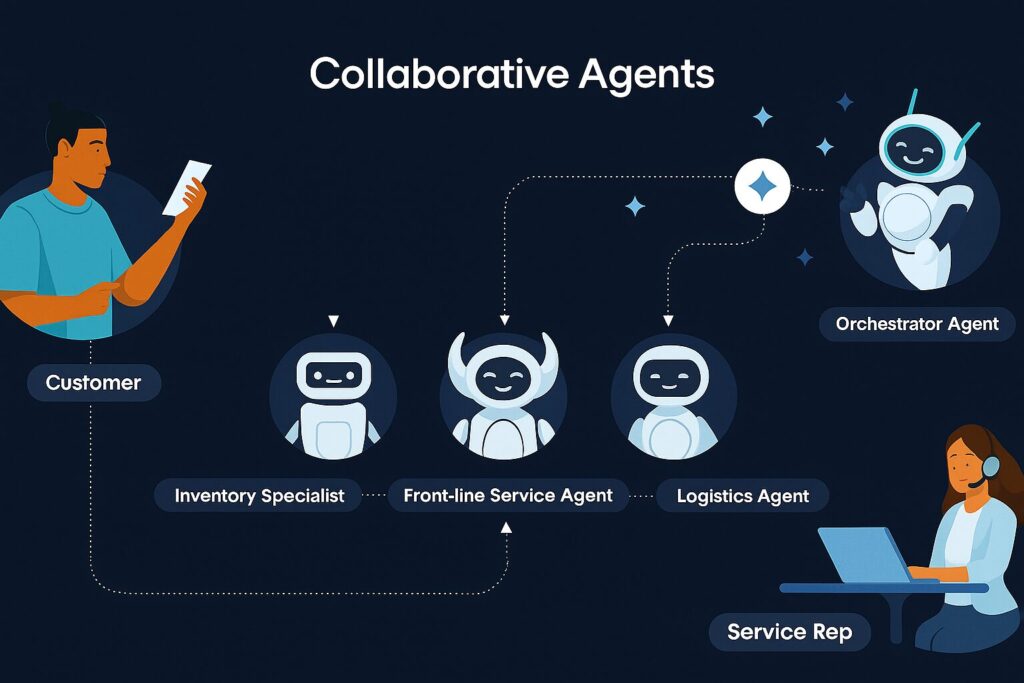
Its core responsibilities include:
Distributing tasks dynamically based on current system state and priorities
Sequencing agent actions to respect dependencies and shared goals
Handling fallbacks and escalations when agents encounter errors or ambiguities
Ensuring that all agents operate in a synchronised, up-to-date context
Modifying workflows in real-time as new data and user inputs emerge
Ultimately, the orchestrator transforms a collection of intelligent parts into an intelligent whole.
A real-world example: Customer support automation
Take the case of a large telecom company that wants to automate frontline customer support. It builds several agents:
One detects sentiment in the customer’s tone and language
Another retrieves standard answers from a large database of FAQs
A third accesses billing and transaction history
A fourth determines whether and when to escalate to human support
These agents are impressive on their own. But without orchestration, they stumble over each other. Two agents respond simultaneously with different answers. The billing agent pulls up information before the customer is authenticated. The escalation agent sits idle while frustration builds.
With an orchestrator agent in place, the interaction becomes smooth. The orchestrator tracks the state of the conversation, determines when to pass control from one agent to another, and ensures that only verified actions are executed. It decides whether automation can handle the query or if a human needs to step in, and at what point.
This layered intelligence dramatically improves customer experience. Instead of fragmented bot replies, users get a responsive, context-aware interaction that feels natural.
Types of agent orchestration
1. Centralised orchestration
In centralised orchestration, one orchestrator agent takes full responsibility for managing the system. It assigns tasks, coordinates agent behaviour, controls the flow of data, and determines the execution order. All agents operate under its direction.
This model is simple to implement and works well for deterministic workflows, especially where control, auditability, and predictability are very important. It allows for tight control over execution logic, making debugging and monitoring easier. However, as the system scales, the central orchestrator can become a bottleneck.
Centralised orchestration works best for linear, repeatable processes like document verification, data transformation pipelines, or scripted task chains.
2. Decentralised orchestration
In decentralised orchestration, there is no single controlling entity. Each agent operates independently, communicates directly with others, and makes decisions based on local context or shared signals.
This approach is more fault-tolerant and scalable. It suits environments where agents must adapt to dynamic inputs, or where failure in one part of the system shouldn't impact the rest. Planning and messaging also become important to ensure tangible outcomes, and the system as a whole may be less predictable.
Decentralised orchestration is a good fit for collaborative research agents, swarm robotics, or multi-agent simulations.
3. Hierarchical orchestration
Hierarchical orchestration blends the control of centralised systems with the autonomy of decentralised ones. Agents are organised in tiers: high-level agents oversee strategy, while lower-level agents handle execution.
Function calls, routing, and decision-making often occur across levels. High-level agents might plan workflows or resolve escalations, while task agents carry out operations. Each layer can function with relative autonomy, but the top tier can adjust or override behaviours below when needed.
This model balances flexibility with structure, making it ideal for enterprise systems where policies are enforced centrally but actions vary by domain.
4. Federated orchestration
Federated orchestration is designed for collaboration across independently managed agent systems. Agents operate within their own organisations or domains but follow shared communication standards and protocols to interact.
There is no central orchestrator. Instead, agents rely on mutual agreements or API contracts to coordinate actions. This model enables interoperability across departments, business units, or partner companies.
It supports dynamic integration of external systems or third-party agents, making it great for ecosystems where data sovereignty, security, and decentralisation are priorities, such as healthcare networks, financial consortia, or supply chains.
The key to effective federated orchestration lies in clear interface definitions, strong identity management, and shared semantic understanding between systems.
Of course, each model comes with trade-offs. Choosing the right approach requires a deep understanding of the domain, the agents involved, and the variability of real-world inputs.
Top 5 tools for AI agent orchestration
As businesses look to operationalise agentic workflows, the orchestration layer becomes a key focus, not just for coordination, but for security, observability, and maintainability. These tools are quickly becoming foundational in enterprise AI stacks, enabling everything from internal copilots to automated customer service.
Below is a comparison of five leading tools in this space. Each has its own strengths and trade-offs depending on use case, maturity, and integration needs.

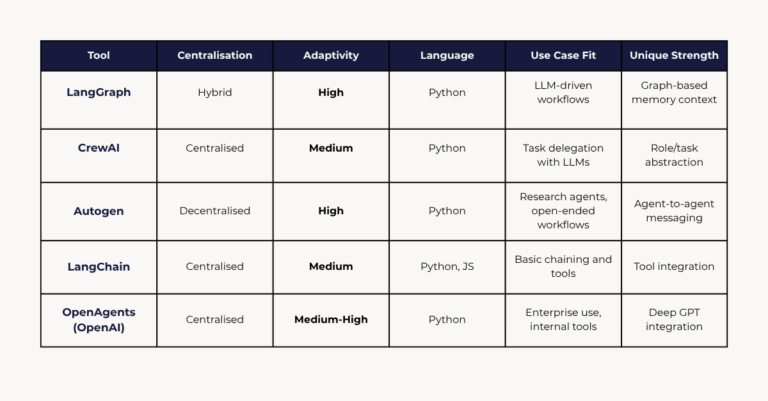
LangGraph introduces a graph-based approach to orchestrating LLM agents. It tracks dependencies and memory across workflows, which makes it particularly effective in dynamic, non-linear use cases where context needs to persist across decisions.
CrewAI offers a streamlined framework where agents are assigned defined roles and tasks within a mission-like structure. It works well for applications where the process is known in advance and needs to be executed with consistency.
Autogen, from Microsoft, enables multi-agent conversations in an open-ended, decentralised manner. Agents talk to each other via chat-like messages, making it well-suited for collaborative exploration, such as scientific research or policy modelling.
LangChain is less a full orchestration framework and more a toolchain. It allows developers to chain together LLM calls, tools, and memory, providing a building block approach to simpler orchestrations.
OpenAgents, developed by OpenAI, focuses on enterprise-grade orchestration of GPT-driven agents. It emphasises secure, contextual interaction between LLMs and internal APIs or tools, making it ideal for internal productivity applications.
Key benefits of orchestrated AI agents
Agentic orchestration helps enterprises move from isolated AI use cases to integrated, intelligent operations. It aligns AI agents, RPA bots, and humans into unified workflows, giving businesses more control, more visibility, and more leverage.
Done right, agentic orchestration transforms how enterprises scale automation, adapt to change, and reveal AI’s endless opportunities for meaningful outcomes. Here’s what the most capable orchestration systems enable:
1. Coordinating work across systems, agents, and people
Most enterprise workflows aren’t confined to a single app or environment. They span tools, teams, APIs, and processes, relying on a mix of humans, bots, and agents. Agentic orchestration gives organisations the glue to connect it all. It ensures data flows cleanly across systems, agents stay in sync, and people stay in the loop where judgment or approval is needed.
It enables agents to handle unstructured or dynamic tasks, robots to manage repetitive, rule-based work, and humans to intervene only where value is added. This division of labour streamlines execution, increases output, and helps teams focus on higher-level priorities.
2. Building end-to-end workflows
Most tasks don’t follow a rigid playbook: real-world processes change based on inputs, conditions, or business context. Agentic orchestration enables workflows to adapt in real time. Using event-driven execution, agents and bots can trigger sub-processes, make decisions, escalate exceptions, or reroute work when needed.
This resilience ensures critical operations don’t break down when edge cases arise or systems fail. Workflows continue uninterrupted, and business continuity is preserved.
3. Scaling AI agents safely and reliably
Enterprises need systems that can manage hundreds or thousands of them with accountability and transparency. Orchestration platforms offer versioning, rollback, error handling, and centralised monitoring so that teams can scale agentic systems without chaos.
Admins can control how agents behave, what data they can access, and when they should defer to a human. This structured governance provides enterprises with confidence in deploying agent-based automation across sensitive or regulated environments.
4. Enabling AI-driven process intelligence
The best orchestration platforms they observe and learn from existing workflows. Real-time process intelligence tools track what agents are doing, where delays happen, and how outcomes vary. That feedback loop can be used to fine-tune workflows, retrain agents, or reallocate tasks.
This observability also helps teams identify where agents could be introduced next, unlocking new areas for automation, optimisation, or insight.
5. Supporting trust, control, and compliance
With orchestrator agents acting as the backbone of automation, it becomes easier to define rules, enforce policies, and establish traceability. Whether through declarative workflows, human approval steps, or audit trails, organisations gain full control over how work is executed.
This is key for regulated industries or sensitive domains where explainability, accountability, and governance are non-negotiable. Agentic orchestration makes AI work in ways that are both intelligent and compliant.
How can agentic orchestration be used?
Agentic orchestration enables businesses to connect agents, robots, and people into unified, end-to-end workflows, making automation possible across a wider range of high-impact, high-ROI processes. Below are key use cases across industries:
Cross-industry AI applications
Purchase-to-pay: Automates procurement from requisition to payment, reducing delays and improving spend visibility.
Order-to-cash: Streamlines sales orders, fulfilment, invoicing, and collections, accelerating cash flow and reducing errors.
Accounts payable/receivable: Enhances accuracy and transparency in payment cycles, supporting better liquidity management.
Energy sector
Grid management: Enables dynamic load balancing and monitoring through agent-led orchestration of data and actions.
Asset lifecycle management: Automates inspections, maintenance scheduling, and asset updates to improve reliability.
Customer onboarding: Streamlines service requests, meter setups, and billing to improve first-time connection rates.
Telecom
Network operations: Automates fault detection, resolution workflows, and performance monitoring for greater uptime.
Customer onboarding: Connects processes from SIM activation to service provisioning for a smoother start.
Billing and revenue management: Orchestrates adjustments, payments, and credit workflows to boost accuracy and customer satisfaction.
Manufacturing
Order-to-cash: Automates order management, invoicing, and reconciliation for faster, error-free fulfilment.
Supplier and inventory management: Coordinates agent workflows for onboarding suppliers, tracking inventory, and triggering restocks.
Production scheduling: Dynamically adapts to supply disruptions or demand shifts, ensuring continuous production with minimal downtime.
The bottom line
In the past, AI success was measured by how well an individual model performed in isolation. But increasingly, success depends on how well systems of agents work together. Orchestrator agents are not optional in these environments.
They bring order to complexity, foresight to execution, and adaptability to automation. As organisations push further into multi-agent systems, the orchestrator agent will become the linchpin that holds everything together.
Wonder how AI capabilities may empower your business? Join our free AI discovery workshop! Contact us to get more information.