
Blink and you’ll miss it: AI industry moves so fast that one single week can feel like a year’s worth. But the real story isn’t speed, it’s the path AI is taking. And this past week made one thing clear: AI is moving from isolated tools into orchestration. Systems. Networks. Layers working together to quietly rewire the way we work.
From copilots in the enterprise to robotaxis in the streets, from climate mapping to AI-made music, the question isn’t “Can AI do this?” anymore. It’s “Which of these changes will actually hit your workflow in the following months?”
Let’s sort through the headlines.
GPT-5 inside Microsoft Copilot: Artificial intelligence becomes a standard
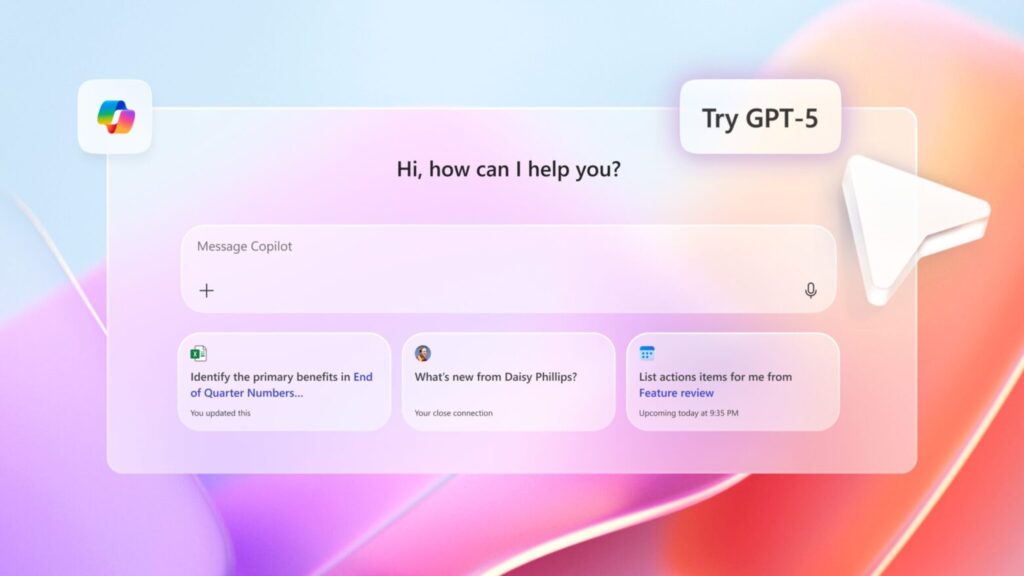
The biggest headline: Microsoft integrated OpenAI’s GPT-5 into its Copilot suite across Microsoft 365 and GitHub.
On paper, it sounds like another model upgrade. In reality, it’s a structural change in how AI enters the enterprise:
Advanced reasoning means GPT-5 can now handle complex workflows end-to-end
Automatic routing lets the model decide when a task needs a quick reply versus deep reasoning
Massive context handling enables Copilot to analyze contracts, long email threads, or datasets without losing coherence
Multi-modal capabilities bring together text, code, and images into a single workflow
Copilot Studio now allows companies to design their own specialized AI agents
And what’s more important, Microsoft built this with enterprise compliance and privacy in mind, blurring the barriers for corporate adoption.
So, we can only expect GPT-5 to become so embedded in everyday work that people will stop noticing they’re even using AI. Expect to see this shift across legal contract reviews, financial analyses, project coordination, and beyond.

Claude Opus 4.1 release: The power of reliability
While Microsoft and OpenAI grabbed the spotlight, Anthropic released Claude Opus 4.1. True to form, it brings to the table structured reasoning, safety, and reliability over spectacle.
Claude has built its reputation on being cautious, consistent, and aligned. That makes this model great for industries where a “hallucinated” number or misinterpreted instruction isn’t just inconvenient but potentially disastrous, like finance, law, and healthcare.
Of course, not every industry needs boldness. In regulated environments, dependability wins over flash. Expect Claude to continue finding steady adoption in sectors where trustworthy outputs are highly respected.
https://www.youtube.com/watch?v=oqUclC3gqKsGoogle Genie 3 release: AI with a physics engine
Google presented Genie 3, a model enhanced with the ability to simulate physical environments through a built-in physics engine. It generates dynamic worlds that you can interact with in real-time at 24 frames per second, retaining consistency for a few minutes at a resolution of 720p.
While at first glance this may seem like gaming tech, its potential applications stretch far wider:
Stress-testing supply chains under unexpected conditions.
Simulating traffic and urban infrastructure planning.
Optimizing robotics and manufacturing workflows.
Genie 3 points to a new role for AI as an experimental platform. Instead of running costly real-world pilots, businesses can “crash-test” strategies virtually, saving time, money, and mistakes.
https://www.youtube.com/watch?v=PDKhUknuQDg&t=1sElevenLabs goes beyond voice
ElevenLabs, best known for pushing the boundaries of AI-generated voice, just expanded its scope to generate music.
At first, it might sound niche. But it marks a broader trend: AI is moving beyond single outputs (text, images, voice) into multi-sensory creativity.
For marketing teams, game developers, and content creators, this opens the door to faster, cheaper, and more experimental audio production. Instead of relying solely on stock tracks or expensive sound design, they’ll be able to generate tailor-made soundscapes instantly.
xAI’s Grok “Spicy Mode”: Personality as a feature
Elon Musk’s xAI rolled out a “Spicy Mode” for its Grok Video AI. The feature doesn’t add raw intelligence, but it adds flair, interactivity, and personality. Accuracy may be table stakes, but it won’t be the only driver of adoption. As AI systems become more and more common, people will gravitate toward the ones that feel most engaging and relatable. The next frontier of AI competition may be less about IQ and more about EQ.Grok Imagine also comes in Spicy Mode 🌶️ pic.twitter.com/vz5Wzf3DyN
— DogeDesigner (@cb_doge) August 4, 2025
Alibaba Qwen-Image: China’s visual push
Alibaba announced Qwen-Image, an AI model optimized for grounded visual understanding.
On a technical level, it’s another powerful model. On a strategic level, it signals the rapid expansion of China’s AI ecosystem.
Global companies will have to keep pace with two very different streams of innovation. Western and Chinese AI systems may evolve in different directions, shaped by their local markets and regulations. The result? Companies operating globally will face a choice or a balancing act between ecosystems.
Tesla Robotaxi AI: Closer than ever
Tesla announced new milestones in its Full Self-Driving (FSD) AI. While robotaxis have long been teased, the progress here signals the gap between promise and reality may finally be narrowing.
If Tesla succeeds, industries far beyond consumer transport will feel the ripple. Logistics, delivery, and urban planning could see massive disruption. But it won’t be a purely technological story: regulators, insurers, and governments will all play key roles in whether autonomous fleets actually hit the streets.


Meta’s new lab: Toward agentic AI
Meta revealed a new research initiative focused on what it calls “personal superintelligence.” Unlike enterprise copilots, these AI agents would adapt deeply to individual users, their habits, goals, and environments.
Today’s conversation focuses on how AI is scaled across companies. Tomorrow’s may be about how AI scales down to you, personally. Expect to see early signs of AI transitioning from a “work tool” to a “life assistant.”
DeepMind AlphaEarth: AI as scientific infrastructure
DeepMind unveiled AlphaEarth, an ambitious project to map the planet with AI at unprecedented resolution.
The potential applications are wide: from climate modeling and agricultural planning to environmental policy. AlphaEarth positions AI not as a productivity enhancer but as a scientific infrastructure capable of supporting global-scale problem-solving.
This is a reminder that AI’s impact will extend beyond offices and industries into the most pressing planetary challenges.
The hardware race: Fueling it all
Behind every breakthrough lies a less glamorous battle: hardware.
AMD’s Threadripper 9000 challenges NVIDIA’s dominance in high-performance AI compute.
NVIDIA and OpenAI are co-designing GPUs tuned to next-generation model demands.
AWS and Theta are exploring decentralized computing for hyperscale workloads.
As hardware gets stronger and spreads out, advanced AI won’t just belong to the tech giants anymore, it’ll be within reach for mid-sized companies, too.
The bigger picture: Orchestration, not just AI models
When you connect the dots, the trend is hard to miss: AI’s next phase isn’t about a single model getting smarter, it’s about systems working together.
Copilots manage documents, communication, and code.
Agents simulating environments and generating new media.
Hardware architectures optimized for orchestration at scale.
It’s clear without saying that AI is maturing into infrastructure. Less about standalone breakthroughs, more about layered ecosystems that slot directly into how work gets done.
Final thought
The real impact of AI isn’t in the hype cycles or headline demos. It’s in the tools that slip so neatly into daily workflows that you stop noticing them at all. At that point, they’re no longer “AI features”, they’re just the way work gets done.
For professionals working with information, GPT-5 inside Copilot is already rewriting daily routines. For others, the change might arrive in different forms, such as autonomous transport reshaping mobility, generative media redefining creativity, or climate mapping informing global decisions.
Wonder how AI capabilities may empower your business? Join our free AI discovery workshop! Contact us to get more information.