
Nowadays, artificial intelligence is everywhere. It’s an efficient tool that assists with tasks and aims to make life and work easier for users. So, it was only a matter of time before AI entered the education sector.
Generative AI is reshaping education by introducing tools that assist both students and teachers. Task automation, tailored learning experiences and assistive technologies make education more accessible. However, the integration of this technology also raises questions about accuracy, security, and fairness.Popular generative AI tools in EdTech
To understand generative AI tools and how they impact educational technology, we need to understand what generative AI is. To put it simply, it’s an artificial intelligence that can create new content based on its knowledge.
Such systems mimic human creativity thanks to their complex internal systems of neural networks and deep learning algorithms. This human-like ability to create something new is what makes AI-powered EdTech tools the talk of the town. Recently, Altamira’s team has attended Bett UK 2025, a global meeting place for the EdTech community, and talked to technical leaders and EdTech entrepreneurs about their experience with AI tools. Here’s what we heard. https://youtu.be/Q9HR8XAQhNo?si=4lH1OZGIiZ5qTCYcTo sum up, AI is becoming an integral part of education, but its adoption remains uneven. While students increasingly turn to AI for help with homework, teachers are beginning to use AI tools to keep pace.
This has created a dynamic environment where both sides explore the potential and limitations of these technologies. At the same time, some businesses use AI to improve learning outcomes while others use it for back-office operations. Some EdTech businesses and even schools have already integrated AI-powered EdTech tools into classrooms, but widespread, creative applications for students are still limited. Many of these tools claim to be groundbreaking, but in reality, they are just scratching the surface of what’s possible. See also: AI tools for teachers: benefits and examples To see how AI impacts the learning and teaching experiences, let’s look at the most popular AI tools.
Chatbots
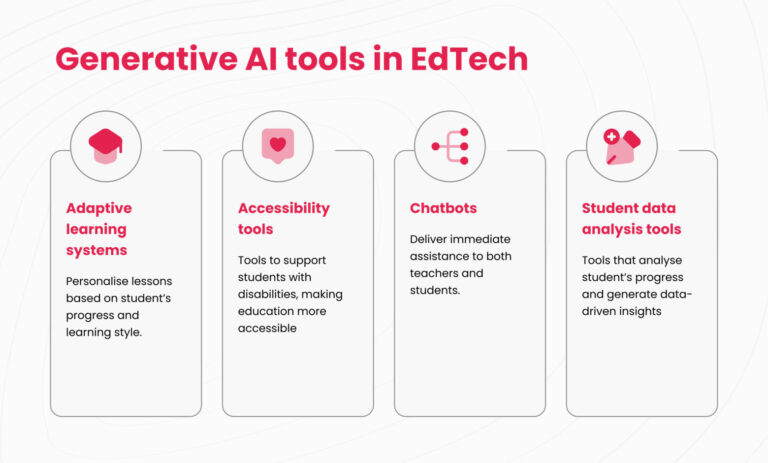
Chatbots are almost everywhere these days, so it’s unsurprising to see them applied in education. These AI-powered tools deliver immediate assistance to both students and teachers. They address frequently asked questions, provide detailed explanations, and help students navigate their coursework.
Chatbots enable educators to concentrate more on instruction by alleviating administrative tasks instead of handling repetitive queries.Adaptive learning systems
AI-powered adaptive learning platforms personalise lessons based on a student’s progress and learning style. These systems analyse performance data and adjust the difficulty of exercises, ensuring that learners receive content tailored to their needs.
This approach helps students grasp concepts at their own pace while keeping them engaged.Accessibility tools
Generative AI is improving accessibility in education by offering tools like real-time transcription, text-to-speech, and AI-generated summaries. These features support students with disabilities, language barriers, or learning differences, making education more inclusive and adaptable to individual needs.
Student data analysis tools
AI helps educators analyse student performance through data-driven insights. By examining patterns in grades, participation, and engagement, AI can highlight areas where students struggle and suggest interventions. The aim of such tools is to provide targeted support and early identification of learning gaps.
See also: EdTech examples that are making a difference in educationReal life example of AI in EdTech: Altamira case study
As a software development company, we have had multiple past projects involving AI. One such project is an AI-powered education platform.
Our client was looking to create a platform that could help children build their confidence and discover the joy of learning. The aim of the project was to improve kids’ academic performance via the use of advanced AI technologies. Let’s break down the main features.
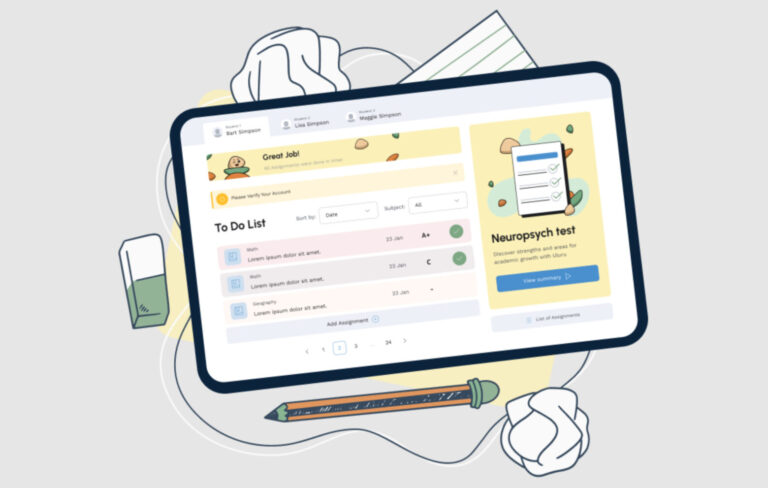
Neuropsychological assessments
Traditional assessments can be lengthy and stressful for both children and parents, often requiring extensive professional intervention. By using AI, the client’s platform streamlines this process, making assessment accessible. The system can analyse behavioral and cognitive patterns, helping to identify learning difficulties early and provide actionable insights for parents and educators. Personalised learning plans The platform adapts to each child’s unique needs, analysing their progress and adjusting educational content accordingly. This ensures that students receive the right level of challenge and support, making learning more engaging and effective. Progress monitoring The platform provides real-time feedback to both parents and teachers since it constantly monitors student progress. This allows for early interventions when a child is struggling, preventing small challenges from turning into larger academic obstacles. Rather than waiting for periodic test results, parents and educators can access meaningful insights that help them make informed decisions about a child’s education. Parental engagement tools AI tools within the platform offer guidance, recommending resources and strategies to help parents play an active role in their child’s learning. By bridging the gap between home and school, these tools encourage a more connected and supportive learning environment. The sum of these features creates adaptive, responsive and more importantly — tailored experiences for students. Read our case study to learn more about the development, challenges and results of this project.Addressing challenges of AI in education
Some of the people we talked to at Bett UK raised concerns regarding AI tools.
This reluctance towards AI adoption comes from a lack of clear strategies and support for AI adoption. While some teachers have embraced AI, others remain hesitant.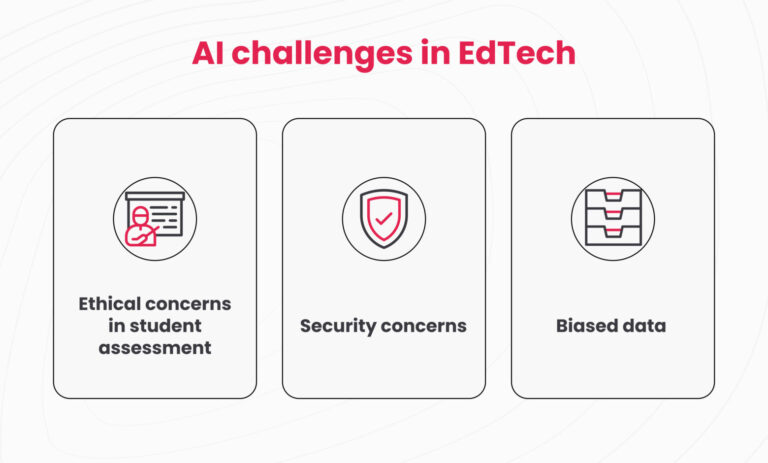
Without proper training and AI literacy programs, educators risk misusing these tools or failing to benefit from them at all.
Connor Gately, Altamira’s Managing Director (UK) has this to say. https://www.altamira.ai/wp-content/uploads/2025/03/Altamira-AI-bias.mp4Ethical concerns in student assessment
The problem: AI-generated assignments make it difficult for teachers to assess students’ actual understanding. Academic integrity concerns arise when students use AI to complete work without engaging in the learning process.
The solution: Assessment methods, such as oral exams, project-based learning, and in-class writing assignments, reinforce academic integrity. Additionally, AI detection tools can help teachers identify AI-assisted work while also guiding students on appropriate AI usage.Security concerns
The problem: AI tools collect and analyse vast amounts of student data, making privacy a major concern. The lack of proper security measures might allow malicious actors to access sensitive information.
The solution: Schools and EdTech providers should adopt strong encryption methods, limit data collection to only essential information, and ensure compliance with privacy laws like GDPR and FERPA. Regular security audits and transparency in AI data usage policies can also help protect students’ information.Biased data
The problem: AI models learn from existing data, which may contain biases. If not carefully monitored, AI-generated content and recommendations can reinforce stereotypes or present skewed perspectives if not carefully monitored.
The solution: To avoid this problem, during AI model training, use diverse and representative datasets. Combining this with regular assessment of AI-driven content for bias will create inclusive and culturally aware educational materials. Despite these challenges, the future of AI in education holds promise. With more research, investment, and strategic implementation, AI has the potential to reshape learning experiences. However, for this to happen, there needs to be a shift from using AI as an administrative assistant to using it as a true learning tool—one that enhances creativity, critical thinking, and engagement in meaningful ways. See also: AI in EdTech: Pros, cons and use casesFinal words
Generative AI is transforming education, offering new tools that enhance learning and accessibility. However, it also presents challenges, such as misinformation, security risks, and bias.AI accuracy is a critical responsibility in EdTech. This means having clear protocols for identifying and handling uncertain cases. Natalie Semak, Altamira’s Chief Delivery Officer
As the technology advances, striking a balance between innovation and responsible use will be key to making AI a valuable asset in education.
How Altamira can help
Whether you want to add the latest generative AI tools to your EdTech platform, make a meaningful impact on online education, prototype your new idea, or elevate your EdTech solution to the next level, our stress-free approach will be perfect for you.
- Get quick deliverables. Visualise and test your concepts with our prototypes, developed even before the contract begins;
- Be always in the loop. Transparent communication and constant updates ensure you are always up-to-date with the latest news about your project;
- Zero headaches. Our expert development team always pushes the boundaries of AI development and EdTech platforms;
- Build quality products. Extensive list of tools at our disposal ensures fast development without the quality loss.