
Nowadays, tools like ChatGPT made AI feel both accessible and exciting. While we generate emails and images to facilitate our work routine, something huge is happening with autonomous AI agents, the systems that can sense their environment, reason about it, and take action without constant babysitting.
The difference from traditional automation is impressive. Where automation sticks to strict rules, agents adapt. They can learn, adjust to real-world inputs, and keep going when the path isn’t fully mapped out. That’s why, you should have a clear picture of how to build agents yourself and whether to go with agentic frameworks or ready-made platforms for your projects.What is an AI agent?
At its core, an AI agent is a piece of software that doesn’t just sit and wait for instructions. It perceives its environment, makes decisions, and takes actions to reach its goal. That’s where it breaks from traditional artificial intelligence or classic automation. Old systems follow strict scripts: if X, then Y. Agents have agency. They can weigh context, choose between options, and adapt as conditions shift.
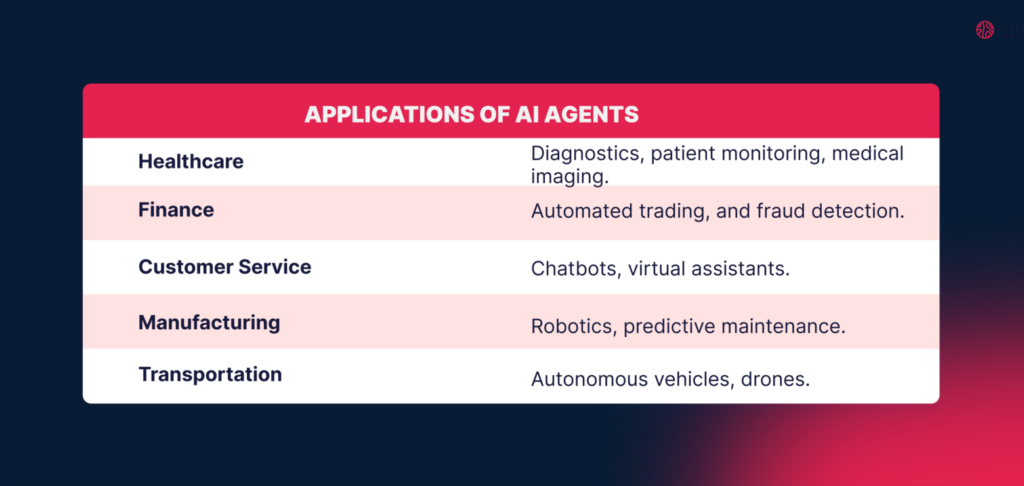
So, you may wonder what sets them apart from chatbots? Three main things stand out:
- Autonomous: They can pursue goals without consistent oversight.
- Goal-oriented: They have a goal, whether defined by a user or pre-programmed, and adjust course when inputs change.
- Learning: They get better over time, improving through new data sources and feedback loops.
What are the types of intelligent AI systems?
AI agents aren’t stamped from a single mold. Each type serves a specific function, and the most effective systems usually combine several, working side by side. Here are a few of the main kinds you’ll come across:Learning agents
These get better with experience. For example, a customer service bot starts out clumsy, answering only the simplest questions. Over time, it learns from conversations, anticipates needs, and begins offering solutions before the user even asks.Utility-based agents
These weigh possible outcomes and choose the one with the highest payoff. A trading algorithm, for instance, evaluates market conditions before deciding which move makes the most sense.Goal-based agents
Built to hit a specific target, they don’t care about anything outside that objective. An automated inventory system that ensures stock levels never dip below a set point is a classic example.Reflex agents
These react instantly to inputs, with no deeper reasoning involved. A smart thermostat that adjusts the temperature based on the room’s current state falls into this category.Model-based agents
Being more complex, these agents use an internal model of their environment to make informed decisions. By simulating how things might play out, they can respond with a broader range of strategies.What are the core components of agentic systems?
Just as humans need senses, a brain, and limbs to function, AI agents also rely on a set of building blocks. These components work together to create a system that can perceive, reason, and act in enterprise environments.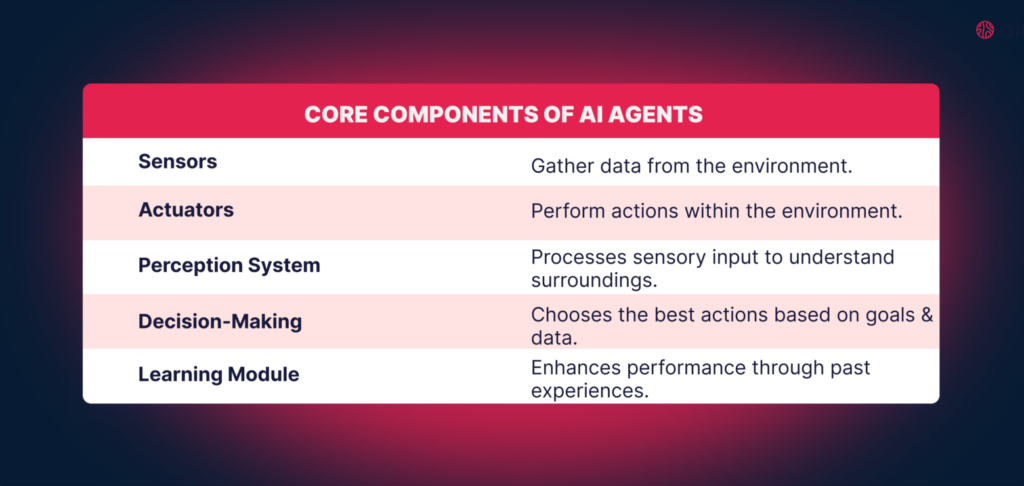
Sensors
Sensors are the agent’s eyes and ears. They gather raw data from the world around them, whether that’s through cameras, microphones, GPS, or specialized devices like temperature sensors. For software agents, “sensors” can mean data streams from databases, APIs, or direct user input. For example, in HR workflows, this might look like tracking employee record updates, onboarding progress, or policy changes. With that steady flow of relevant information, the agent can stay accurate and adjust to new situations.Intelligence
This is the agent’s brain. Intelligence is what makes sense of all the input, spotting patterns and reasoning about context. Depending on the use case, this might involve rule-based systems, machine learning models, or large language models(LLMs). Modern agents often lean on LLMs to interpret requests, recall past interactions, and make nuanced decisions. Reasoning also lets agents recognize when a task is time-sensitive, preventing mistakes like assigning deadlines based on outdated information. And with natural language processing (NLP), they can communicate in a way that feels intuitive, making interactions smoother for users.Actuators
If intelligence is the brain, actuators are the hands. They’re what carry out decisions. In the physical world, actuators might be robotic arms, wheels, or speakers. In software, these actions include sending commands to another program, updating a system, or generating text.Plugins
Plugins extend what an agent can do. They act like specialized add-ons, giving agents access to extra data, new enterprise systems, or enhanced functionality. A plugin might connect the agent to a CRM, pull in financial data, or unlock a new type of analysis.Methods for building AI agents
Build AI agents yourself
Starting from scratch gives you complete control, but it also comes with a steep price tag in time, talent, and infrastructure. Every piece of the system has to be built: the sensors that feed in data, the reasoning layer that interprets it, and the actuators that take action. That means assembling a team skilled in machine learning, natural language processing, and enterprise integration. The work involves:- Designing custom algorithms tuned to your use case
- Building and maintaining data pipelines for real-time inputs
- Debugging and optimizing until the system is reliable
- Connecting it all smoothly with your existing enterprise systems
Build using an agentic framework
Agentic frameworks give you a head start. Instead of piecing everything together from scratch, you get pre-built key components and structures designed for autonomous systems. It’s like you get a blueprint: it defines how perception, planning, and decision-making should fit together so agents can pursue goals effectively. Most frameworks already include the essentials, such as natural language processing, memory management, and integration tools. That makes it easier to get an agent up and running quickly, while still leaving room to customize how it behaves and what systems it connects to. In practice, this approach balances speed with flexibility. You don’t reinvent the wheel, but you also don’t lose control over how the final product works.Build an AI agent using an agentic framework
Using an agentic framework is about following a clear structure while keeping room to adapt. You move faster than building from scratch, but you still make the important calls. Here’s the typical flow:1) Choose a framework Pick the option that fits your use case:
- LangGraph: Good fit for conversational agents, with NLP and flexible integrations.
- CrewAI: Works best for collaborative, multi-agent problem-solving.
- LlamaIndex: Great for knowledge-heavy apps, with tools for large volumes of enterprise data.
- Arcade: Geared toward rapid development and deployment for enterprise needs.
2) Set up the environment
Install dependencies and configure your tooling so you can build and test comfortably from day one.3) Design the agent’s architecture
Define capabilities, map conversation flows, and outline decision paths. These blueprints guide how the agent reasons and acts.4) Test, train, and optimize
Validate responses across scenarios, train on your data, tune hyperparameters, and iterate until accuracy and quality hold up under load.5) Deploy and monitor
Ship to your target surface (web, app, internal tool), then keep a close eye on real usage and refine based on feedback. In practice, you’ll still write custom code for specifics: handling API calls, talking to databases, or wiring up enterprise systems. After the design comes model training, optimization, and thorough testing before going live. This path gives you a high degree of control, but it does demand solid technical skills and ongoing maintenance to keep performance reliable over time.Using an AI agent-building platform
Agent-building platforms lower the barrier to entry. Instead of writing every line of code, you work with no-code or low-code tools that handle much of the heavy lifting, while still offering enterprise-grade features. At their core, these platforms ensure that the agent’s “brain” (reasoning) and its “body” (sensors and actuators) are connected and ready to operate in real-world environments. The process usually starts with picking a platform that fits your needs, for example, Microsoft Bot Framework or IBM Watson Assistant are common choices. From there, it’s about defining your use case and configuring the agent. Instead of wrestling with infrastructure, you use intuitive interfaces to set up responses, shape behaviors, and define rules. What might take weeks with traditional automation can often be done in hours. Most platforms also ship with pre-built connectors and plugins, making integration with enterprise systems clear and simple. Testing and monitoring are usually built in as well, so teams can deploy quickly and fine-tune based on feedback without spinning up extra tooling.Agentic framework vs. AI agent builder: Key differences
The choice between an agentic framework and an AI agent builder isn’t just about preference. It shapes how long development takes, how much customization you can achieve, and who is responsible for ongoing maintenance. Here’s the quick comparison:| Feature | Agentic Framework | AI Agent Builder |
| Development time | Longer | Shorter |
| Customization | High (full control, unique features) | Lower (standardized options) |
| Complexity | Higher | Lower |
| Technical expertise required | Higher | Lower |
| Integration | Built by your team | Often pre-built or simplified |
| Maintenance | Your responsibility | Often managed by the provider |
| Security & compliance | Your responsibility | Often included |
| Best fit | Complex, particular needs with internal teams | Faster deployment, simpler use cases, less technical teams |
What are the general guidelines for beginners?
Getting started with agentic AI can feel like a lot. The good news? You don’t have to master everything at once. Here’s a simple path to ease in: Step 1: Learn the basics Start by understanding how large language models (LLMs) like GPT-4 power agents. Experiment with prompt engineering to see how different inputs shape responses. Step 2: Explore popular tools- AutoGPT: Great for experimenting with autonomous task execution.
- LangChain: Ideal for connecting LLMs and APIs into more complex workflows.
- AgentGPT: A no-code option if you just want to test quickly.
2025 as the year of agentic exploration
If you ask the market, 2025 is already shaping up to be the year of the agents. IBM and Morning Consult recently surveyed 1K enterprise developers, and nearly all of them — 99% — said they were exploring or building AI agents. The trend is hard to resist. But scratch the surface, and the picture gets more complicated. On one side are the optimists. Maryam Ashoori, PhD: Director of Product Management, IBM® watsonx.ai™ points to the survey results and sees proof that agents are moving from theory to practice. For her, the excitement isn’t about function-calling chatbots but about a bigger change: systems that can reason, plan, and act without constant oversight. Today’s agents can already crunch data, forecast trends, and automate basic workflows. But for them to truly handle complex decision-making, we’ll need breakthroughs in contextual reasoning plus a lot more testing against real-world edge cases. Then there are the skeptics. Marina Danilevsky, Senior Research Scientist at IBM, Language Technologies, isn’t convinced that what we’re calling “agents” is anything new. To her, much of it looks like orchestration with a fresh coat of paint. Programming has always relied on orchestration; the word “agent” just makes it sound fresher. And when people declare 2025 as a turning point, she wonders what exactly they mean: is it about capabilities, value delivered, or simply hype? Even the ROI of LLMs themselves is still unsettled. And yet, optimism keeps bubbling up. Chris Hay, a Distinguished Engineer at IBM, sees 2025 not as a finish line but as the start of an era of experimentation. Every major tech company and hundreds of startups are building and releasing agent platforms. Salesforce, for example, has already launched Agentforce to let customers spin up agents inside its ecosystem. The result is an environment where skepticism and excitement coexist. The hype is loud, the definitions still fuzzy, and the ROI uncertain. But one thing is clear: 2025 will be a year when more people than ever roll up their sleeves and see what agents can actually do. Whether that ends in frustration, transformation, or something in between, it’s going to be an interesting ride.Build custom AI agents with Altamira
Designing and deploying your own AI agents gives you the freedom to automate in ways that truly align with your business needs. The key is choosing the right platform and approach so the agents work where it matters. With Altamira, you can create and launch agents quickly, often with little to no coding. Once in place, they can:- Take over routine tasks, such as IT ticket resolution, HR inquiries, and customer support.
- Connect smoothly with your existing systems to remove process disruption.
- Orchestrate complex automations across teams, reducing the need for manual handoffs.
- Keep improving over time by learning from real-world interactions.