
Nowadays, it’s so easy to use AI agents. In many organizations, teams can move from just an idea to a production-ready agent in a matter of weeks. Such rapid AI implementation lowers the barrier to adoption and introduces a problem that many teams are not prepared for: understanding whether those agents are delivering real business value once they are live.
Agents may respond to customer inquiries, process invoices, route support tickets, or assist internal teams with research and operational decisions. Activity is visible, and systems appear healthy, but that visibility does not automatically translate into confidence. Without the right performance framework, you can hardly tell whether the agent workforce is improving business outcomes or simply adding another layer of automation.


Measuring AI agents is fundamentally different from measuring traditional software. Agents are nondeterministic, they collaborate with one another and with human teams, and their behavior evolves over time.
Traditional metrics such as uptime, response time, and error rates are still useful, but they only describe system health. They say very little about whether AI agents are reducing cycle time, improving decision quality, or enabling teams to operate with fewer handoffs and fewer headaches. As agent deployments scale, relying solely on these metrics creates blind spots that make it harder to justify expansion, set guardrails, and build organizational trust.
So, it’s high time to explore a practical approach to measuring agent performance that aligns with how businesses operate, giving teams and executives a shared framework for managing, scaling, and trusting AI agents in production.
What are AI agent metrics?
AI agent metrics are the measurements you use to understand how autonomous systems behave once they are part of real operations.
| AI agent metrics answer three basic questions: is the agent doing the work it was designed to do, does it do that work consistently, and does it operate within the rules the business is accountable for. |
As organizations deploy AI agents across more business functions, adequate measurement is a must-have. When an agent moves from simple automation into decision-making, the cost of getting it wrong increases quickly. An agent that processes loan applications, supports clinical decisions, or coordinates supply chains is no longer just a productivity tool. It becomes part of the business’s risk surface.
| That’s why leadership needs to know that agents behave predictably enough to scale, safely enough to govern, and transparently enough to explain when questions arise. |
Different roles look at this through different lenses. Engineering teams focus on whether the system responds reliably and produces technically correct results. Product leaders look for signals that AI agents lead to cost savings, improve throughput, or raise user satisfaction. Compliance and risk teams care about whether decisions align with regulatory requirements, internal policies, and ethical constraints. A single metric rarely satisfies all three groups, which is why a structured framework is important.

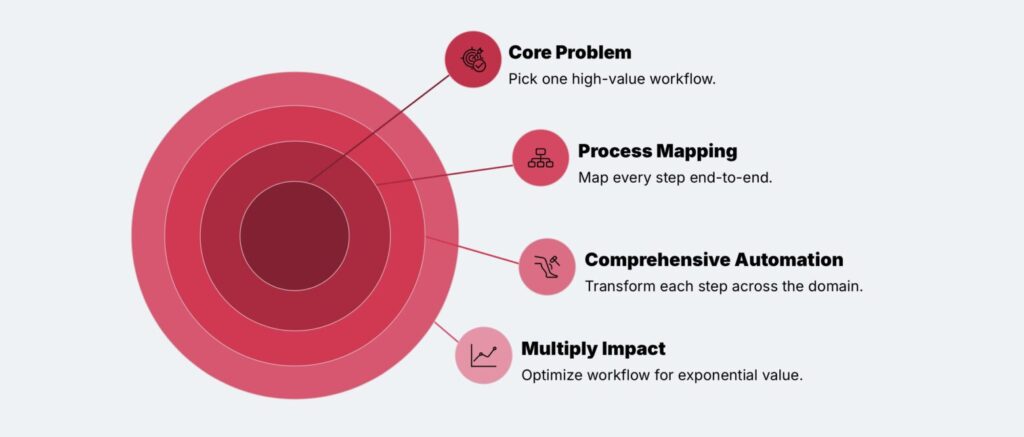
Most AI agent metrics fall into three broad categories
Performance metrics focus on the level at which your agent completes its assigned tasks. For example, accuracy, speed, cost per task, and how much human intervention is still required. These metrics help answer whether the agent is pulling its weight.
Reliability metrics take into consideration consistency over time and across various scenarios. They help identify whether the agent produces stable results when inputs change, edge cases appear, or systems upstream behave unpredictably.
Compliance metrics evaluate whether the agent operates within legal, regulatory, and organizational boundaries. For example, adherence to rules, auditability of decisions, and alignment with ethical standards. In regulated environments, these metrics are often the deciding factor in whether an agent can scale at all.
Core performance metrics for AI agents
When teams start AI agent evaluation in production, technical performance is usually the first thing they look at. The goal is simple: understand whether the agent is doing the work it was introduced to handle. Core performance metrics provide that baseline, giving developers, operators, and business leaders a shared way to assess effectiveness across different use cases.
Altamira's CEO, Evgen Balter mentions that: "Beside other best practices, smart business process decomposition enables your organization to identify KPIs and observability solutions that will allow you to see, manage, and optimize the performance of AI agent."

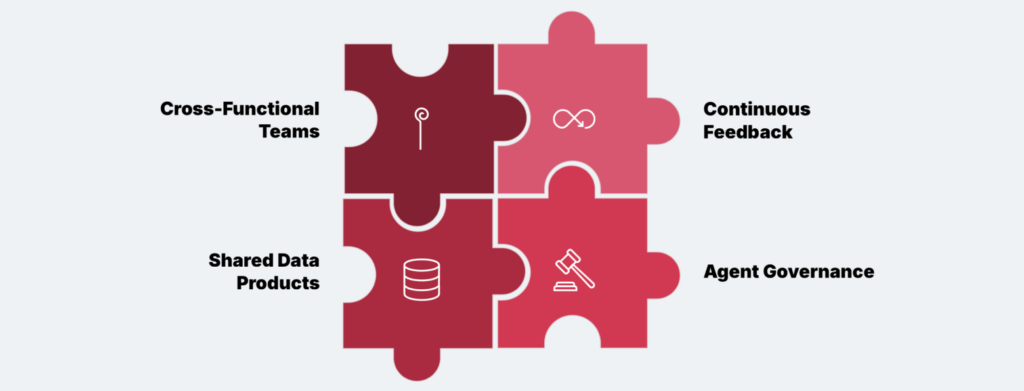
Task completion rate
It is one of the most useful starting metrics. It measures the percentage of tasks an agent finishes successfully without human intervention. What counts as “completed” depends on the type of agent in use.
- For conversational agents, it tracks how often user requests are resolved end-to-end without escalation.
- For task-oriented AI agents, it measures whether instructions are executed correctly.
- For decision-making agents, it evaluates whether decisions meet predefined criteria such as policy rules or outcome thresholds.
This metric ties directly to both user experience and operational efficiency.
- Each completed task represents less manual effort for human teams.
- Fewer escalations mean fewer handoffs and less context switching.
- In multi-agent systems, drops in completion rate often reveal coordination issues between agents rather than individual failures.
Task completion rate does not capture every dimension of agent performance, but it establishes a clear baseline.
Response quality metrics
Response quality metrics focus on whether AI outputs are not just fast, but also correct and appropriate for the situation. In production systems, quality is often the difference between an agent that saves time and one that creates downstream cleanup work.
The most common response quality metrics include the following.
- Precision measures how many of the agent’s positive predictions are relevant. High precision means the agent is not triggering actions or surfacing information that turns out to be wrong or unnecessary.
- Recall measures how many relevant items the agent successfully identifies out of all possible correct answers. High recall matters when missing a valid case carries a real cost.
- F1 score balances precision and recall into a single metric. It is useful when you need a realistic view of performance, and neither false positives nor false negatives can be ignored.
For classification-based agents, teams often track AUC-ROC, which measures how well the model distinguishes between classes at different decision thresholds.
- In fraud detection, a low score can mean suspicious activity slips through unnoticed.
- In medical or clinical support systems, it can indicate that critical cases are being missed.
These metrics help teams understand not just whether an agent responds, but whether its responses are dependable enough to support real decisions.
Efficiency metrics
Efficiency metrics look at how well an AI agent uses the resources available to it. They help teams understand whether an agent is doing useful work without creating unnecessary cost as usage grows.
Key efficiency metrics typically include the following.
- Response time measures how quickly an agent delivers an output after receiving input. In customer-facing workflows, response times above a few seconds often lead to drop-offs, lower satisfaction, and incomplete tasks. Slow responses reduce the likelihood that agents will be trusted to handle work independently.
- Computational resource consumption tracks how much memory, CPU, or GPU capacity, and model context an agent uses to complete its tasks. For large language model–based agents, token usage becomes a main driver of both performance and cost.
- Cost per interaction calculates the operational expense of each completed task, including infrastructure, model access, and supporting services. This metric is often what brings performance conversations into budget reviews.
Efficiency metrics are super important at scale. Small inefficiencies that are invisible at first become material costs once agents handle thousands or millions of interactions.
Hallucination detection
Hallucination detection focuses on one of the most common and most damaging failure modes in agent systems: confidently presenting incorrect information as fact. This is a common thing for AI agents built on generative models, where fluent output can mask underlying errors.
To manage this risk, teams rely on quantitative signals rather than subjective review alone. Common evaluation approaches include the following.
- Measuring coherence between agent responses and trusted knowledge bases to see whether outputs align with known facts.
- Evaluating how closely a response matches the intent of the original query, rather than drifting into loosely related content.
- Testing factual correctness against verified sources, particularly in regulated or high-risk workflows.
These methods help surface hallucinations before they affect users or downstream decisions. They also make it possible to track whether changes to prompts, models, or agent logic improve factual grounding over time.
Reliability and robustness metrics
These metrics focus on how an AI agent behaves over time and under pressure. An agent that performs well in ideal conditions but degrades when inputs change, data is incomplete, or edge cases appear is not ready for real-world use. These metrics help teams understand whether performance is stable enough to trust beyond controlled scenarios.
The following metrics are commonly used to evaluate reliability and robustness in production environments.
Consistency scores
Consistency scores assess whether an AI agent behaves predictably in similar situations. This matters most for AI agents built on foundation models, where small changes in input can sometimes lead to noticeably different outputs. In production, that kind of variability is often what undermines trust.
One way teams measure this is through neighborhood consistency metrics. These statistical techniques examine how the model represents and responds to inputs that are close to one another, and quantify how much the responses vary. High variance signals that the agent may be unstable even when the underlying situation has not meaningfully changed.
This is clearly evident in high-stakes domains.
- In finance, consistency matters a lot when analyzing market conditions or generating investment guidance. An agent that produces different recommendations for nearly identical scenarios is tricky to rely on, regardless of its average accuracy.
- In healthcare, consistent interpretation of similar medical images or patient data is necessary for safe decision support. Variability in these cases can lead to uncertainty or unnecessary review.
Consistency metrics often surface issues that traditional accuracy scores miss. A model can be accurate on average while still behaving erratically at the edges. A practical way to assess consistency is to submit multiple, slightly varied versions of the same query and measure the statistical variance in the responses. When variance is high, it is usually a signal that the agent needs tighter constraints, better grounding, or clearer task definition before it can be trusted at scale.
Edge case performance
Strong average accuracy can hide serious weaknesses. Many AI agents perform well on common inputs, then break down when they encounter situations they see less often. Measuring performance in these edge cases is what reveals whether an agent is ready for real-world use or only for controlled conditions.
To evaluate this properly, teams need targeted testing rather than broad averages.
- Build test sets designed specifically to stress decision-making boundaries.
- Include inputs that are rare, ambiguous, incomplete, or slightly contradictory.
- Observe not just whether the agent fails, but how it fails and whether the behavior is predictable.
Simulation-based approaches help expose these gaps. Frameworks such as τ-bench help recreate multi-step scenarios that resemble real operational complexity. Instead of testing a single response in isolation, they evaluate how agents adapt as context changes and tasks compound.
General benchmarks are a starting point, but they are not enough on their own. For meaningful evaluation, edge case testing should reflect the realities of your domain.
Custom edge-case test suites force agents to operate in environments where mistakes are costly, and assumptions break down. The results often drive more improvement than tuning for average performance, because they show where additional guardrails, human oversight, or design changes are needed.
Drift detection
Even well-performing AI agents can lose effectiveness over time. As conditions change, inputs begin to diverge from the data the agent was trained or tuned on. When this happens, performance does not usually fail all at once.
Drift detection focuses on identifying these changes before they affect users or downstream decisions. Teams typically monitor shifts across several dimensions.
- Changes in input data distributions, such as new patterns, formats, or behaviors that were rare or absent during training.
- Changes in response quality, including accuracy, relevance, or increased uncertainty in outputs.
- Changes in user interaction patterns can signal that the agent is no longer meeting expectations or is being used in unintended ways.
Statistical tools such as control charts are commonly used to track stability over time. They establish baseline performance ranges and flag when key metrics move outside acceptable thresholds. This approach allows teams to spot gradual degradation that would be easy to miss in continuous monitoring.
Automated drift monitoring is especially important once agents operate at scale. By continuously tracking a small set of well-chosen performance indicators, teams can respond early with retraining, prompt adjustments, or tighter constraints. That intervention is far less costly than addressing widespread errors after trust has already been damaged.
Recovery metrics
Recovery metrics focus on this ability to detect mistakes and correct course before damage spreads. These metrics measure how agents behave when they reach the edge of their competence.
- Does the agent acknowledge uncertainty instead of producing a confident but incorrect answer?
- Does it request clarification or escalate when information is missing?
- Does it recover gracefully after an error rather than compounding it?
Research often refers to this behavior as self-aware failure. The idea is simple and practical: track how often an agent admits it does not have enough information rather than inventing an answer. In many real workflows, a well-timed “I don’t know” is far safer than a fluent guess.
Building the right guardrails
Governance is what makes your metrics credible. Without it, performance data exists in a vacuum. You may know how often an agent completes tasks, but you do not know whether it is doing so safely, legally, or in a way that protects the business over time.

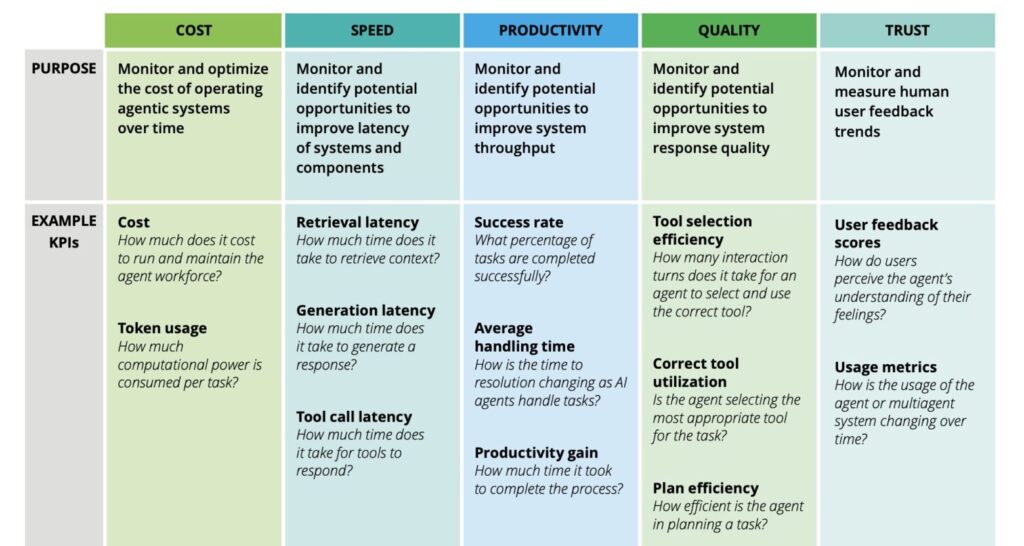
Source: McKinsey
That is why governance cannot be treated as cleanup work. Controls need to be in place from the first deployment, not bolted on after issues surface. When governance is embedded into performance measurement, it does more than prevent mistakes. It reduces downtime, shortens review cycles, and speeds up decision-making because every agent operates within clear, tested boundaries.
Strong guardrails turn compliance into a source of consistency rather than friction. They give executives confidence that productivity gains are real, repeatable, and safe to scale.
In practice, effective governance looks like this.
Continuous PII monitoring and handling
Personally identifiable information should be tracked in real time. Metrics should cover exposure incidents, rule adherence, and response times for remediation. Detection needs to trigger automatic flagging and containment before issues escalate. Any mishandling should result in an immediate investigation and the temporary isolation of the affected agent until the review is complete.
Compliance testing that matures with the model
Compliance requirements change as models change. Evaluation datasets should replay real interactions that include known compliance risks and be refreshed with every model update. The specifics vary by industry, but the approach stays consistent.
- In financial services, this means testing for fair lending practices.
- For healthcare, HIPAA compliance.
- For retail, consumer protection standards.
Compliance measurement should be automated and continuous, not a quarterly checkbox.
Ongoing red-teaming
Red-teaming is not a one-time exercise. Teams should regularly attempt to push agents into unsafe or unintended behavior and measure how the system responds. Track successful manipulation attempts, detection time, recovery behavior, and resolution duration. These metrics establish a baseline and make improvement measurable.
Evaluation datasets grounded in real interactions
Recorded production interactions can be replayed in a controlled environment to test edge cases safely. These datasets act as a standing safety net. They allow teams to identify risks before customers encounter them, not after trust has already been damaged.
Evaluation methods: How to evaluate agent accuracy and ROI
Traditional monitoring shows activity. It tells you that agents are running, responding, and completing steps. What it does not show is whether that activity translates into business value. That gap is where risk hides, especially as agent workloads expand and decisions become harder to reverse.
Evaluating agent accuracy and ROI requires more than system logs. It calls for a mix of quantitative signals and qualitative review that connect agent behavior to outcomes the business cares about. Leaders need evidence that agents are reducing costs, improving throughput, lowering error rates, or enabling teams to focus on higher-value work. Teams need continuous feedback loops that show where AI agents help and where they create friction.
Evaluation datasets sit at the center of this process. They provide a controlled environment where agents can be tested without affecting live operations. By replaying real interactions, these datasets make it possible to measure accuracy in realistic conditions rather than idealized benchmarks.
They also support ongoing improvement.
- Accuracy can be measured against known outcomes instead of abstract scores.
- Drift can be detected early by comparing current behavior to historical baselines.
- Guardrails can be validated by intentionally replaying compliance-sensitive scenarios.
- Retraining can reflect how agents are used, not how they were expected to be used.
When evaluation is treated as an ongoing system rather than a one-time test, accuracy and ROI are easier to prove and improve. The organization moves from hoping agents create value to knowing where they do and why.
Quantitative assessments
Quantitative evaluation starts with productivity, but productivity on its own is easy to misread. High throughput can look impressive until you account for errors, rework, or the burden pushed back onto human teams. Speed only matters when it comes with acceptable accuracy.
Productivity metrics
Productivity metrics need to balance volume, quality, and effort.
- Fast output loses value if it increases human review time or correction cycles.
- High task counts can hide the fact that agents avoid harder work.
- Improvements should reduce total time spent across humans and agents, not just agent execution time.
A more reliable way to measure productivity combines accuracy, task complexity, and time invested.
Formula:
(Accurate completions × complexity weight) / time invested
This approach discourages agents from optimizing for easy wins. It rewards handling harder tasks correctly and aligns measurement with the quality standards set at deployment. Over time, it creates a clearer signal of whether agents are truly improving productivity or simply shifting work around.
A single snapshot of performance is rarely useful. What matters is how agent behavior changes over time. Trend analysis over 30-90 days makes that progression visible and actionable.
This kind of longitudinal tracking helps teams answer practical questions. Are agents improving as they see more real data? Are errors becoming less frequent or just different? Are efficiency gains compounding or flattening out?
To make this work, teams typically track a small set of signals on a continuous improvement dashboard.
- Goal accuracy trends, showing whether agents meet defined success criteria more consistently over time.
- Error pattern evolution, highlighting whether failures are being eliminated or simply shifting to new areas.
- Efficiency improvements, such as reduced time per task or lower cost per interaction at comparable quality levels.
When agents plateau or regress across these windows, it is usually a sign that something needs attention. Retraining may be required, prompts or policies may need tightening, or the underlying architecture may no longer fit the workload. Trend analysis turns those signals into early warnings rather than late-stage surprises.
Token-based cost tracking
Token-based cost tracking makes agent economics visible at a level most teams miss. Instead of looking at model spending in aggregate, it ties computational cost to individual outcomes. A practical way to do this is to calculate cost per successful outcome rather than cost per interaction.
Formula:
Total token costs / successful goal completions = cost per successful outcome
This metric shows the cost to an agent of delivering a result that meets predefined success criteria. It filters out failed attempts, retries, and partial work, which are often hidden in average usage numbers.
Once this baseline is clear, organizations can make meaningful comparisons.
- Benchmark agent costs against the fully loaded cost of a human performing the same work.
- Include salary, benefits, training time, and management overhead in that comparison.
- Compare like-for-like in terms of quality, not just response speed.
Viewed this way, cost becomes a performance signal rather than a financial afterthought. Teams can see where agents are genuinely more efficient, where they break even, and where further tuning is needed before scaling. This is operational ROI in concrete terms, grounded in outcomes rather than assumptions.
Qualitative assessments
Not everything that matters can be captured in a score. Qualitative assessment plays a key role in catching issues that quantitative metrics often miss, especially in regulated or high-stakes environments.
Compliance audits
Human-led sampling of agent outputs can surface subtle problems that automated scoring overlooks, such as tone drift, misleading explanations, or edge-case compliance gaps.
These reviews need to happen frequently. AI systems change behavior faster than traditional software, particularly as inputs and usage patterns evolve. Running audits weekly rather than quarterly allows teams to catch issues early, when they are easier to fix and less likely to erode trust. Early detection prevents small inconsistencies from turning into compliance risks or reputational damage.
Structured coaching
Structured coaching is where human judgment fills the gaps that metrics cannot. By reviewing failed, ambiguous, or inconsistent interactions, teams can see patterns that dashboards rarely reveal. These reviews often uncover blind spots in training data, unclear prompts, or edge cases that were never explicitly defined.
This process works because agents can immediately absorb feedback. Once an issue is identified, adjustments can be made and validated without long release cycles. That turns review into a continuous improvement loop rather than a postmortem exercise.
Over time, structured coaching keeps agent behavior aligned with business expectations. It ensures that improvements are not just technical, but practical, reflecting how work actually happens and what the organization needs agents to do well.
Establishing a monitoring and feedback framework
A monitoring and feedback framework is what turns agent activity into something the business can manage. It connects day-to-day behavior to measurable value and creates a clear path for continuous improvement. In practice, it functions much like a performance review system for digital employees, showing what is working, what needs attention, and where intervention is required.
A strong framework usually includes the following components.
Anomaly detection for early warning
When multiple agents operate across different workflows, early signals matter. Behavior that is normal in one context may indicate a serious issue in another. Statistical process control methods help teams account for expected variability while setting alert thresholds based on business impact rather than raw deviation. This allows issues to be flagged before they escalate into failures that users notice.
Real-time dashboards for unified visibility
Dashboards should surface anomalies as they happen and present human and agent performance side by side. Because agent behavior can shift quickly due to model updates, data drift, or environmental changes, dashboards should include metrics such as accuracy, cost burn rates, compliance alerts, and user satisfaction trends. The goal is immediate comprehension, whether the viewer is an executive or an engineer.
Automated reporting that speaks to business outcomes
Reports should translate technical signals into plain business language. Instead of listing metrics in isolation, they should show how agent behavior affects results, cost efficiency, and risk posture. Clear summaries and recommendations make it easier for leaders to act without needing to interpret raw data.
Continuous improvement as a growth loop
Strong monitoring feeds directly into learning. High-quality agent responses should be added back into evaluation datasets to reinforce desired behavior. Over time, this creates a self-reinforcing loop in which good performance becomes the baseline for future measurement, and improvement compounds rather than resets.
Combined monitoring for human and AI agents
Hybrid teams work best when people and agents are measured against complementary standards. A shared monitoring system reinforces accountability, clarifies roles, and builds trust by making performance visible and comparable across the entire workflow.
When monitoring and feedback are treated as a system, agent performance becomes easier to understand, easier to improve, and easier to scale without introducing new risk.
The final word
Measuring the efficiency of AI agents is no small feat. There is no single formula that guarantees success, and teams are learning in real time what works and what does not. Tracking the right metrics matters, but metrics alone are not enough. Without a feedback loop, measurement becomes passive observation rather than a tool for improvement.
Agent success rate is not about how fast you can deploy. Speed matters early, but it does not sustain value. What matters more is building systems with visibility, iteration, and scale in mind from the start. Without that foundation, performance degrades quietly, trust erodes, and teams lose confidence in decisions they can no longer explain.
The complexity compounds quickly. Measuring a single agent is manageable. Measuring ten requires structure. Measuring 20 without a framework turns into guesswork. At that point, intuition stops working, and only disciplined measurement keeps systems under control.
For teams looking for a more formal way to assess both sides of agent effectiveness, Gartner outlines a practical framework that covers agent-specific metrics, cost and value modeling at scale, and common points where ROI breaks down. Used well, it provides a structured way to move from experimentation to repeatable results.
The organizations that succeed with AI agents will not be the ones that move fastest. They will be the ones that measure clearly, learn continuously, and scale with intent rather than hope. Build secure AI systems with Altamira. Contact us to learn more!