
AI agents aren’t waiting for some future moment. They’re already sitting inside everyday tools and workflows, handling tasks that used to require entire teams. Most companies feel this transformation, even if they don’t talk about it openly. The workflows are changing, and so is the way decisions get made.
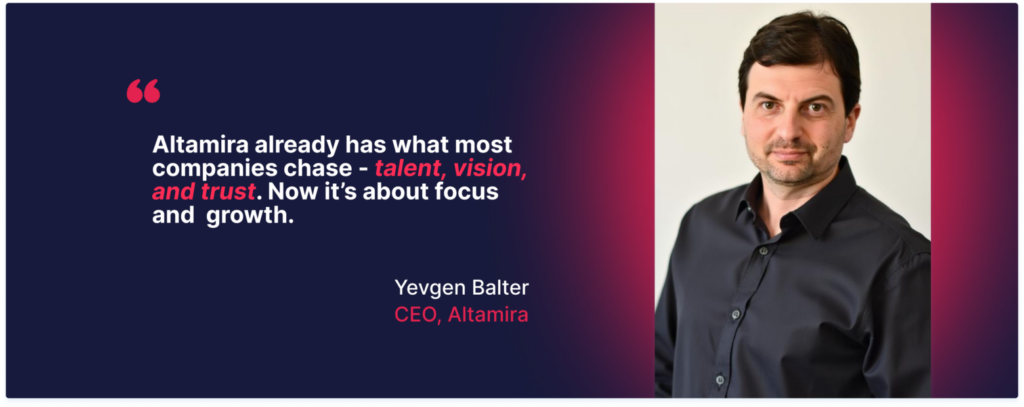
That’s the backdrop for our conversation with Yevgen Balter, Altamira’s CEO, who has been steering Altamira through the move from “AI experiments” to real, operational AI. It’s a look at what intelligent systems can actually do inside a business and what it takes to build them without headaches and endless pilots.
You also get a sense of leadership in a field that refuses to stand still. How to guide teams when tools evolve monthly. How to build AI that helps people instead of overwhelming them. How to stay steady when the loudest voices are often the least grounded.

The Vision
What’s your definition of an AI agent, beyond the buzzword?
An AI agent isn’t a chatbot. It’s a system that understands context, takes action, and delivers outcomes. In simple terms, it’s about giving software the ability to think and act, not just respond.
How do you see AI agents changing business operations in the next few years?
They’ll shift from being side tools to becoming core contributors. They’ll automate decisions, processes, and communication. Teams will design workflows around agents instead of layering them on top.
What separates companies that use AI well from those that only experiment?
Execution and integration. The teams that win connect AI to their real operations: data, systems, and people, instead of running pilots that never scale.
Building for the real world
What are the biggest challenges in moving from prototypes to production-level agents?
Reliability, data quality, and security. A demo is easy. But building something that works with real users, real data, and real compliance standards is where the work happens.
How do you see Altamira helping clients adopt AI agents responsibly and effectively?
We start with outcomes, not technology. We pick use cases where AI improves a workflow and keeps humans in control. Transparency and safety come built in.
What problems are we focusing on first?
We start with high-impact, repetitive tasks, like support, document analysis, and internal automation, where AI can save time immediately and build trust for bigger transformations.
Leadership & Direction
How do you guide a team working in a field that changes every month?
By building a culture that learns fast and experiments often. We can’t predict everything, but we can stay close to real use cases and share what works.
What mindset shift do leaders need for AI-powered teams?
Move from “control and plan” to “guide and enable.” Leaders set direction and context. The team, people and AI, handles execution.
What does success look like for you, for the company, and for the broader ecosystem?
For me, delivering real value to clients. For the company, becoming a trusted AI partner for mid-size businesses. And for the ecosystem, AI adoption that is thoughtful, practical, and good for people.
The human side
Many people fear that AI will replace human work. What’s your take?
AI replaces repetitive tasks, not the work that requires judgment, empathy, or creativity. The best results come when people focus on what only people can do, and AI handles the rest.
What lesson from your career helps you lead through this transformation?
Technology matters only if it drives outcomes. Progress happens when strategy, engineering, and people move together, not when we chase trends.
The future
Looking ahead 3–5 years, what role will AI agents play in everyday business?
They’ll be everywhere — assisting in communication, decision-making, operations, and customer engagement. AI agents will become invisible infrastructure, like email or CRM systems are today.
What excites you most about that future?
The idea that AI agents will finally move from theory to real impact, helping people work smarter. I’m excited about building systems that amplify human potential and give teams more time for creativity, strategy, and meaningful work.
Final words
Stepping back from the conversation, AI agents aren’t arriving in some dramatic wave: they’re already woven into day-to-day operations, often in places people don’t notice.
The companies that move ahead won’t be the ones chasing novelty. They’ll be the ones who understand where an agent can take friction out of a workflow, shorten a decision, or return time to a team. Small gains that add up.
There’s also a quiet reminder here: progress doesn’t come from predicting the future. It comes from staying close to real problems and solving them one at a time. When teams do that with the right systems and the right leadership, AI agents stop being a concept and start becoming part of how the business runs.
The next few years will be defined by the organizations that build reliable intelligence into their operations and give their people more room to think, create, and lead.