Legacy modernization often stalls at the executive level for one reason: perceived risk. When a core system supports reporting, operations, and revenue workflows, the fear of breaking it outweighs the desire to improve it. Over time, however, that hesitation creates a different kind of exposure, rising maintenance costs, slower change cycles, and growing hiring limitations.
We recently migrated a mid-size ERP platform from PHP to .NET 9. The system included roughly 300,000 lines of code, a Yii-based Web API architecture, and a relational database with around 200 tables. It supported complex reporting and tightly embedded business rules developed over years of iteration. A full rewrite was technically possible. It was not strategically responsible.

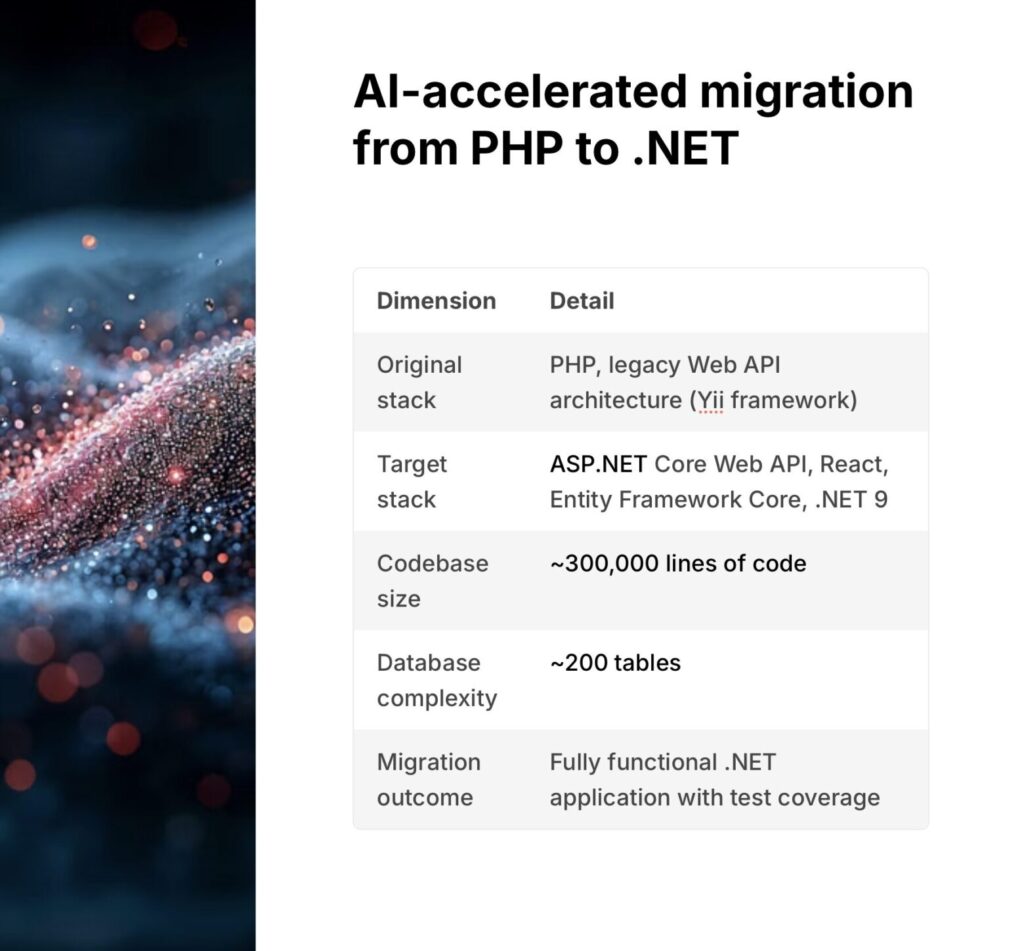
Instead of rebuilding the system from scratch, we executed a structured, AI-assisted migration. The goal was clear from the very beginning: preserve business logic and data integrity while transitioning to a modern stack built on ASP.NET Core Web API, Entity Framework Core, and React.
Why a full rewrite was the wrong decision
Code rewrites sound nice in theory. They promise a clean slate and architectural purity. In practice, they introduce interpretive risk. Business logic that evolved over years gets reimagined. Edge cases are rediscovered the hard way, timelines expand, so do the budgets.
For an ERP system with deep operational dependencies, the main priority was continuity. Every rule embedded in that codebase represented a business decision. Losing or misinterpreting even a small portion could disrupt reporting, billing, or compliance workflows.
That’s why modernization needed to reduce risk, not relocate it.


Where AI created leverage and where it didn’t
We used AI coding assistants as structured engineering tools. Their role was focused and controlled: translating high-volume, repetitive code components from PHP to C# within an architecture defined by senior engineers.
AI handled:
- Translation of controllers, models, and services from Yii to ASP.NET Core patterns
- Conversion of ActiveRecord models into Entity Framework Core entities
- Mapping of relationships, limitations, and migrations across approximately 200 tables
- Generation of unit and integration tests that did not previously exist in the PHP system
Every translated module went through senior engineer review. When discrepancies popped up, they were corrected and fed back into the AI-assisted workflow. This review–refine loop continued until the code met production standards.
AI accelerated mechanical translation, and engineers validated meaning.
Architecture decisions, technology selection, infrastructure planning, and business rule verification remained fully human-led. The target structure - .NET 9, EF Core, layered services, CI/CD strategy was defined before translation began. AI operated within those constraints.
When AI defines architecture, you introduce uncertainty. When AI executes within a defined architecture, you increase throughput without surrendering control.
Protecting data and business logic
The ERP’s relational model was central to operational reporting. Rather than redesigning the schema, we preserved its structure. AI translated entity mappings and relationships while engineers verified integrity and performance.
Equally important, the modernization introduced structured test coverage. The legacy system had minimal automated testing. The new .NET implementation launched with unit and integration tests that strengthened long-term maintainability. Modernization was not limited to technology replacement; it reduced future operational risk.
Measurable impact
The migration was delivered approximately 3 to 4 times faster than a comparable manual rewrite would have required. That acceleration came from removing repetitive translation effort, not from compressing oversight or reducing validation.
Faster delivery matters strategically. The longer a core system remains in transition, the greater the exposure to operational disruption, scope expansion, and stakeholder fatigue. Shorter modernization cycles lower both financial and organizational risk.
The strategic takeaway
Many executive teams frame modernization as a binary choice: live with legacy limitations or fund a disruptive rebuild. That framing is outdated.
Structured AI-assisted migration creates a third path - one that preserves business continuity while accelerating technical transition.
At Altamira, we treat AI as operational infrastructure rather than experimentation. It is integrated into delivery workflows where it reduces manual effort and increases control. We also refuse to introduce unnecessary complexity in the name of modernization.
We proactively measure every architectural choice against business impact, not technical fashion. Legacy systems rarely collapse suddenly. They erode over time through slower change, higher maintenance cost, and talent friction. A disciplined, AI-assisted approach allows you to modernize without betting the business on a rewrite.
If you’re evaluating what your current platform can realistically support and where its limits are starting to show, that conversation is worth having. Modernization doesn’t begin with replacing everything. It begins with understanding what you already have and strengthening it with purpose. Contact us to learn more about how we can help modernize legacy systems.