
Overfitting is what happens when a machine learning model gets too good at remembering. Sounds weird, right?
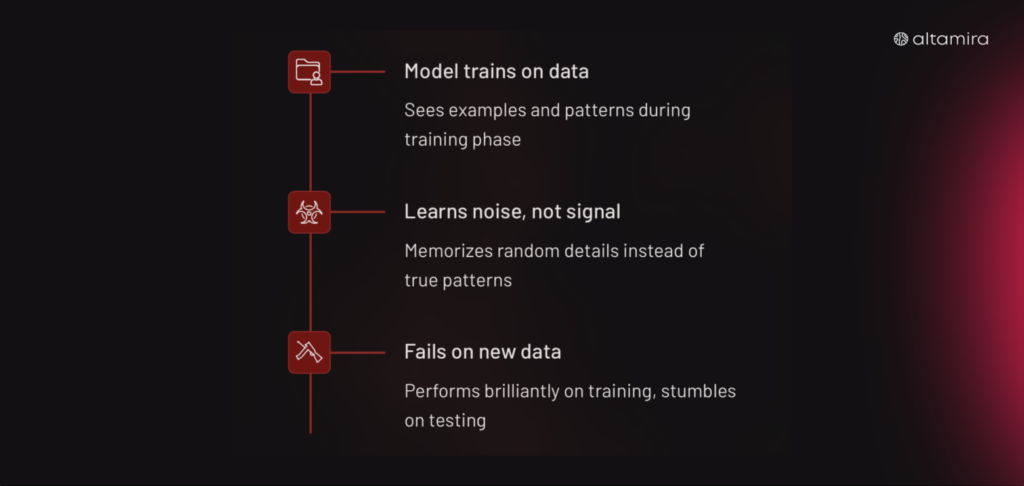
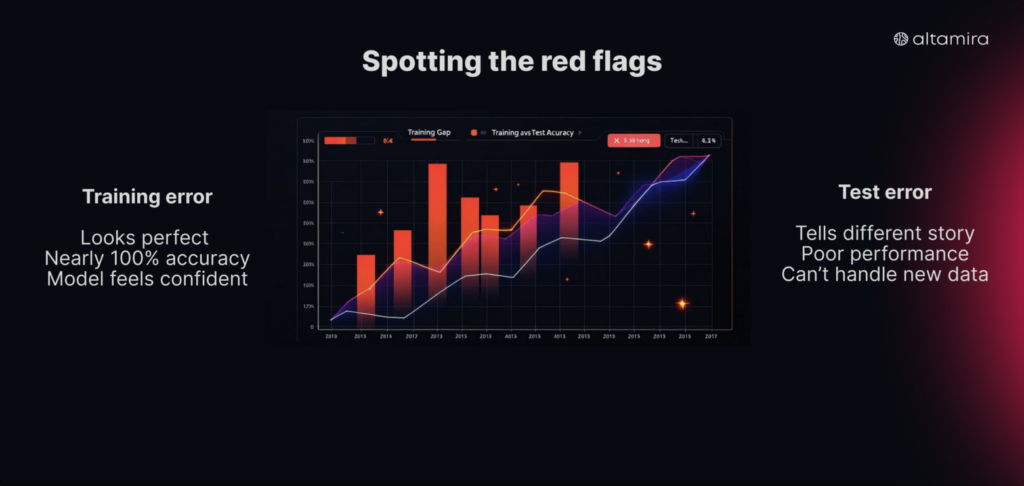
Imagine you’re studying for an exam and you memorize every practice question instead of learning the topic. On test day, the questions are different, and you freeze. That’s overfitting. ML model does the same thing when it trains for too long or tries to learn every tiny detail in the data. It starts memorizing noise, e.g., random, irrelevant bits, instead of understanding the real patterns. It performs brilliantly on the data it saw during training, but stumbles on anything new. The whole point of machine learning is generalization: using past data to make sense of future data. Overfitting breaks that purpose. As a model can’t generalize, isn’t learning, it’s just echoing. You can usually spot it by comparing results. The training error looks great, almost perfect. The test error, though, tells a different story. That gap between the two is the red flag. To avoid it, data scientists hold back a portion of the data as a test set. They use it to check if the model is actually learning or just memorizing. If the test results lag far behind the training ones, it’s time to simplify the model, retrain it, or apply regularization. So, in short, overfitting is a model that knows the answers but not the subject.
How to detect overfit models
Detecting an overfit model starts with testing how well it performs beyond its comfort zone - the training data. One of the most reliable ways to do this is k-fold cross-validation. It gives you a clearer picture of how the model behaves with unseen data.Here’s how you can detect overfitting:
- You split your dataset into k equal parts, called folds.
- You train the model on k–1 folds and test it on the remaining one.
- You repeat this process until every fold has served as the test set once.
- After each round, you record the model’s score.
- At the end, you average all scores to see the model’s overall performance.
How to avoid and address overfitting
Avoiding overfitting isn’t about building the biggest or smartest model. It’s about creating one that knows when to stop learning. Here are the techniques that help keep your model balanced: accurate, but not overconfident.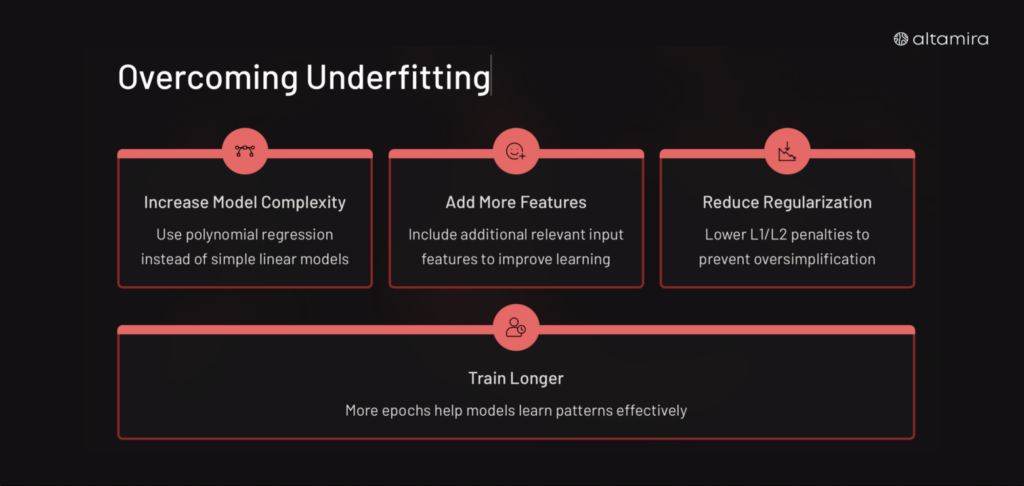
Early stopping
Training too long is like overstudying. You start memorizing instead of learning. Early stopping pauses training before the model starts fitting the noise. The hard part is timing: stop too early, and you risk underfitting. The goal is to find that middle ground where learning stops being useful.Train with more data
More clean and relevant data helps the model see what really matters. The broader the dataset, the harder it is for the model to cling to random noise. But quality matters more than quantity as adding messy or unrelated data only makes things worse.Data augmentation
When data is limited, you can create slight variations of it: flipping, rotating, or altering existing samples. This adds variety and helps the model generalize better. Just don’t overdo it as too much synthetic noise can create new problems and your model fails.Feature selection
Not every input is valuable. Some features overlap or add no real signal. Feature selection trims the excess, keeping only what drives meaningful predictions. This makes the model simpler, faster, and more generalizable.Regularization
Sometimes you don’t know which features to drop. Regularization handles that by adding a penalty for complexity. It keeps large coefficients in check and discourages the model from chasing noise. Techniques like Lasso, Ridge, and Dropout all work on this principle.Ensemble methods
Instead of relying on one model, combine several. Methods like bagging and boosting aggregate multiple weak learners into one strong performer. Each model sees a different slice of the data, and together, they balance out each other’s mistakes. In practice, avoiding overfitting isn’t about using one trick. It’s about knowing when your model has learned enough and having the discipline to stop there.Overfitting vs Underfitting
Overfitting and underfitting sit on opposite ends of the same problem — how well a model learns from data. An overfit model learns too much. It memorizes every detail of the training data, including the random noise, and performs poorly on anything new. It’s like a student who knows the practice questions by heart but can’t handle a surprise test. An underfit model learns too little. It misses even the obvious patterns in the data and struggles to perform well on both the training and test sets. Think of it as a student who skimmed the textbook once and guessed the rest. The balance between the two defines real learning:- Overfitting: High training accuracy, low test accuracy: the model is too specific.
- Underfitting: Low accuracy everywhere: the model is too simple.