
The goal of modern software development is to deliver continuous value through small, frequent, and automated releases.
The release management process can be a time-consuming and effort-intensive process, involving the entire team and stakeholders.
So the question is – can you make it easier? We are confident that it is possible if you manage the entire process properly and work closely with our experienced team of professionals.
Managing releases helps plan work efficiently and, therefore, prepare for the expected results. For product users, it is a kind of quality support and guarantee of receiving further improvements. Furthermore, to prevent costly delays, sudden bugs or errors and keep your organisation's processes running smoothly, you need to adopt automated CI/CD pipelines, feature flagging, and real-time monitoring for release management.
In this article, we aim to discuss what effective release management entails and its role within the development cycle. We will also describe who is involved in the release process, and to what metrics you should pay attention. So, without further ado, let's get started!


What is the release management process?
The Release is a complex process of delivering the scope of a new product, planned changes, or a particular feature that brings value to the clients and, as a result, to the business. The overall purpose is to carry out the idea from its inception to its full implementation and release to the market. For a manager, the task is similar to a quest: to implement the necessary changes through all stages, avoiding potential pitfalls, adhering to the stated time frame and budget.
It is worth considering that release management in a broader sense may include additional activities, such as announcing an updated product, launching advertising campaigns, and providing training support to specialists, among others.
We have prepared a visual scheme that demonstrates the main steps of the software development cycle and describes the key activities that occur at each stage. As you can see, developing any solution, even a basic one, requires a significant amount of work, and without the right management, this task becomes even more challenging.
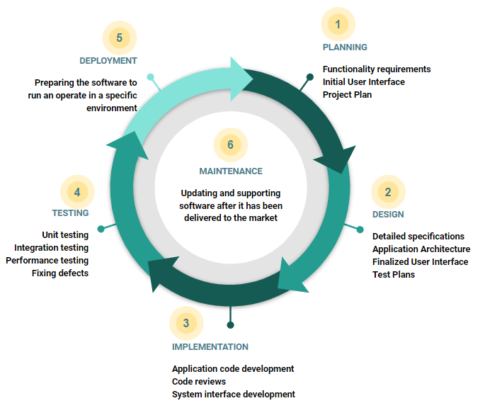

Software release management cycle explained
As mentioned earlier, software release management is a complex process that combines planning, implementation, testing, and deployment of software changes, as well as control of their quality during subsequent use. Take a look at the picture below to gain a better understanding of the entire cycle.
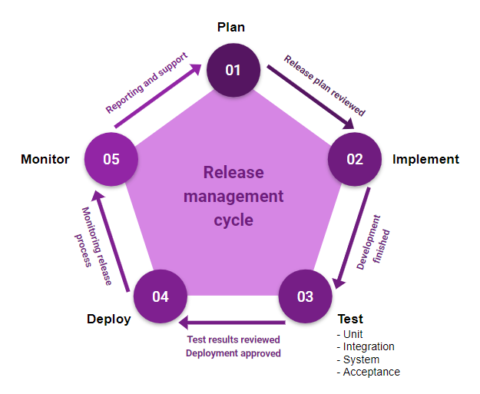

Every step of release management is crucial, and it follows certain rules that you should adhere to. Without knowing them, you may face numerous challenges on your way to app release. To avoid them, let's take a closer look at each step and the actions it requires.
#1 Plan
Although Deployment (Release) is the final part of the software development life cycle, release management is a process that starts from the very beginning, with planning. Release planning is the process of determining the desired outcome of one or more releases and maximising the chances of achieving it. Specific, realistic, achievable, and measurable goals are established during the planning process.
At this stage, the necessary efforts are being analysed, the available resources are taken into account, as well as competencies, and the time necessary for implementation. The compatibility of the required changes with the existing functionality should also be checked. The outcome of the planning will be a release plan or product roadmap with the scope of work to be completed by specified delivery dates, taking into account both optimistic and pessimistic forecasts, as well as potential risks and a mitigation plan to address them.
The plans should be updated and disseminated regularly to create the right expectations for all stakeholders in the project. Here is how releases can be planned:
By trunk-based development with feature flags: features are integrated into the main branch early and toggled off until ready.;
By continuous delivery: every sprint or commit can be safely deployed to production;
Scaled Agile teams may still use release trains, but high-performing orgs like GitHub, Amazon, and Etsy favour continuous delivery over batching work.
Usually, it depends on the project (its particular needs and requirements) when and how to release features. Releases can also be performed on-demand or separately. Therefore, it is better to discuss with your team which strategy you will use to avoid any further misunderstandings.
#2 Implementation
The development team builds software based on user stories and acceptance criteria. In Scrum, release planning is carried out iteratively, often at the end of a sprint, when it's clear how much progress has been made.
#3 Testing
A particular release, which contains changes, features, and bug fixes, will not be deployed until all comments and testing criteria have been taken into account. A release with a concrete version number passes through automated pipelines that include unit, integration, contract, and smoke testing, often run in parallel using cloud-based test environments.
This process focuses on both functional and non-functional needs, performing both positive and negative test cases.
#4 Deployment
This implies all actions that prepare the software system for use. In general, the deployment process consists of several interrelated actions with possible transitions between them. This activity can occur from both the developer and the end-user. When a user deploys a release, it is typically referred to as an installation of the software. “Deployment” generally can be interpreted as pushing and organising code work in a particular environment.
#5 Monitoring
At this point, the changes are committed to production. Any issues or defects found in the production environment must also be reported to stakeholders and addressed in the next release.

How to manage releases in an Agile world
Based on our experience, we can say that it is better to perform project management using Agile methodology. So let's discuss how the Agile approach to release management works. It is essential to note that this approach is referred to as continuous development.
Continuous development is the ability to incorporate all changes (such as new features, configuration changes, bug fixes, experiments) into production rapidly and reliably by process automation. The traditional approach to releases implies that you will do big releases. In the case of Agile, you will be working with continuous delivery of small, production-ready changes that are easier to test, deploy, and roll back.
Such an approach to releases helps to:
minimise apps' bugs and defects;
easily adapt and respond to all changes;
provide updates to users earlier;
receive timely feedback about the quality, satisfaction, and stability of the software.
Now, let's review the CI/CD (Continuous Integration and Delivery) methodology in detail. Take a look at the picture below and the detailed explanations of each mentioned process.
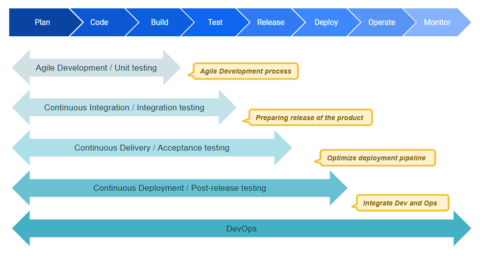

#1 Continuous integration means that all changes made to the code are merged into a central repository (the operation is called a “merge”). The merge can happen several times a day, and after each merge in a specific project, a build is created and testing is started automatically.
#2 Continuous delivery aims to ensure that software updates occur in a sustained way. This set of operations ensures fast deployment in production without altering existing functionality. Nevertheless, it is always necessary to base decisions on the business's needs and the processes for implementing new functionality.
A notable point is that if the development of a particular feature is not yet complete or hasn't been tested, the technique of feature toggling is employed. It implies that the developers hide the feature so that it doesn't appear in the user interface. It can save time in creating and maintaining an additional branch for this feature, as well as resolving conflicts after merging. With this practice, we ensure that the code is ready for release almost all the time.
#3 Continuous deployment ensures that all new functionality, after passing automated tests and quality gates, is deployed incrementally using canary releases or blue-green deployments.
In order for you to keep up with customer demand, you need to create a deployment pipeline. You need to get everything in version control. You need to automate the entire environment creation process. You need a deployment pipeline where you can create test and production environments, and then deploy code into them, entirely on demand.
Erik to Grasshopper, The Phoenix Project © Scaled Agile, Inc.
#4 DevOps is a set of practices that combines software development (Dev) and IT operations (Ops). It aims to enable rapid and reliable delivery by automating testing, infrastructure provisioning, deployment, and monitoring across various environments.
The DevOps model fosters a productive work environment by bringing together development and operations teams. Members of both teams can coordinate their work with each other and collaborate, which helps to reduce risks in the overall release process. A properly configured process helps detect, analyse, and eliminate errors on time at any particular stage: while planning, developing, building, or releasing changes before they are deployed to the live environment.
A collaboration between the development teams and IT operations teams provides timely solutions to issues related to updates, changes in operations, software settings, security systems, or infrastructure. As a result, the end-user receives the benefits of the updated fine product in a short time period without any delays or critical issues.


Who is involved in the release management process?
The release process requires constant attention from numerous specialists, including developers, QA engineers, and the product owner. Everyone performs a specific set of tasks, and thanks to effective cooperation, everything is completed on time, and every issue is resolved easily. Let's explore what every specialist does and how this impacts the release process.
Product Owner
This is the main stakeholder on the project, who communicates the main objectives, the product vision, and the delivered value. He participates in the entire process to ensure consistency in achieving the result, ensure a correct and unambiguous understanding of the ultimate goal, anticipate and eliminate any obstacles, and minimise risks. He also ensures that the final product meets business requirements and helps to organise acceptance testing.
Important notion
Acceptance testing is a level of software testing, the purpose of which is to determine whether the made changes meet business requirements and bring value to end-users. Acceptance Testing is the fourth and last level of software testing performed after System Testing and before making the system available for actual use. It can be performed by the members of the organisation that developed the software or end-users known as beta-testers.
Development team
The development team plays a key role in release management, as they participate in most of the processes throughout the product life cycle. They estimate the initial cost and time, define the baseline requirements, create documentation, and develop functionality. They also resolve all issues on the spot and ensure that the solution functions as intended.
DevOps engineers
When discussing Agile methodologies, we often refer to the term DevOps engineer. DevOps employs a set of practices that combine software development and IT operations, aiming to shorten the systems development life cycle and provide continuous delivery with high software quality.
In other words, a DevOps specialist optimises processes by automating and integrating with the development team to build, test, and deliver software reliably and at a high velocity.
QA specialists
Their main task is to ensure the release meets the established criteria and specified requirements. There are automated and manual QA engineers who perform all necessary checks in different ways (by using written scenarios or checking the connectivity, functionality, etc., manually).
There is also a set of crucial tasks that the manager considers during the release process. He is responsible for:
Monitoring the speed and quality of deployment;
Being proactive, not reactive and managing possible risks;
Not “breaking” the existing functionality;
Having a roll-back plan set up;
Being flexible to new changes;
Aligning the product delivery deadline with the duration of the release process;
Finalising stable versions and thus reducing the number of unstable git branches and versions.
Release management metrics explained
As with any other development stage, release management also presents its own challenges. Therefore, it is essential to understand the key metrics that indicate whether everything is going smoothly or if additional actions are needed to bring everything into order. We have compiled some key release management metrics that every manager should be aware of.
Bugs vs Features
It’s important to track the delivery balance between bug fixes, refactoring, and user-facing features. Tools like Jira or GitHub Projects can help visualise work type distribution across releases.
The team needs to strike a balance, respecting agile values – responding to change over following the plan, when sometimes valuable changes need to be delivered as soon as possible instead of planned features.
Additionally, it is crucial to track the number and severity of bugs in a specific component of the software within each release. This will indicate that this functionality requires additional testing and/or specific changes. This can impact another metric, the estimated release cost.
Estimated vs Actual release downtime
Discrepancies between the estimated release downtime and the actual release downtime over several releases can help identify bottlenecks and optimise them by making future release plans more accurate.
Number of releases delivered on schedule
If the software changes are delivered not as expected, a cause should be identified, assessed, and addressed. This is an important part of continuous improvement. The following questions must be answered:
For how long was the release delayed?
At what stage is the release now?
What is the reason for the delay? (Ideally, the reason for the delay should be identified in advance in order to have time to react, notify the stakeholders, and take the necessary measures.)
What does the team need to get back on track?

Summing up
Each stage of project release management is very important. Well-established processes, collaboration between teams and stakeholders, and attention to results at each stage of the development cycle ensure the timely and high-quality delivery of software changes.
Every detail should be taken into account, because if risks were not counted at the planning stage or requirements were formulated incorrectly, the delivery of the solution and its release can be delayed. It is essential to consider all aspects of the release process and communicate them to each team member. And that is exactly what project release management is for.
FAQ
What are the main elements of a product release map in Agile?They are the approximate release of the project, plans for every release, subsequent iterations and plans for them, feature development within each iteration, and individual tasks that are needed to develop and deliver the features.
Who is responsible for release management?All processes are controlled by a manager who is responsible for scheduling, managing and coordinating releases. This person also take all risks under control and resolves issues timely to avoid release delays and shifts of schedule.
What are DevOps responsibilities?DevOps needs to be able to communicate effectively, improve visibility across the CI/CD pipeline, stay focused on building new features and services fast and without compromising the solution quality.
What is the difference between build and release?A release implies the official launch of the ready solution, while when we say build, we mean a developed version of the software that is given to testers and being checked.
What is the life cycle of release management?The release management life cycle is the structured process of planning, scheduling, coordinating, and deploying software releases. It typically includes the following stages:
Planning – Define the scope, schedule, and resources for the release.
Build – Develop and integrate new features or updates.
Testing – Validate the release through QA, automated tests, and user acceptance testing.
Deployment Preparation – Finalise release notes, rollback plans, and deployment scripts.
Release – Deploy the release to the production environment.
Post-release Review – Monitor performance, resolve issues, and gather feedback for future improvements.
In Agile, the release life cycle is iterative and flexible. It focuses on delivering smaller, incremental updates frequently, rather than one large release. Key stages include:
Backlog Grooming – Prioritise features and fixes based on value and feedback.
Iteration Planning – Define deliverables for the upcoming sprint or iteration.
Development & Continuous Integration – Build and integrate new features.
Testing – Perform ongoing testing within each sprint.
Incremental Release – Deploy working software at the end of each sprint (optionally to production or staging).
Feedback & Adjustment – Use user feedback and metrics to refine the next iteration.
This cycle supports continuous delivery and quick response to change.
What is the difference between deployment and release management?The key difference lies in scope and visibility:
Deployment is the technical act of moving code to a live environment (e.g., pushing a build to production). It can be automated and may not be visible to users.
Release management involves the broader coordination of planning, scheduling, testing, communication, and governance around making features available to users. A release may include multiple deployments and often involves user-facing changes.