
Nowadays, data is the most valuable asset for most businesses. So the more information you can collect the better, right? Actually, no. The situation is a little bit more complicated. Because even terabytes of data may bring you no results if it’s not managed properly. In small and medium companies, this task may be performed by a lead engineer from an IT department while large enterprises sometimes need an ETL developer.
To help you figure out if you need this position in your tech team, we’ll outline the key responsibilities of an ETL developer and look at the list of skills this person must possess. But let’s start from the basics and discuss the ETL process first.
What is ETL?
The abbreviation ETL stands for Extract, Transform, and Load. In general, it’s a process aimed at discovering business insights from unstructured data retrieved from different sources. Here’s what exactly happens at each stage:
Extract. Every modern organization deals with a vast amount of data every day. For example, a CRM system gathers information about customers, ERP software processes information about business processes and so on. The extract phase is when all such information is collected and transferred to a temporary depository.
Transform. Naturally, even the same data extracted from several systems may have a different format and structure. For instance, CRM software may store prices in euro while ERP’s default currency may be US dollars. At the transformation stage, raw data is converted into a unified form so it can be used later.
Load. It’s the final phase of the whole ETL process when transformed (i.e. structured and formatted) data is loaded into a database or a data warehouse. The latter is used for exceptionally large amounts of information that often involve big data processing.
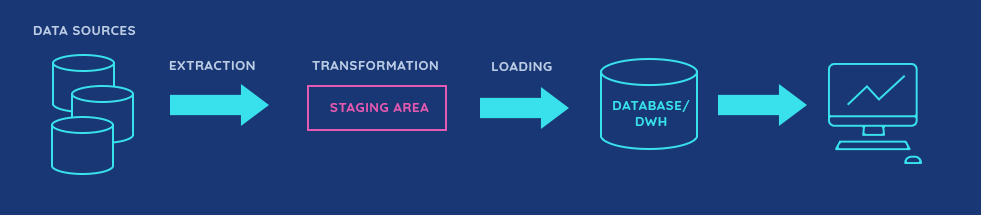

Once data is written into the target database, it can be analyzed with the help of business intelligence tools. Usually, such tools are connected to a database so users can conveniently manipulate (e.g. drag and drop) the pieces of information they need.
What does an ETL developer do?
Simply put, an ETL developer is a person responsible for setting up extracting, transforming, and loading process as well as ensuring that it runs smoothly and flawlessly. As a rule, a job description for this position includes the following duties:
- Analyzing the company’s data needs
- Defining the unified format for the data
- Designing a target database
- Creating a data flow from original sources to the target database
- Development of ETL tools (unless ready-made solutions are used)
- Testing and troubleshooting the system
- Maintaining the ETL process and database
Depending on whether an ETL developer works independently or as a part of a data engineering team, he or she may be involved in the above activities to different extents. For instance, if there is a database programmer on board, an ETL developer doesn’t model and create a target database but only overviews the process.
Yet, even if there is no data engineering team, ETL developers don’t work in isolation. To determine system requirements, they consult with business analysts. In addition, a person who occupies this position constantly communicates with top managers to properly determine what data and in what format will help a company to meet its business objectives.
The skillset of an ideal ETL developer
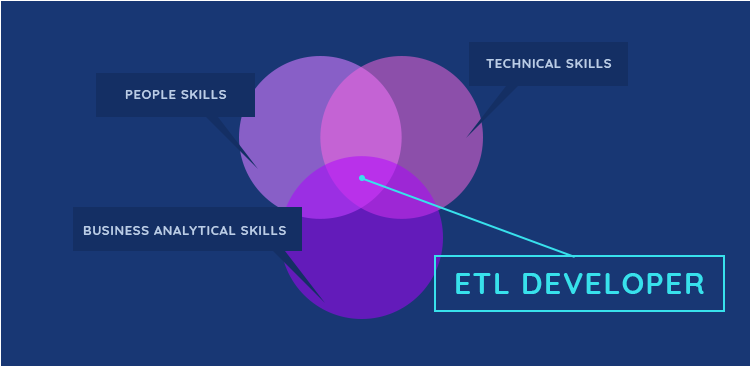
The role of an ETL developer is quite complex since it requires expertise in several fields. Besides having strong technical skills, this person must excel in communication, have a deep understanding of the industry and business as well as be able to manage and lead. But let’s look at this in greater detail.
Key technical skills
- ETL tools and software. Nowadays, there are a lot of off-the-shelf solutions that help to perform the extraction, transformation, and loading of the information. Talend, Informatica, and Pentaho are the most popular of them. Ideally, an ETL developer should have experience in working with this (or similar) software. He or she is also responsible for its integration with the company’s existing systems as well as further administration.
- Database engineering. Usually, the target database is created by another team member (database developer) or a development team. However, an ETL developer should have expertise in data mapping and good knowledge of SQL/NoSQL databases to properly manage the development process. Also, he or she has to be familiar with data warehouse architecture techniques such as EDW, ODS, DM, etc.
- Data modeling. It’s crucial for an ETL developer to be able to read, analyze, and transform the data in order to determine its output formats represented in a target database. Such formats are called data models and they are the starting points which help an ETL developer define the tools required for data transformation.
- Scripting languages. Although there are many ready-made ETL solutions, the data storage needs of every business are unique. Hence, an ETL developer must know the scripting languages to automate or tweak some processes. Ideally, it should be Python, Ruby, Perl, or Bash since those are the most widely used ones.

Other skills and personal traits
- Organizational and time management skills. A daily routine of an ETL developer comprises many diverse tasks from technical, business, and people management areas. That’s why the ability to keep things organized is of utmost importance for people in this position.
- People and analytical skills. ETL developers regularly communicate with a lot of different people, including business owners, junior programmers, and vendors. Hence, they must be able to understand the ideas coming from the business side, properly interpret them, and provide clear instructions to the IT team.
- Creativity. It’s true that the position of ETL developer is technical. However, it also contains a creative element since this person has to design the most efficient way to manage and make use of data. To build a pipeline of a data flow, an ETL developer should be able to see the big picture and think out of the box.
When does a company need an ETL developer?
Not all companies need an ETL developer. For example, if an organization doesn’t process a vast amount of data on a daily basis, other tech specialists can cover the tasks related to its data storage needs. So you should consider the option of hiring an ETL developer only if:
- your business is growing fast and the IT team can no longer efficiently leverage the data
- you plan to build a new large-scale data processing system or want to extend the existing system
- your main activity relies on data or you have many business intelligence / machine learning projects
It’s also worth mentioning that finding a perfect candidate for this position is quite a challenge. Most programmers prefer to have a narrow specialization and not many of them are equally good at business management and coding. That’s why looking for a reliable software development company might be a better alternative.
Putting it all together
The future belongs to those who can control the data. An ETL developer can help your organization make the most out of the information it collects. But since the role is quite complex, it requires not only a strong technical background but also the ability to see the business side of all operations a company conducts. For this reason, finding a person who would possess all necessary skills and knowledge is not an easy and sometimes even impossible task. Hence, partnering with an IT outsourcing company might be a better idea.