
Data is now widely seen as a necessary fuel for innovation and company growth in the short term. As The Economist magazine famously suggested in one of its old issues: “data is the new oil”. Just like a car can't move without gasoline, a modern-day company can't go anywhere without data.
The market for data is evolving rapidly, and an important catalyst for this is the newest popular methods of accessing data in various ways through booming connectivity methods such as mobile phones, IoT sensors, etc. All these technologies generate new forms of information and ways of using it, for instance, AI that relies on a large amount of high-quality data to work.
The increased demand for data has led to expanding markets and the emergence of data processing companies classified as Data-as-a-Service (DaaS) companies such as Datanyze, Safegraph, Clearbit, PredictHQ, and DataFox.
DaaS provides faster, higher-quality data. This data quality can satisfy the needs of even the most demanding customers. For example, those who are engaged in training machine learning algorithms. Other companies can use the power of such data to optimise their operations, including supply chains.
“As organisations become increasingly digitalised, many are looking at DaaS models as they move to the cloud to streamline the delivery of data and their data supply chain,” said Simon Field, EMEA CTO at Snowflake. “Convenient access to data insights is key for organisations and can typically explain the growth of DaaS adoption by organisations.”
Having data available within one location in the cloud is another benefit of DaaS for any organisation that wants to empower the entire workforce on data-related matters and tasks, allowing for better communication.
What is Data as a Service?
Data as a service (DaaS) is a data management strategy that uses the cloud to provide storage, integration, processing, and/or analytics services over a network connection.
DaaS can be compared to SaaS (Software as a Service). Just as SaaS eliminates the necessity of software installation on devices and gives users access to digital solutions over the network, DaaS transfers most of the storage, integration, and processing operations to the Cloud.
Data as a service is far from a novel industry. This market is decades old, and many successful data companies, such as Bloomberg, Oracle Data Cloud, and Nielsen, were created some time ago and are industry leaders.
It is worth saying that this approach is only now beginning to take hold. It's easy to explain that the original goal of cloud computing services was to offer application hosting and data storage services. Over time, shared cloud computing services evolved and began to focus on integration, analytics, and data processing.
Today, DaaS is beneficial to many companies from different industries due to the advent of low-cost cloud storage and bandwidth combined with cloud platforms. The combination of all of this allows you to manage and process data quickly and at scale.
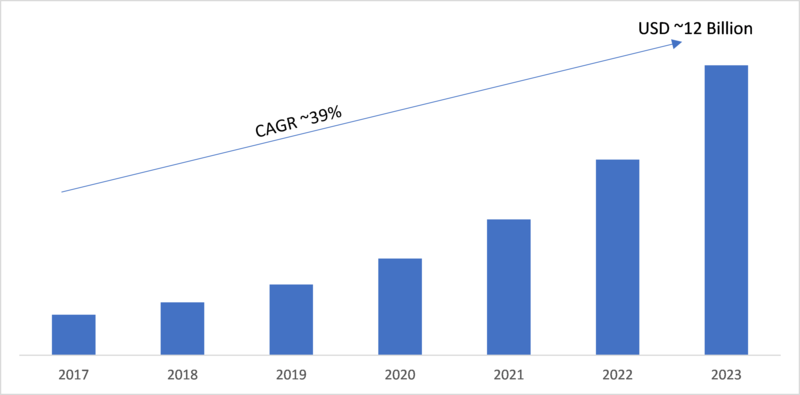
The DaaS market is actively developing today. For example, analysts from Market Research Future (part of Wantstats Research and Media Pvt. Ltd.) predict that by 2023, the size of this market will increase to USD 12 billion.


DaaS Key Attributes
DaaS is all about empowerment
DaaS companies must focus on integrating into existing workflows rather than demanding that customers change the way they do business. This requires deep customer knowledge, easy integration, and data that delivers immediate value to the business.
It is important that DaaS companies focus on seamless integration and solving a well-defined customer problem.
DaaS is a margin
Data companies often have significant production costs, especially on a small scale. However, as the data business grows, gross margins often skyrocket in tandem with business growth. It is important to understand how your cost structure of acquiring, creating, and working with data changes as you gain new customers, exercising economies of scale.
If your gross margin for your fiftieth client is significantly higher than for the first, then you are on the right track. This growing bottom line is a key element in building a large and resilient DaaS company.
DaaS must be machine-readable
As we discussed earlier, the accuracy and quality of data foster innovation powered by machine learning and AI. Any inaccuracy in the data can lead to disaster.
Therefore, DaaS must be machine-readable. To make sure that the data is correct, you can implement tools that will help you brush up on your solution.
For example, Crowdflower (now Figure Eight), Mighty AI, and Samasource label the data and clean it up for algorithmic use.
DaaS must be continuously updated
DaaS companies provide reusable data. The data must have a combination of speed (change over time, days, or hours) and intrinsic value in knowing the occurring changes. The higher the data transfer rate, the greater the potential value exists in that company's data.
Real estate or stock market data is a great example of value growth at a faster rate.
The above aspects show the difference between traditional data companies and DaaS. In case you are planning to establish and grow a DaaS company, you should consider these elements.
As demand for AI-enhanced products grows, DaaS will only grow with it, but its data quality, speed, and margins are what separates winning companies from losing companies in the long run. As demand for DaaS grows, so will the marketplaces, data cleansing products, and services built around it.
Why use Data as a Service?
It is no secret that in any industry, a business has two fundamental goals: to increase revenues and to reduce costs. DaaS helps with both.
On the one hand, structuring the work with data enhances efficiency and speeds up business processes, thereby simultaneously reducing costs while also improving the top line without even reinventing the wheel.
On the other hand, the DaaS methodology allows you to detect bottlenecks and, at the same time, potential growth points in the company's production cycle, such as introducing predictive analytics and optimising logistics, which can result in real, game-changing increases in the bottom line.
It is worth saying that DaaS is used both for the company's internal needs and for the fulfilment of tasks set by customers. Moreover, in both cases, DaaS structures the workflow and accelerates the receipt of the result.
As practice shows, the DaaS concept works best when implementing the following six stages as part of a single, sequential chain:
Creation and/or collection of data. Data can be obtained from external sources (media, social networks, data from mobile devices) and internal (databases, CRM, ERP, and most importantly, IoT).
Transportation. There are dozens of standard and non-standard ways of wired and wireless data transmission – modern providers can make networks out of almost anything.
Storage. Cloud storage solutions have become the standard of work today – there are various virtualisation technologies and a huge selection of hardware solutions on the market.
Data analysis. This is the most difficult stage, where all the power of technological capabilities and the latest advances in mathematics are realised. At this stage, the most expensive specialists are involved, and most of the company's primary data finally turns into useful (convertible into money) and, most importantly, presentable and readable information for clients.
Information security. Elements of this unified system must be present at every stage of the DaaS model.
Integration and implementation of the obtained results. The final stage, preceded by preliminary testing of the solution and the development of a pilot project, clarifies whether the solution has a positive effect and is a success.
How does DaaS work?
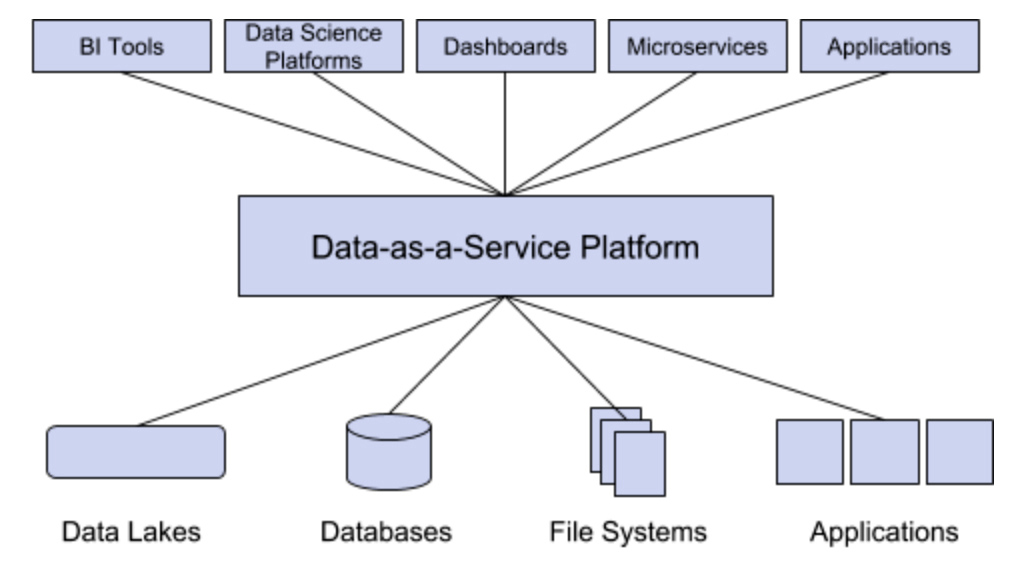

The Data-as-a-Service platform is a complex solution in which various data sources and tools (for instance, self-service reports, business intelligence, and applications) interact. Once the platform is deployed, end users can access data using standard SQL over ODBC or REST.
Companies can also use external DaaS services to access data. Many companies provide DaaS services through simple APIs. An example is the leading providers of company data: Opencorporate, Crunchbase, Orbis, etc.
What are the benefits of Data as a Service?
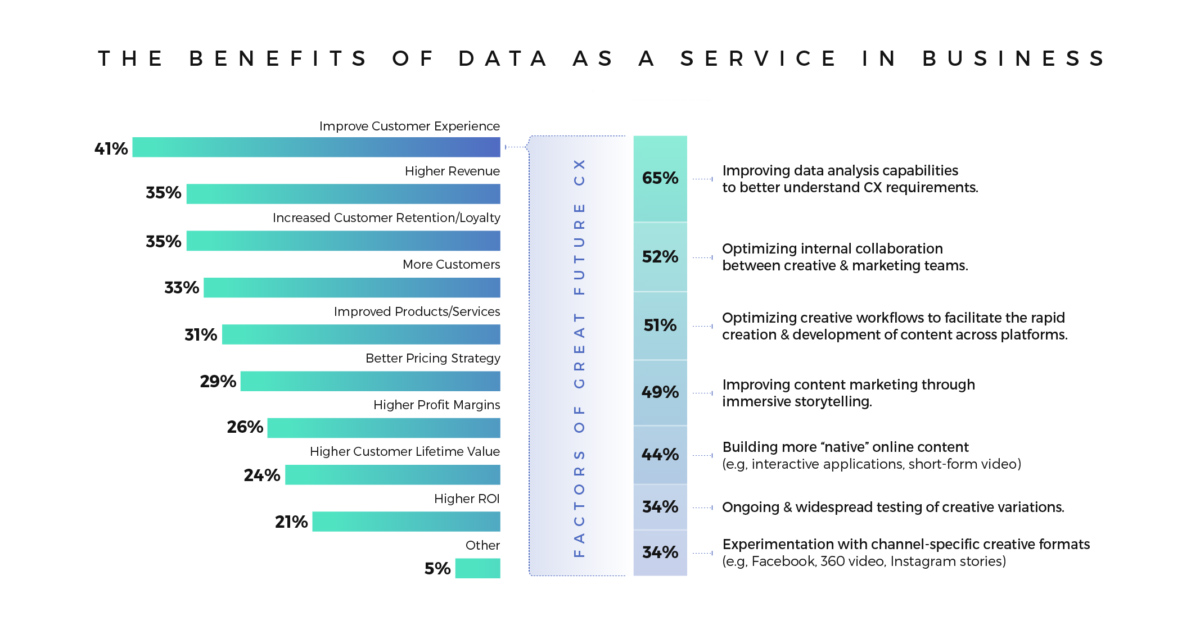
The potential impact of data as a service (DaaS) is enormous. And not just in terms of revenue, DaaS can benefit the entire organisation and its customers when used correctly and successfully. Listed below are some of the main benefits that DaaS can bring to a business.

Data monetisation
Many companies today have a lot of data. But they are experiencing some problems in organising and using this data. Using DaaS, companies can not only help cope with the basic challenges but also start monetising the data. This approach will make the data more accessible.
Cost-cutting
DaaS means that you buy processed data as a service. Instead of spending on data management and analysis software and employing data scientists to store their own data, companies pay one price to do it all in one package. They still get access to the data, but it's already cleaned and processed for them!
DaaS means making decisions based on a data-driven approach, not making subjective or impulsive decisions based on emotion and behavioural bias. But rather, based on hard facts backed by numbers. Thus, you can save resources by conducting fewer tests to prove a certain theory.
Improving user experience
DaaS can help companies develop personalised customer experiences with predictive analytics to understand consumer behaviour and patterns, better serve customers, and build loyalty.
The fast track to innovation
A strategy built on a large amount of quality data allows you to introduce more innovations with less risk. Ideas based on this data are more likely to be successfully implemented. And most importantly, the speed of this implementation increases significantly, and all thanks to accessing data, which serves as a source of information for new initiatives and stimulates growth.
Flexibility in decision-making
Data from different sources in near real-time allows companies to make more effective strategic decisions and better data management. Data as a service can combine internal, external, and open data sources for a comprehensive business view. DaaS can also quickly deliver data for ad-hoc analytics using end-to-end APIs that serve specific business scenarios.
Financial flexibility
DaaS enables companies to balance investment and operating costs. Companies can use DaaS to run services without investing in systems and staff to manage their data. Besides, DaaS reduces the capacity of the source systems, reducing licensing, MIPS, and hardware costs. DaaS also helps organisations reduce service costs.
Reducing risks
No need to guess. Companies that rely on a DaaS provider are empowered to use data to take the right action and win. With DaaS, companies can leverage data virtualisation and other technologies to access, aggregate, transform, and deliver data using reusable data services, optimising query performance and ensuring data security and management, thereby reducing risk.
Providing access to data anywhere (42 per cent)
Enabling better flexibility (37 per cent)
Reducing the support burden on IT staff (36 per cent)
It's no surprise that nearly half of the respondents noted unhindered access and reduced burden as some of the biggest benefits of cloud-based systems. This is because businesses traditionally collected, maintained, and managed their own data. In the last decade, however, data size and complexity have grown enormously, making internal and external management far more challenging.
Challenges to Consider When Using DaaS
Confidentiality
As soon as an organisation decides to share and deploy data outside of its own organisation, data management's privacy comes to the fore. In a Data as a Service environment, confidentiality issues are of great importance because the data exchanged is deep and most often related to critical aspects that directly affect key business processes in the organisation.
Security
This factor is critical for many organisations. The DaaS is also not protected from information leaks. DaaS provides easy access to data in its environment. On the other hand, it can make business-critical datasets open to multiple vulnerabilities. And as many organisations are moving to Data as a Service, it is critical to ensure security.
Data management
Data in the DaaS environment comes from many sources, and although this improves their quality, it isn't easy to manage large amounts of data.
To ensure a high level of data governance, the data integrity in a DaaS environment must be tested and verified to ensure that it is consistent with any other data. Verification is difficult to implement at this level, but it is an essential component to ensure that your organisation meets data quality standards.
Limited capabilities
Customers can only work with tools hosted on or compatible with their DaaS platform, instead of using any tool of their choice to create their own data processing and analysis solutions. Finding a DaaS platform that offers maximum flexibility in the choice of tools solves this problem.
Thus, as with any cloud solution, the cornerstone of the DaaS paradigm is data security and privacy, with high flexibility of integration solutions and broad functionality.
DaaS providers have all the necessary infrastructure for collecting, storing, analysing, and providing data insights in the form that the user needs, including Data Science tools (machine learning and other artificial intelligence methods) and process engineering.
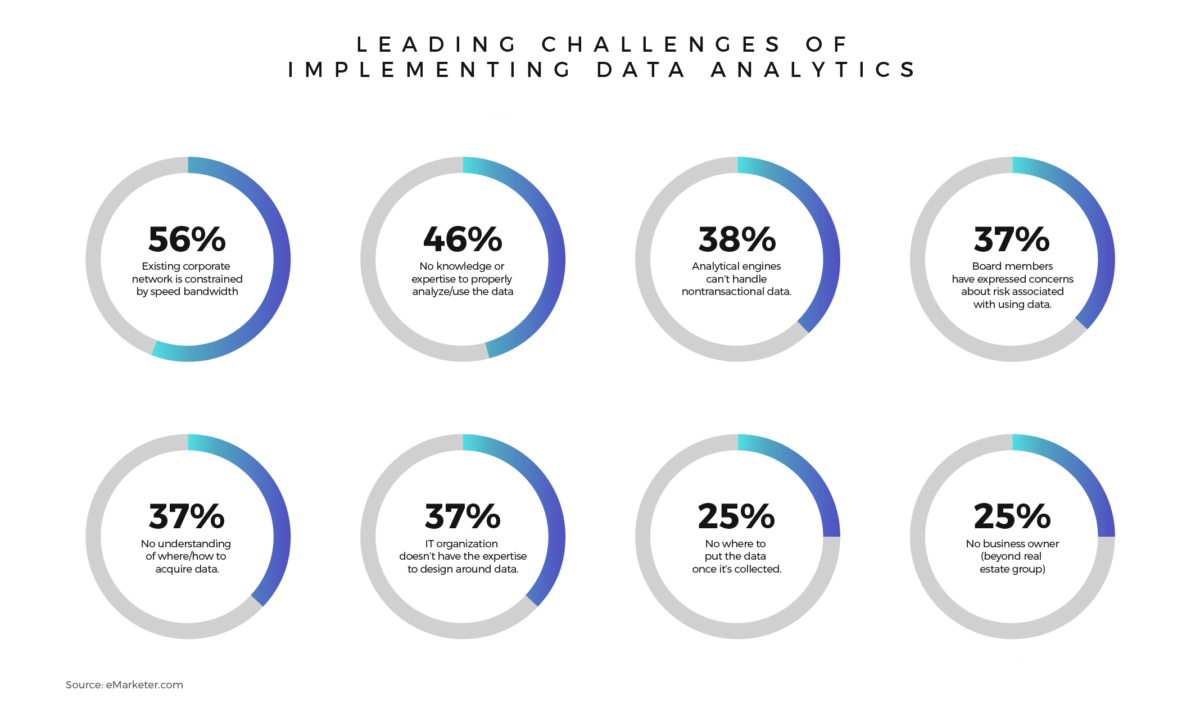
According to the American company Retail System Research, a business is likely to face the following problems while working with DaaS, which is what kind of poll:

Who can use DaaS?
Data as a Service is economically viable with the possibility of reducing costs or increasing revenues by 5% or more. For a company with billions of dollars in turnover, this 5% can translate into a herculean dollar amount and can make a huge difference to measures of profitability.
In terms of scale, DaaS benefits businesses of all sizes with a well-thought-out strategy that includes evaluating the workflow in terms of two basic concepts: the tasks to be solved and the data that either already exists or needs to be obtained.
Only the volume of investments, the quantity, and the quality of the elements of the DaaS approach used depend on the size of the business.
For example, a restaurant food delivery startup can take advantage of free Google-powered data services, a couple of virtual machines in a low-cost cloud, free web hosting, free antivirus software, RSS feeds, and automated searches.
But a large company can implement tens of thousands of RFID tags with antennas and readers in production, equip sites where minerals are mined with cameras and LoRa transmitters, buy statistics on its industry from a consulting company, and process all this on a Hadoop cluster of a hundred servers in less than 1 business day.
You can have data without information, but you cannot have information without data.
Daniel Keys Moran
How to get started with data as a service
Getting started with DaaS may seem impossible. The main reason is that DaaS is still a relatively new type of business management solution. However, the task is not impossible or overly difficult, but it is irresistible.
Resorting to DaaS eliminates much of the setup and preparation work associated with building an on-premise data solution. And with the ease of deployment of the DaaS solution and the availability of technical support services from DaaS vendors, this process does not require specialised personnel from the company.
Basic steps to get started with DaaS include:
Choosing a DaaS solution. Factors to consider when choosing a DaaS offering are cost, scalability, reliability, flexibility, and how easy it is to integrate DaaS with existing workflows
Registering and activating your DaaS platform
Transferring your data to the DaaS solution database. Depending on how much data you need to transfer and the speed of the network connection between your on-premises infrastructure and your DaaS, data migration can take time
Enjoying the DaaS platform that is ready for use
What are the leading tools that are used to enable DaaS?
Generally, data as a service consists of the following types of technologies:
Data integration tools
Data integration tools select, prepare, extract and transform data. The tools also collect data from different sources to gather in one centralised place. The most common such tools are:
Talend data integration software. Which integrates corporate data to connect, access, and transform any data in the cloud or on-premises.
Informatica PowerCenter. This data integration tool allows you to access, retrieve, and process data from various sources.
Data virtuality. It is an integration and data management platform for instant data access, easy data centralisation, and data management.
Database Management Systems (DBMS)
DBMS is a complete software system to define, create, update, manage and query a database.
IBM Db2: an AI-powered hybrid database management software to manage structured or unstructured data either on-premise or in the cloud. Db2 is built on an intelligent common SQL engine designed for scalability and flexibility.
Microsoft SQL Server: a relational database management software to store and retrieve data used by other applications.
Self-service data preparation tools
Self-service data preparation tools help organisations democratise data. Empowering them by arming them with analytics capabilities, enabling business leaders to explore complex data at scale and have a greater understanding, and hence control of the organisation through these insights and the exercise of appropriate levers.
Pentaho 10.2: Pentaho provides open-source BI and data integration products that bridge the divide between big data and data preparation.
Azure Data Factory: It's a cloud-based, serverless data integration service offered by Microsoft. It allows users to create, manage, and automate data-driven workflows, also known as pipelines, for orchestrating data movement and transformation at scale.
To conclude
Working with data can provide many competitive advantages, but many companies experience difficulties with managing data within the company. These circumstances contributed to the development of the innovative DaaS model.
While DaaS offers the standard family-as-a-service benefits, it also has some value outside of its convenience of aggregating information. If used correctly, it enables companies to leverage a wide range of data to improve various business processes.
The functionality that is easy to learn through self-service portals allows you to use the power of analytics with a minimal level of technical knowledge and expertise.
The arduous task of managing the data is outsourced to a highly qualified vendor, allowing enterprises to reap the benefits of high-level data analytics handed to them and not be burdened by the constant need to search, manage, and validate data.
With the expected exponential growth in the size, complexity, and diversity of data, the benefits of the data-as-a-service model are bound to become even more pronounced.
As companies jostle for market share and struggle to get on solid footing, even the slightest competitive advantage in terms of dealing and operating with data can be the difference-maker.
DaaS is poised and uniquely positioned to provide the capabilities that today's data-driven companies crave, demand, or, even if they do not yet know about it, certainly very much need.
FAQ
What is DaaS?Data as a service (DaaS) is a data management strategy that uses the cloud to provide storage, integration, processing, and/or analytics services over a network connection. DaaS can be compared to SaaS (Software as a Service). Just as SaaS eliminates the necessity of software installation on devices and gives users access to digital solutions over the network, DaaS transfers most of the storage, integration, and processing operations to the Cloud.
Why use Data as a Service?It is no secret that in any industry, a business has two fundamental goals: to increase revenues and to reduce costs. DaaS helps with both. On the one hand, structuring the work with data enhances efficiency and speeds up business processes, thereby simultaneously reducing costs while also improving the top line without even reinventing the wheel. On the other hand, the DaaS methodology allows you to detect bottlenecks and, at the same time, potential growth points in the company’s production cycle, such as introducing predictive analytics and optimising logistics, which can result in real, game-changing increases in the bottom line.
How does DaaS work?The Data-as-a-Service platform is a complex solution in which various data sources and tools (for instance, self-service reports, business intelligence, and applications) interact. Once the platform is deployed, end users can access data using standard SQL over ODBC or REST. Companies can also use external DaaS services to access data. Many companies provide DaaS services through simple APIs. An example is the leading providers of company data: Opencorporate, Crunchbase, Orbis, etc.
What does data as a service do?Data-as-a-Service (DaaS) enables you to access data through APIs or web services without managing the underlying infrastructure. You don’t need to collect, clean, or store data yourself; DaaS providers handle that part. You simply use the data when and where you need it, whether it’s for analytics, training a model, or integrating it into your product.
What is the difference between SaaS and data-as-a-service?Software-as-a-Service (SaaS) provides applications, like CRM systems, design tools, or email platforms, that you use through the cloud.
Data-as-a-Service, on the other hand, focuses on delivering structured data, often in real-time, which you can feed into your own tools or systems. While SaaS focuses on functionality, DaaS focuses on information.
How to build data-as-a-service?Step-by-step, here’s what it takes:
Define your data sources
Normalise and clean the data
Set up secure storage and access layers
Build an API or interface for delivery
Handle privacy and compliance
Monitor and maintain
It’s not a quick build, but it’s doable with a focused scope and the right infrastructure.