
Artificial intelligence isn’t just around the corner, it’s already here, improving the way companies work and people interact with technology every day. What’s different now is the move from static systems to a new generation of AI agents.
AI agents don’t need instructions, they anticipate, plan, and often make decisions faster and more effectively than humans. What once looked like simple chatbots or rule-based tools has finally evolved into adaptive systems that can tap into vast knowledge bases and apply advanced reasoning.- 43% of enterprises allocate over half of their AI budgets to agentic AI, with 62% expecting ROI above 100%.
- According to a PwC survey, 79% of U.S. business leaders report at least some level of AI agent adoption: 19% at scale, 35% in pilot/testing, and 25% in limited ways.
- 66% of companies adopting AI agents report measurable value through increased productivity.
- 48% of senior executives expect to increase headcount due to the changes AI agents will bring to the workplace.
Defining the perception in AI agents
Perception is what gives an AI agent awareness. It’s how the agent gathers information from the world around it, makes sense of that input, and decides what to do next. Cameras, sensors, or data feeds act as its senses, helping it understand the state of the system it operates in. An AI agent without perception isn’t really an agent at all. It would just be a fixed program, following preset rules and reacting only to inputs it was explicitly designed for. Useful in some cases, but unable to adapt to dynamic environments. What sets an AI agent apart is this ability to perceive. It can notice what’s happening, adjust to new situations, and take action in ways that are meaningful in the real world. That’s the difference between simple automation and intelligence.How AI perception works
Perception is the first step before an AI agent can do anything useful. Whether it’s generating text, driving a car, or checking code, the process always begins with understanding what’s happening in the environment.
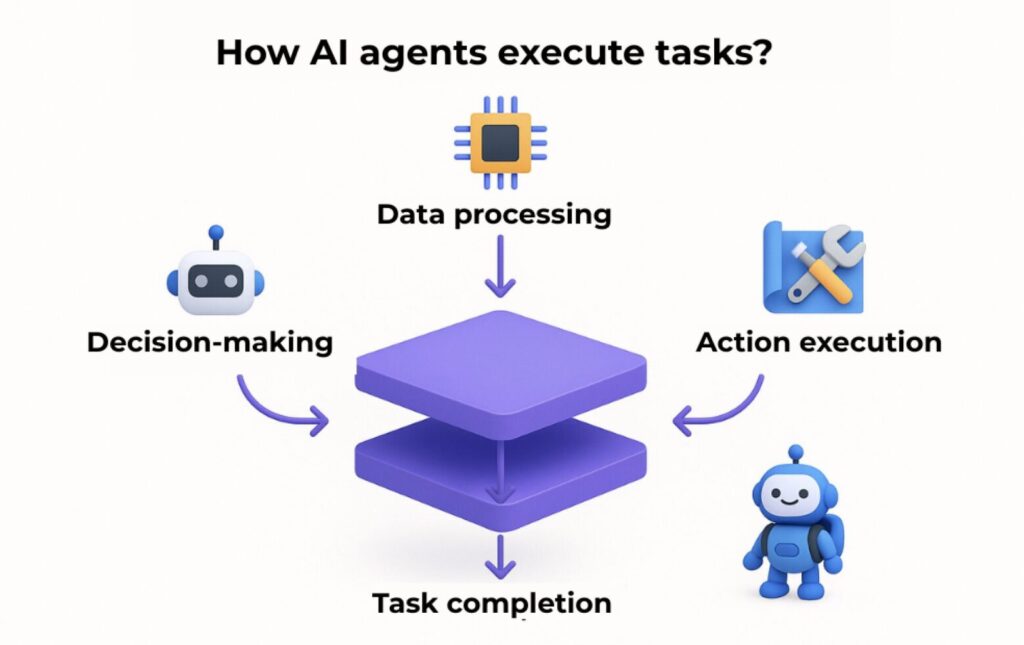
The steps are simple to describe, but complex to execute:
Collecting input
Agents take in raw signals from their surroundings. A camera provides vision. A microphone captures sound. LiDAR maps distance. Sensors track pressure, temperature, or movement. These inputs form the raw material of perception and it enables an AI powered agent to react.Processing the data
Raw signals are noisy. They need to be cleaned and transformed into features that the system can work with. In vision tasks, neural networks highlight edges, shapes, and objects. In speech, audio waves are converted into text.Recognizing patterns
Once cleaned, the data is interpreted. Machine learning models detect patterns and context. A transformer model can understand that “reset my account” is a request, while a robot can distinguish between a box on the floor and a person in its path.Deciding and responding
Perception in AI ends with action. A self-driving car applies the brakes when it detects a pedestrian. A customer support bot provides the right answer after understanding intent. The cycle is continuous, and the speed of this loop defines how effective the agent is. At its heart, perception is about turning messy, unstructured signals into meaning. The better the perception layer, the more reliable the agent’s decisions and the more value it delivers in real-world tasks.How different types of agents perceive the environment
Not every AI agent perceives in the same way. The depth and sophistication depend on the agent’s design and purpose.Simple Reflex Agents
These agents react to immediate stimuli with predefined rules. They don’t “remember” past inputs, their perception is limited to the here and now.Model-Based Reflex Agents
A step further, these agents maintain an internal model of the world. They track changes over time, not just moment-to-moment input.Goal-Based Agents
Here, perception is tied to objectives. The agent doesn’t just sense; it evaluates whether the current state aligns with its goals.Utility-Based Agents
These agents compare options using a utility function. They perceive, evaluate trade-offs, and choose the action that delivers the highest value.Learning Agents
Perception evolves with experience. These agents adapt based on feedback, refining their ability to sense and interpret over time.Multiagent Systems
Instead of one agent perceiving everything, multiple agents share the load. Each one contributes a piece of the puzzle, and together they form a collective understanding of the environment. Sensor fusion and collaborative learning make this approach especially powerful in dynamic settings like disaster response or distributed monitoring. AI perception, whether in a single agent or across many, is not just about raw sensing. It’s about context, memory, and purpose. The more advanced the perception layer, the more an agent can adapt, collaborate, and act in real-world business environments.AI agents in business
AI perception has already moved from research labs into everyday business operations. In many cases, you don’t even notice it, and that’s the point. When perception works well, it fades into the background, quietly improving reliability and speed. In healthcare, perception systems assist radiologists by scanning thousands of images and flagging subtle anomalies that a human eye might overlook. Of course, they don’t replace medical expertise, but they act as a second set of eyes that improves accuracy and saves time. Retail businesses use perception to track what’s happening on shelves and at checkout. Instead of waiting for manual counts or customer complaints, stores can see in real time when items are missing, when lines are too long, or when suspicious activity is taking place. Manufacturers apply perception to quality control. On production lines, computer vision systems inspect every unit for defects, reducing waste and catching issues before they scale. It’s the kind of vigilance that human inspectors simply can’t sustain at volume. And for accessibility, perception technology has been life-changing. Tools that convert speech to text or describe visual data allow people with hearing or vision impairments to interact more freely with the world around them. Across all these industries, the common thread is dependability. AI perception isn’t there to impress but instead to make processes safer, faster, and less reliant on human monitoring. When it works, you don’t see it. You just see the results. Isn’t it great?Possible challenges
AI perception may feel advanced, but in practice, it is far more fragile than most business leaders assume. The gap between a system that performs well in a controlled test and one that performs reliably in the real world can be huge. That gap comes down to the limits of perception. Ambiguity is one of the hardest problems. For example, a self-driving car can misinterpret a shadow across the road as an obstacle. A chatbot might read a sarcastic review as positive feedback. Humans handle these edge cases effortlessly because we bring context and experience. Machines don’t. At the same time, bias is another persistent headache. Perception systems learn from data, and if that data is skewed, the outcomes will be too. Facial recognition tools that misclassify certain groups are not just technical failures, they’re business and ethical liabilities. Privacy concerns can’t be ignored either. Systems that rely on cameras, microphones, and sensors inevitably raise questions about surveillance. The technology may work, but public trust can collapse if perception is seen as intrusive or misused. And then there’s the cost of accuracy. Real-time perception is computationally expensive, especially when scaled across fleets of vehicles, production lines, or customer interactions. Businesses often underestimate the infrastructure and energy demands that come with deploying perception at scale. These challenges aren’t side notes for engineers to solve later. They are business risks that must be factored into any adoption strategy. Companies that treat perception as “plug and play” will face surprises later, it’s guaranteed. Those who plan for its limits and invest in ways to manage them will be the ones who see lasting value.Wrapping up
Perception is the layer that turns AI from theory into practice. Without it, agents remain abstract programs. With it, they become tools that can engage with reality, adapt to change, and deliver measurable outcomes. For business leaders, the technical details of how models detect edges in an image or transform audio into text aren’t the priority. What matters is clarity around a few practical questions:- Which signals in your environment are most important to capture?
- How accurately and consistently can your systems perceive them?
- What decisions and actions are being driven by that perception?