
AI agents have moved from a “what if” experiment to the backbone of modern operations. Unlike chatbots that just respond, these systems anticipate, decide, and execute.
From healthcare to finance, leaders keep asking the same question: where they can get AI agents that truly deliver? That’s why we’ve put together a guide of the top companies driving AI agent development in 2026. Each has strengths worth noting. Let’s explore!What is an AI Agent?
Before we dive into the companies leading the industry, let’s pause on a simple question: What exactly is an AI agent? AI agents are autonomous software systems that use AI to pursue goals and complete work on your behalf. They combine reasoning, memory, and planning to make decisions, adapt in real-time, and keep getting better the more they’re used. Their strength comes from today’s foundation models and multimodal AI. That means they can process almost anything, including text, voice, images, video, even code, and turn it into action. For example, an agent might draft a report, approve a transaction, update a database, or coordinate across multiple systems. And when agents work together, they can orchestrate entire workflows, dividing tasks, sharing context, and completing complex processes without constant human supervision.Here’s how it works in practice:
Perception
Just as we use our senses to understand the world, an AI agent gathers information from its environment. That environment might be you as the user, or external systems like websites, databases, and apps. AI agents eventually can read text, parse audio, or even analyze images, then interpret patterns, intentions, and commands.Thinking
Once the agent has context, the information passes through its “brain.” That brain is built of three pillars:- Memory (to recall previous interactions),
- Knowledge (facts, training data, learned experiences),
- Reasoning (the ability to weigh options and choose the best course).
Action
The agent then acts: it might respond in text, schedule a meeting, call an API, or orchestrate a multi-step workflow across tools. The point isn’t just to answer, it’s to get your task done.Learning
And the loop doesn’t stop there. Each time an agent perceives, thinks, and acts, it gains experience. Over time, it adapts to context, becomes better at problem-solving, and even discovers new efficiencies no one explicitly programmed it to find. That’s why autonomous AI agents are so powerful. They’re so-called assistants, capable of scaling across industries and workflows.Agentic AI market: overview
The agentic AI market is no longer a niche. In 2024, it was valued at just USD 5.40 billion. By 2030, it’s projected to reach USD 50.31 billion, which is a nearly tenfold expansion in six years, growing at a CAGR of 45.8%. Few technologies in history have scaled this fast.
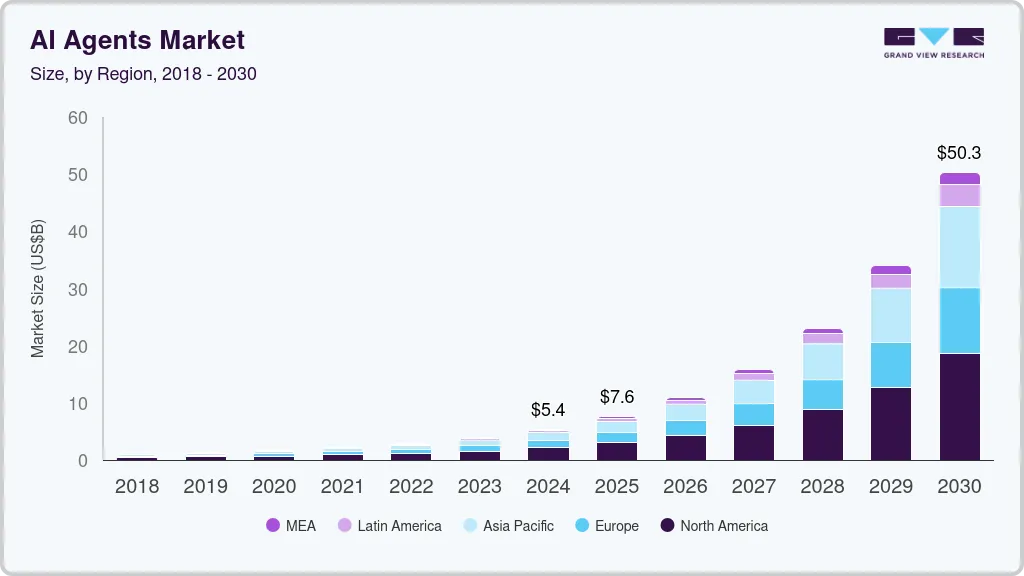
What’s behind that growth? A mix of forces:
- Automation pressure → Businesses need to cut costs and speed up decisions.
- Smarter language models → Advances in NLP let agents process complex instructions.
- Personalization demand → Customers expect tailored experiences, not one-size-fits-all service.
Technology insights
- Machine Learning leads today: accounting for 30.5% of global revenue in 2024. These algorithms let agents learn from data, adapt, and improve operational efficiency.
- Deep Learning accelerates tomorrow: expected to post the highest growth rate, fueled by breakthroughs in neural networks, big data, and computational power (with NVIDIA GPUs and CUDA at the core).
Adoption trends
- Ready-to-deploy agents held the largest share in 2024: companies want fast results without building from scratch.
- Single-agent systems dominated early adoption, but multi-agent systems are emerging to handle orchestration across entire business processes.
- Cloud platforms are making agent deployment cost-effective and scalable, lowering the barrier for mid-market players.
What it means for leaders
This market is maturing. The companies that win won’t be those dabbling with copilots and pilots, but those that rebuild workflows around agents at the core. The bottom-line impact of generative AI has been elusive, the so-called “gen AI paradox.” Agents are the solution of how that paradox gets resolved: not as reactive helpers, but as proactive collaborators capable of orchestrating entire processes and unlocking new revenue streams.Top best AI agent companies: AI agent development without stress
With that in mind, let’s look at the top companies for deploying AI agents and explore why some stand out by making them an asset.Altamira – Building AI Agents as a Second Workforce
Being “AI-friendly” is one thing, but what’s it like to be AI-native? With this partner, every client engagement starts with a simple question: how can intelligent agents orchestrate this process end-to-end? This means AI agents aren’t layered on top of existing workflows, they are the infrastructure. From discovery (agents map problems, generate prototypes, estimate ROI) to delivery (agents monitor, adapt, and improve), Altamira treats agentic AI as the backbone of operations. Why leadership teams choose Altamira?- AI that delivers → Every outcome is tied to hard KPIs: cycle time, compliance, error rate, throughput. As a result, teams stop playing with AI and start using it properly: in workflows, decisions, tools, where it matters.
- Second workforce → Agents evolve with every project phase and work 24/7, like a second workforce.
- AI at the core of everything → 40%+ of recurring tasks inside Altamira run on AI agents. 300+ hours saved for teams every month.
- Zero babysitting → Projects delivered without constant oversight. From AI tools to core systems, you get zero-headache solutions that don’t become your team’s problem.
- Always more than promised → Uncover additional wins you didn’t expect. Like the dispatch project, where Altamira hit a 35% time reduction, then unlocked another $250K in annual fuel savings.
As a result, you can cut operational costs by 40-50% through smart agent orchestration and automation, uncover hidden opportunities where AI can generate value,and unlock new revenue channels with agentic tools that extend customer reach and service capacity.
Most teams are stuck “playing” with AI, they use it for fun experiments or light content generation, not where it actually impacts revenue, risk, or speed. Altamira serve businesses that want to have the best AI agent in operations, without adding another tech project to babysit.Deviniti — GenAI Agents for Regulated Industries
Based in Poland, Deviniti focuses on self-hosted AI agents designed for security and compliance. They offer custom AI agent development, generative AI solutions, AI integrations, and model fine-tuning. Their value lies in control: you own the system, and you keep your data safe. Deviniti is strong for companies where regulation is the blocker.

Hippocratic AI – Agentic Healthcare at Scale
Healthcare is always understaffed and highly regulated, so Hippocratic AI has zeroed in on that pain point. Its agents don’t try to diagnose or treat. Instead, they take on low-risk but high-volume tasks: chronic care management, patient follow-ups, and wellness coaching. The genius lies in its Clinician Creator program. Licensed professionals can use Hippocratic’s no-code builder to design and deploy their own agents, and even publish them in an AI Agent App Store. This not only scales healthcare support but creates a new revenue model for clinicians themselves.

HatchWorks AI — Generative-Driven Development
HatchWorks, from Atlanta, brands its approach as generative-driven development. The idea is to weave GenAI into the software lifecycle from day one, using it to drive both design and delivery. They offer strategy, data engineering, and full-stack AI software development. Their strength lies in embedding AI into customer-facing apps, improving user experiences and revenue outcomes.

10Clouds — Using Gen power
Warsaw-based 10Clouds brings a consultancy-meets-delivery model. As many other AI agent development companies, their teams specialize in ML, NLP, and data science, building intelligent systems and integrating them into client workflows. What sets 10Clouds apart is its consulting-heavy approach. They advise on how to structure AI around decision-making, analytics, and insights. It’s a good fit for companies that want guidance plus delivery.

NinjaTech AI – SuperAgent for Everyday Productivity
Being one of the leading companies for enterprise AI agents, NinjaTech AI takes a different approach. Instead of focusing on enterprises or verticals, it built a SuperAgent that orchestrates more than 20 top-performing AI models (OpenAI, Anthropic, Meta, Google, etc.) into a single assistant. It’s less about enterprise-grade compliance and more about democratizing agentic power. Startups, small teams, and individuals looking for a versatile AI assistant will find NinjaTech appealing.

Beam AI – Modular Enterprise Automation
Beam AI focuses on enterprise operations, deploying modular, self-learning agents that can adapt to shifting business demands. Imagine multi-agent coordination across departments: one agent handling invoices, another managing logistics, a third optimizing procurement. Its prebuilt library of agents accelerates adoption, offering out-of-the-box AI powered solutions for customer service, finance, and healthcare workflows.

AgentOps AI – Observability for AI Agents
While most top AI agent development companies focus on what AI agents do, AgentOps focuses on how they’re built and monitored. It’s a developer-first platform offering time-travel debugging, real-time observability, and logging across multi-agent interactions. With integrations for 400+ LLMs and frameworks (LangChain, CrewAI, AutoGen, OpenAI SDK), AgentOps helps teams move from prototype to production without losing visibility. Its sweet spot is engineering-heavy companies that are already building custom agents and need to ensure reliability, cost control, and compliance.