
Digital education has come a long way from simple virtual whiteboards and online quizzes. Today’s EdTech platforms manage everything from personal data and academic records to payment systems and internal communications.
As these platforms become more deeply embedded in school infrastructure and more interconnected with external systems, they present a broader attack surface, making them a high-value target for cybercriminals. The combination of rich personal data and often under-resourced security measures turns the education sector into fertile ground for exploitation.See also: AI in Cyber Security: Benefits and Use Cases
Why EdTech security matters
At first glance, education may not seem like an obvious target for cyberattacks, but it quickly becomes one of the most vulnerable sectors.
Schools and EdTech companies hold a goldmine of sensitive information: student records, login credentials, grades, health data, and even payment details. Once stolen, malicious actors can sell it on the dark web, leak it for disruption, or lock it down in ransomware attacks that bring entire systems to a halt. The risks are even more acute in K–12 settings, where students often use devices without fully understanding digital threats. With minimal training and supervision, younger users can easily fall for phishing scams or unintentionally expose critical information, making them a weak link in the security chain. Centre for Internet Security reported that 82% of K–12 schools in the U.S. experienced a cyber incident between July 2023 and December 2024. In Europe, the situation doesn’t look much better either: 73% of the UK education sector has been hit by cyberattacks in the past five years. Unlike banks or healthcare providers, many educational institutions lack dedicated security teams or mature governance models, making them slower to detect and recover data from breaches. The mix of high-value data, under-resourced defences, and vulnerable users has created a near-perfect target for cybercriminals.Common EdTech security risks
Not all threats to EdTech systems are immediately visible. Some arrive through seemingly legitimate channels, like compromised user credentials or third-party integrations.
Others exploit overlooked vulnerabilities in the platform’s design or code. These blind spots are where many platforms fall short and where attackers strike.
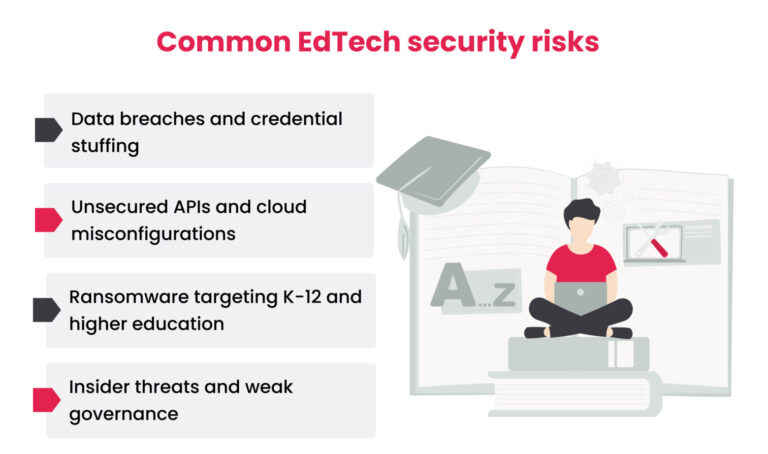
Data breaches and credential stuffing
A common entry point for attackers is simply logging in with stolen or guessed credentials.
If your platform allows weak or reused passwords, it’s only a matter of time before someone breaks in. Once inside, attackers can quietly scrape data, impersonate users, or escalate their access. This is called credential stuffing, which involves using previously leaked login details from other platforms. It is especially effective in education, where students and staff often recycle the same weak passwords across multiple systems.Unsecured APIs and cloud misconfigurations
APIs power the core functions of most EdTech platforms, such as connecting services, enabling integrations, and supporting user experiences. When left without protection or proper authentication, they become one of the easiest entry points for attackers.
Similarly, cloud storage misconfigurations like leaving access permissions too open can unintentionally expose sensitive files to the internet, making them accessible to anyone who knows where to look. In both cases, a single oversight, like weak access controls or skipped authentication checks, can result in a major breach, without the attacker needing sophisticated tools.Ransomware targeting K-12 and higher education
Ransomware attacks are increasingly disrupting educational institutions, locking down systems and halting operations.
Incidents like the shutdown of Highline Public Schools or the attack involving California-based PowerSchool are no longer isolated events; they're becoming alarmingly routine. In these high-pressure situations, schools face difficult decisions, sometimes even choosing to pay the ransom to resume operations quickly. While K–12 schools have suffered some of the most publicised breaches, colleges and universities are just as exposed. Attackers often rely on phishing emails tailored to students, such as fake login prompts or financial aid notices, to gain an initial foothold.Insider threats and weak governance
Not all threats come from the outside.
Lax access control, excessive administrative privileges, and insufficient oversight can create serious risks from within, whether through honest mistakes or malicious intent. An administrator downloading student data to a personal device, a teacher sharing login credentials, or a contractor receiving unnecessary system access can all lead to significant breaches. More often than not, these incidents are the result of governance failures, not bad actors. See also: How EdTech is transforming the classroomTips on building a secure education app
Security must be a priority from the very beginning of product development, before the first line of code is written, and the first feature is scoped.
While EdTech founders don’t need to be security experts, they must make thoughtful security decisions early and revisit them regularly. Here’s a practical guide to building your platform with security at its core.
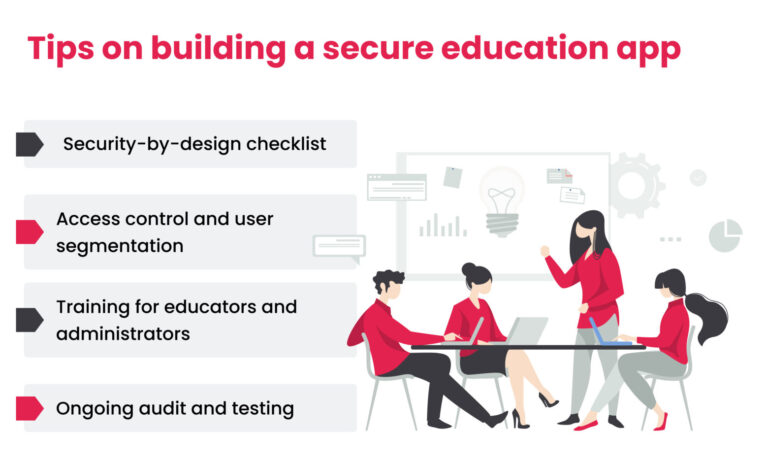
Security-by-design checklist
A secure app starts with solid foundations.
Data must be encrypted when in transit and at rest, passwords must be stored using proven hashing algorithms, and secure defaults must be used across your infrastructure. Don’t make assumptions, always validate user input, protect API endpoints with proper authentication, and limit third-party integrations to only those essential for your app. Most importantly, test thoroughly: just because a feature works doesn’t guarantee it’s safe.Access control and user segmentation
Not every user should have access to every part of your platform.
For example, teachers don’t need to see billing information, and students shouldn’t access admin panels. Clearly define user roles and enforce strict permission boundaries. Additionally, segment database access based on these roles to ensure that if one area is compromised, the breach doesn’t spread across your entire system.Training for educators and administrators
Even the best-designed system can fail if users don’t know how to recognise scams or protect their credentials.
That’s why it’s essential to provide clear, jargon-free training, teaching users how to spot phishing attempts, understand the importance of two-factor authentication, and respond when something seems suspicious.Ongoing audit and testing
Effective security depends on regular internal and external audits to uncover hidden risks.
This includes running penetration tests and continuously monitoring for unusual behaviour. When vulnerabilities are found, respond quickly and communicate transparently. A mature response plan not only satisfies regulators but also builds confidence and trust with your users.See also: How generative AI is transforming EdTech
Final words
Cybersecurity in digital education means building systems that students, educators, and institutions can truly rely on.
While there’s no one-size-fits-all solution, the common thread is clear: the safest platforms prioritise security from day one. Whether you’re building a new EdTech product or managing an existing one, you need to ask the hard questions early, fix the basics, and put the right guardrails in place. In digital education, trust hinges on how well you protect the people who use your platform.As Conor Gately, Altamira’s Managing Director (UK), explains:
As EdTech becomes more central to learning, it also becomes a more attractive target. This is about maintaining trust, not just about protecting data. When a school adopts new technology, they're entrusting us with their students' information, their teachers' work, and their institution's reputation.
FAQ
What are the four types of security education?Security education generally falls into four categories, each serving a different purpose:
- Security awareness. It helps people recognise common threats (like phishing or weak passwords) and know how to respond.
- Security training. It’s about teaching specific skills for handling threats.
- Security education. Broader and more formal, this often includes academic or professional programs. It covers principles, ethics, and theories behind cybersecurity, not just the how-to.
- Security drills and exercises. These are simulations or hands-on practice sessions, often used to test response plans and team coordination during real or staged incidents.
Cybersecurity in education is about protecting schools, universities, and online learning platforms from digital threats.
This includes securing student data, maintaining learning systems, and preventing disruptions. It also involves teaching staff and students how to spot and avoid common risks, since human error is often the weakest link. What is security education?Security education is the structured process of learning how to protect systems, networks, and data from threats.
It’s usually more in-depth than basic training, often part of a formal curriculum or professional development program. It’s not just for IT specialists either; as digital risks grow, many roles benefit from understanding how security works at a foundational level.