
Web solutions have become very common among various businesses. One can hardly find a company that won’t benefit from having a web portal. This type of software allows organisations to automate numerous processes and significantly increase employee, customer, and partner engagement with the business. But how much money does a company need to develop a handy web portal that will satisfy its needs? And what factors will influence the price?
In this article, we’ll try to answer all these questions and provide you with some basic info about web portals, their types, and functionality. Perhaps more importantly, we will explain what differentiates web portals from websites, as people still often confuse these two terms for the same thing.

What is web portal development?
To begin with, let’s define a web portal. Essentially, a web portal serves as a single access point to various types of information provided by a company. That information can be categorised and accessed by certain links. For example, a web portal will allow you to access company articles, product-related information, or vendor or supplier lists.
However, to access that information, you need to perform one crucial step: create an account or log in using your email and password. Web portal users can access various information provided by web portal owners. That information can be gathered from various sources and conveniently located in one place, making web portals very user-friendly. You can also communicate with other web portal users, in addition to accessing information.
Key differences between Web Portal and Website
When it comes to custom development of web solutions, many confuse a web portal with a website because they have some basic features. In particular, both are internet solutions accessible via a unique web address (i.e. URL). Yet, these web products serve different purposes, have their distinctive characteristics, and are not interchangeable.
Therefore, we have prepared a comparison table to help you understand what defines each of these web solutions. Let’s take a closer look at it to clarify everything.
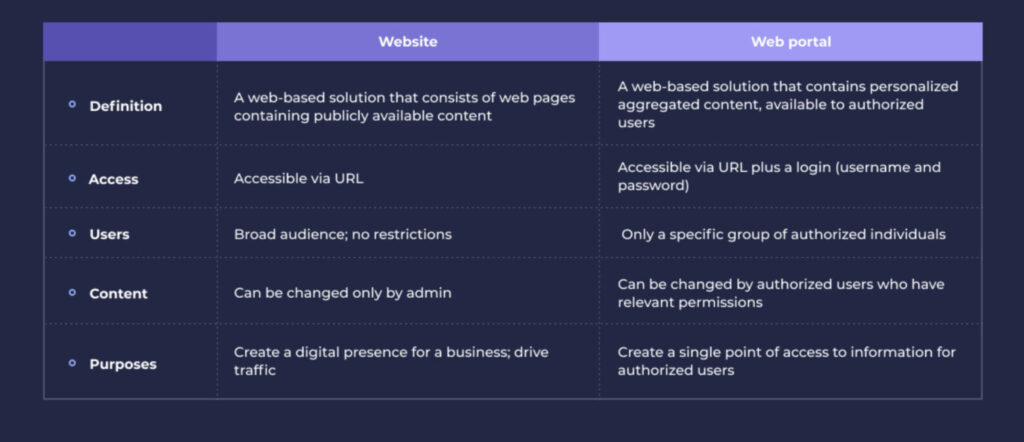

To sum up, a website is a platform that helps a business digitally present itself to the world and convey messages to everyone interested in its products or services. It doesn’t require active participation from users, but instead aims to highlight brand uniqueness and raise awareness of it.
Web portals have a narrower focus, as their primary goal is to provide specific information to particular individuals. Their content changes based on user input. While websites can offer static and dynamic content, web portals work only with dynamic content and always require authorisation from the user side. Now that you know all the key differences between web portals and websites, it is high time to examine the first one in detail.
New trend
These days, a new kind of solution has become extremely popular among business owners. We are referring to advanced, internal web-based portals, also known as omnichannel portals. This is a huge, unified technology centre that helps companies manage content, clients, various collaborations, knowledge, and save work templates, among other things. To learn more about omni-portals, read this article.

Common types of business web portals
As we’ve already mentioned, web portal development helps businesses create a personalised experience, share documents, and streamline communication & processes. Since every company needs to operate effectively, web portals can be utilised in various ways. In general, there are two main types of web portals.
Horizontal web portals
Several companies often use them. They are like their standard platform, which aims to provide all crucial information that users might need to know while searching for external services. Examples of horizontal web portals would be educational, governmental, and cultural ones.
Vertical web portals
They are also known as vortals. Companies utilise these web portals to provide users with tailored information related to their services. Companies can share something really specific that cannot be supplied in a usual website. Examples of such portals are college and bidding ones.
And now, let’s speak about more specific web portals that are oriented and geared towards specific purposes and have different target audiences.
Customer portal
By developing a customer portal, an organisation can not only take its customer support and sales process to the next level, but also get a chance to improve brand loyalty. Users of such a portal have the opportunity to place and track orders themselves, report problems, activate or deactivate services, receive personalised recommendations, review their purchase history, and perform many other tasks without needing to contact the company’s customer service representatives. This saves their time, increases satisfaction, and helps to build long-term relationships.
B2C customer portal
A B2C customer portal is a must-have tool if you are selling goods or services. Not only does it help drive sales by offering better customer service, but it also enables companies to establish long-lasting and loyal relationships that evolve into partnerships with their customers. Several key features should be present in your B2C portal: account creation and editing, intuitive yet advanced order placement, tools for checking and managing orders, multiple payment methods to enable every customer to complete the purchase conveniently and securely, personalised recommendations of goods or services, and reporting tools.
B2B customer portal
These days, companies that offer the same goods or services are competing for customers. That is why having a competitive advantage, such as a B2B customer portal, is so crucial. This product can help companies to offer well-organised customer self-service (meaning that personal touch and automation will be balanced), perform better post-order management, offer information to customers 24/7, create a personalised approach to each customer, offer flexible and convenient payment options, and implement advanced order management tools.

Employee portal
Building an employee portal should be one of the first steps for companies going through digital transformation. It’s like an internal social network where users can communicate, assign tasks, update each other on essential events, leave comments, log time sheets, request vacations, and more. Additionally, employee portals facilitate a smoother onboarding process for new hires, helping them integrate more seamlessly into the team. As a result, people collaborate more effectively and stay more engaged.
Partner portal
Companies do not exist in isolation; they must regularly cooperate with many other businesses. This is especially true for the real estate, travel industry, banking, healthcare, and logistics sectors. To conduct their activity successfully, organisations from these business niches need to ensure an ongoing process of information exchange, two-way communication, and constant involvement of all parties engaged. A partner portal is a valuable tool for making interactions with other businesses reliable, effective, and results-oriented.
Vendor portal
This type of portal is ideal for companies that require a powerful communication and data exchange platform to manage multiple vendors. Vendor management is crucial but time-consuming, so vendor portals are created to encourage self-service, reduce employee overload, and even save some costs. Vendor portals also facilitate easier and more effective department cooperation, as your employees can consolidate all vendor information in one place and access it when needed.
Membership management portal
This type of web portal will be beneficial for businesses that offer membership subscriptions, such as learning platforms. Besides the apparent benefits of self-service, such portals enable greater accuracy of members’ data at any given point in time, as users can update it whenever their personal information changes. In addition, the management of the customer base becomes almost entirely automated. Members receive all materials, including build training or any other plans for using a service, and monitor progress, payments, and other details with minimal manual administration effort on your part.
Web portals that are gaining popularity in 2025
Last year, the pandemic brought about many changes and challenges. Many business industries have had to rethink their strategies, approaches, and even the digital tools they use daily.
In a world where society was significantly constrained by virus outbreaks and people, for various reasons, found themselves stuck in their homes, it limited and changed many people’s daily lives. Working, studying, and training from home became widely popularised.
But it is hard to stay productive without reliable solutions. Therefore, the need for developing new web portals is a no-brainer. We have analysed the market and searched for new web portals that have appeared. Ultimately, we found that three key types of web portals are currently in demand. Let’s take a closer look at them.
Community portal
This type of web portal is created for groups of people who share the same interests and would like to build a network to share their experiences, ideas or specific matters. A community portal is a unique space where individuals from various parts of the country or city can engage effectively and create content related to their particular interests. The community portal should include a blog, forum, admin panel, media file support, and convenient communication tools like a built-in messenger. With the outbreak of the pandemic, people tend to use community portals more often since they help them feel less isolated.
E-learning portal
Needless to say, e-learning is not only a huge trend right now, but it is also a necessity that appeared due to lockdowns and the inability of students to attend colleges and universities in person. We all know how many e-learning apps you can find on the market, but what about web portals? They are way more convenient and do not require downloading. E-learning portals can provide access to various study materials, including video lectures, e-books and guides, presentations, interactive materials, and more. Such portals can be used not only by students but also by corporations to train their employees.
Good to know
Our experts have previously covered the topic of enterprise web portals used by companies of various sizes. Such solutions facilitate effective communication between internal departments within a company, enabling better management and information distribution. If you are interested in hearing about all the advantages of enterprise web portals and their website development, then read this post.
Key benefits of web portal development
It doesn’t matter for what business industry you are building a web portal since, after all, they all have the same key benefits that you should know of.
How to build a web portal
Let’s say you’ve decided to start developing a web portal for your business. The first thing you should know about the development process is that it will be quite challenging, time-consuming, and costly. People who are not related to the technical sphere often think that development consists of two main steps – building a web portal and creating its design. But in fact, it is way more complicated than that.
The development process consists of numerous stages and steps, and each one is crucial and indispensable. We have prepared information to help you better understand the web portal development lifecycle. And, without further ado, let’s check all the steps immediately!
#1 Preparations
Some people in the business sphere neglect this step because they prefer not to waste their time collecting data. They are eager to write specifications and start the development as soon as possible. However, this is a significant mistake that can lead to budget deficits and unforeseen risks.
The discovery phase is crucial for every project, especially for those as complex as web portals. Preparations should include the following steps:
Everything begins with the right question: “Who will use your web portal?” The answer to this question will help you identify your target audience, their key needs and pains and decide what kind of portal you need to develop. The discovery stage will also help you determine the major feature set and tech stack used.
Pro advice
Preparation or as we call it “Discovery Phase” is crucial and you should not skip it. We have already described the importance of preparation and the deliverables you can expect after it is completed. So we’d recommend you take a minute and read that post.
#2 Planning
After the discovery stage is complete, you will receive a thorough report from a Business Analyst and a draft of the initial project specifications. You will also be aware of the technology stack that will be used for your projects, the risks that may arise, the development time, and the approximate project cost. With all that information in hand, you can begin planning the development of your web portal. At this stage, it is crucial to break down large tasks into smaller ones, set deadlines, define the scope of work for each stage, and create more or less accurate work schedules.
#3 Design
The architecture of the web portal comes first; once it is ready, your team can create a look for your solution. Architecture can be made in the form of a sitemap describing the hierarchy of all pages in your web portal. It is also crucial to define the connections between those pages and then consider their look.
When making your web portal visually appealing, you should always keep your target audience in mind (and the type of web portal you want to create should also be considered). The selection of colours, icons, and other elements will depend on this. For example, the partner portal should be stricter, without bright colours and hideous elements, keeping it simple, professional, and organised. The portal for employees can be less rigid in style.
Once you and your designer reach a compromise, it is time to start prototyping. As a result, you will be able to take a glance at a preview of how your future web portal will look and make the necessary alterations and modifications if needed. Do not be mistaken; the design is just as important as the functionality of your web portal.
Related Topic
Some people think that web design and web development imply the same processes. However, it is not so. We recommend checking out the article on our blog, dedicated to the differences between web design and development, to ensure you are on the same page with your team.
#4 Development
To begin the development stage, you need a prototype and a site map of your web portal. With these things in hand, your development team can start coding and turning your idea into a real-life solution. The main goal of this stage is to get a product that looks, functions and feels exactly as you wanted and envisioned it to.
The first thing that will be developed is your web portal’s home page. Then, the team will proceed to create all the other necessary and important sections, buttons, and other elements of your portal.
At Altamira, we have developed several successful web portals for our clients’ businesses. So speaking about the web portal development part, we’d like to name some technologies that are going to be used:
Development from scratch will be performed using PHP
CMS-powered solutions can be built on WordPress or Salesforce
As to the team that will enable you to turn your idea into reality, it should include the following specialists.
#5 Testing and Release
Testing is a crucial part of any project development, as it helps identify all errors, weaknesses, and other bottlenecks in the solution and allows for immediate fixes. So rest assured that your web portal will be thoroughly checked and tested before being released. The portal's performance, navigation, registration, and account creation – all these and many other features will be tested. The goal of the testing is to ensure that everything functions properly and that the user experience is at its highest level.
It is also essential to verify the compatibility of your solution with various browsers. SEO and plugin installation (if you have a CMS-powered website) are also essential. Testers will verify that all plugins function correctly and that your web portal is optimised for search engines (SEO-optimised). Once everything is tested, works as intended, and is in order, you can launch your solution.
#6 Maintenance
Some business owners believe that once they have a perfect solution for their company, there is no need to invest further in it. After all, it works just fine, and it can feel as though it will continue to feel this way indefinitely, or at least for years into the future. However, the reality is that you need to improve your web portal and perform regular functionality checks continually. For instance, some plugins may stop working correctly over time. Alternatively, they may become incompatible and cause some functional issues.
Additionally, web portals should offer high levels of usability and engagement, which is why it is necessary to enhance them with high-level functionality and not overlook opportunities to add something new and exciting. Based on our experience, we can confidently say that maintenance is just as important as web portal development itself.
Web portal development services we offer
Altamira team has vast experience in building various web portals for different purposes and target audiences. All our clients can benefit from 2 key types of services that we offer.
Consulting services
Including marketing research, market competition research, thorough planning, selection of feature set and tech stack, writing of technical documentation (software requirements and specifications) and prototyping of your web portal.
Full cycle development
We develop web portals for a desired platform, integrate all required third-party services, assist you in mastering the new solution, facilitate its launch, and provide ongoing improvements and continuous support.
Our experience and approach to web portal development
Altamira is a highly experienced web portal development company that believes that examples speak louder than words. Therefore, we’d like to mention a couple of great web portals we’ve worked on. One of them was for an aircraft brokerage business, and the second one was for a company that provides services for deaf or hearing-impaired children (speaking of starting a company with a noble cause). Both companies had some productivity issues. Their employees were overloaded with tasks, and the order and request management was quite complicated.
Both businesses needed a digital optimisation to boost productivity and client service functions, and to improve communication and cooperation between their employees. We have developed functional web portals powered by the best available technologies to carry out these specific projects.
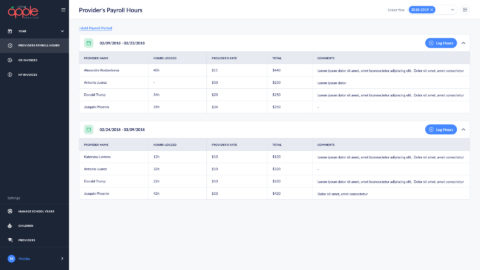
The solutions we’ve released work like a charm, and we’ve only received positive feedback from business owners who entrusted us with the development of their web portals. To provide you with some real examples of web portal functionality, we’ve prepared a couple of screenshots of one of our projects.

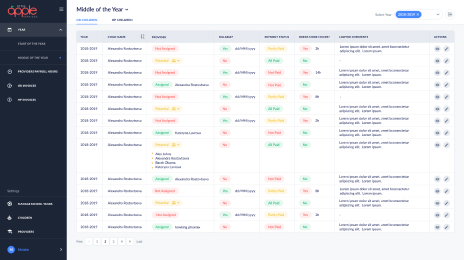
As you can see from the example, the web portal has advanced functionality. Not only can a person register, manage an account, and obtain information about necessary services and payments, but they can also manage invoices, school years, children's lists, and much more.
Various options can be combined in one solution to make the service offerings more transparent, organised, and convenient. Every necessary detail is right at the users’ fingertips. With just a couple of mouse clicks, you can access all the information.

Now, as to our approach to web portal development, we deliver not only high-quality products, but we also consider their integration into our clients' working environments. So, let’s say our client already uses a CRM or ERP; we have to ensure that the web portal can be successfully connected to them and transfer or receive all crucial data.
We also pay special attention to APIs since they can make a web portal even more functional. Among all the web portal development services we provide, the security and convenience of the end product are always our top priority. We always ensure that the web portal is easy to use, its functions are intuitive and useful, and the design aligns not only with the latest trends but also with the needs and requirements of the companies we work with.
The real web portal development cost
If you decide to work with a web portal development company from Ukraine, the average custom web portal development cost will range from $30,000 to $80,000. Of course, there is no ceiling to the cost, and the final price may be significantly higher if, for example, you require a highly complex solution with multiple user groups having distinct rights and permissions.
For a better understanding of the web portal development price and the amount of time required for its development, we have prepared a table. This table is relevant for the MVP (Minimum Viable Product) of a custom web portal development, so the price of a complete solution can be higher, as well as the total development time.
| Dev stages | Dev hours | Total cost |
| Specifications | 30 | $960 |
| Design | 25 | $975 |
| HTML/CSS | 36 | $900 |
| PHP Development 4 | 425 | $11475 |
| PHP Development 6 | 128 | $5248 |
| Testing | 178 | $3026 |
| Admin | 29 | $638 |
| SM | 81 | $1863 |
When choosing the type of contract, opt for a time-and-materials agreement rather than a fixed-price agreement. Web portal development typically takes some time, and your requirements may change; therefore, it’s a wise decision to remain flexible in terms of scope and budget.
Factors that influence web portal development price
Like with building any other bespoke software solution, there is no fixed cost for web portal development. Many factors can impact the budget required for a project. So let’s take a look at the most significant of them.
Functionality

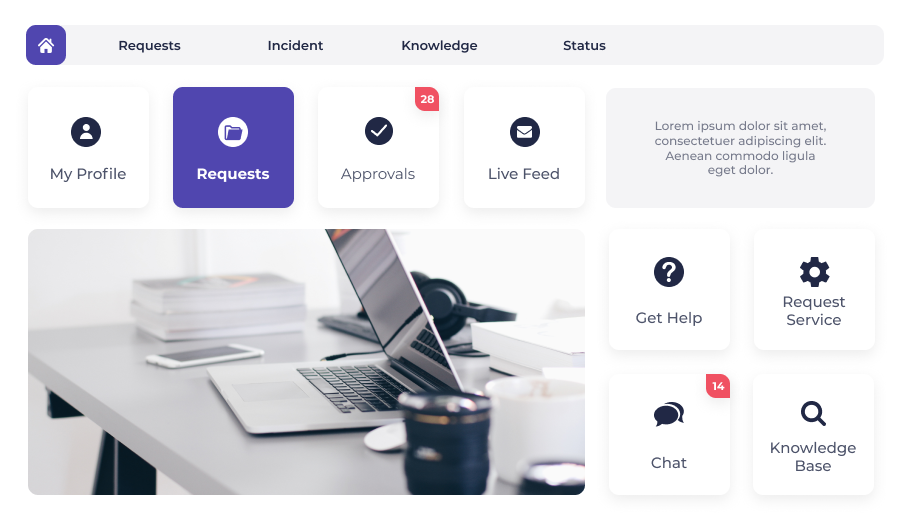
It’s up to you to decide what functionality to include in your web portal. But, naturally, the more complex you want it to be, the more money you’ll need. Here are the most popular features of web portals:
In addition, it’s important to ensure a system integration with third-party solutions as well as make a web portal powerful, maintainable, and scalable.
Outsourcing company vs freelancers
It’s another choice you’ll have to make at the very beginning. As a rule, freelancers charge less; however, there are numerous risks associated with this type of cooperation model. For instance, independent programmers frequently fail to meet deadlines or quit the project midway. So a low price oftentimes ends up coming at a high cost. That’s why it’s better to entrust and delegate web portal development to a reliable IT outsourcing partner.
Developers' seniority levels
Senior engineers have higher hourly rates than do their junior colleagues, but the latter ones usually work more slowly/less effectively. Ideally, you would have a coding team composed of programmers of different levels of seniority. If you envisioned a complex and long-term project, hiring a dedicated team might be the best option.
Programmers' geographic location
It’s not a secret that developers’ rates differ depending on the region of the world. Programmers from the US are believed to be the most expensive, charging approximately $100-200 per hour, while engineers located in Asia may cost as little as $15-40 per hour. However, developers from Asia have a reputation for delivering lower-quality products. Therefore, it’s better to choose Eastern European programmers who offer a superior price-to-quality ratio, with hourly rates ranging from $25 to $40.
To wrap it up
Today’s business world is driven by technology, so web portal development is a must for any company that wants to stay competitive. In general, portals can be used in many areas of an organisation, for instance, customer support, business partnerships, or internal collaboration.
The exact costs you’ll need for the project will depend on numerous factors such as the development method you will choose, product complexity, developers’ seniority levels, and their geographic location. Our recommendation is to choose a coding team from Ukraine to get superior quality for a reasonable price.
FAQ
How much does a web portal cost?The cost of a web portal depends on what you’re building. A basic internal tool and a full-scale customer-facing platform don’t live in the same budget range. Key factors include:
Scope – How many features? How complex are they?
Team – Are you hiring freelancers, a dedicated agency, or building in-house?
Timeline – Rushed projects often cost more.
Integrations – Connecting with third-party systems can add extra layers of work.
So, the cost is less about “how much” and more about “how much are you building?”
How much does it cost to build a portal?It depends on your requirements. Building from scratch gives you full control, but it also means starting with nothing: planning, design, development, testing, deployment, support — it all adds up.
You’ll want to think about:
User roles and permissions – Will different types of users see different things?
Data Handling – Are You Storing Sensitive Data? That affects how it’s built.
Admin tools – How much control will your team have behind the scenes?
Mobile access – Should it work seamlessly on tablets or phones?
Scalability – Is this a one-off tool or the first step in something bigger?
Bottom line: building a portal is less about ticking boxes and more about figuring out what problems it needs to solve — and how robust the solution needs to be.