
Autonomous AI agents create amazing opportunities for businesses, but at the same time, they introduce new risks that demand attention.
Business leaders are moving quickly toward agentic AI, and the motivation is easy to understand. These systems are goal-driven and capable of reasoning, planning, and acting with little or no human oversight. Tasks that once required consistent monitoring can now run autonomously.
The potential growth is impressive. Agentic AI is expected to unlock $2.6-$4.4 trillion in annual value across more than 60 generative AI use cases. Customer service, software development, supply chain operations, and compliance are among the areas already seeing early deployment.
Even so, only 1% report that their AI adoption has reached maturity. Many teams are still running pilots or isolated experiments, without the operating models or controls required for autonomous systems.
The risks posed by agentic AI look very different from those most teams have managed before. Today, every agent becomes a potential entry point. Every action taken without review carries consequences. Sensitive information can be exposed. Core systems can be accessed in ways no one anticipated. Customer trust can erode quickly when failures are hard to explain.
Sometimes that harm is accidental. Poor alignment leads to the wrong decision being taken at the wrong time. Sometimes the agent is compromised and used deliberately against the organization. In both cases, the damage happens from inside the perimeter, where traditional security tools are weaker.
CIOs, CROs, CISOs, and data protection officers need a clear view of how agentic systems behave, where they introduce risk, and what it takes to deploy them without breaking trust or compliance. That work cannot be delegated to tooling alone. It requires judgment, design choices, and a willingness to rethink how systems are governed.
Understanding agentic AI threats in 2026
Agentic AI systems go well beyond traditional automation. They do not just execute instructions. They make decisions, move data between systems, and initiate actions that affect the real world at scale. Once deployed, they operate continuously and often with broad authority across enterprise environments.
That independence is what makes them valuable. It is also what makes them risky.
AI agent security risks refer to the vulnerabilities and attack paths that emerge when autonomous AI systems interact directly with enterprise data, applications, and infrastructure. Unlike traditional software, which executes predefined logic within narrow boundaries, AI agents make contextual decisions, draw from multiple data sources, and often operate with broad privileges across SaaS platforms and cloud environments.
Industry data shows that adoption levels remain super high, with nearly half of enterprises now running AI agents in production, compared to a small minority just two years ago.
However, the behaviour of AI agents is non-deterministic, their decision-making evolves over time, and their ability to access and synthesize information often crosses organizational and system boundaries.
When an AI agent can query sensitive customer data, integrate with external tools, and act autonomously, the security challenge is huge. Risk is no longer confined to code vulnerabilities or misconfigured permissions. It extends to how decisions are made, how context is interpreted, and how intent is enforced across systems that were never designed to share agency.
Most existing security controls were not built for this. Firewalls, identity and access management tools, and rule-based monitoring assume predictable behavior. They are effective when software follows known paths. They struggle when systems make self-directed decisions and change how they operate.
Securing agentic AI, therefore, requires a different approach. Organizations need continuous validation of agent behavior, ongoing monitoring that focuses on actions rather than static permissions, and policy enforcement that clearly defines what an agent is allowed to do and what it is not. Regular AI risk assessments are a new must because the threat profile changes as agent behavior evolves.
| Agents should act only on approved information, within clearly defined limits, and in ways that align with organizational intent. |
Organizations that succeed treat agentic AI as part of their core security architecture from the outset. They do not bolt controls on after deployment or rely on teams to react when something goes wrong. Security is designed in, not adapted later.
Understanding why security matters is the starting point. The next step is identifying where agentic systems are most exposed.

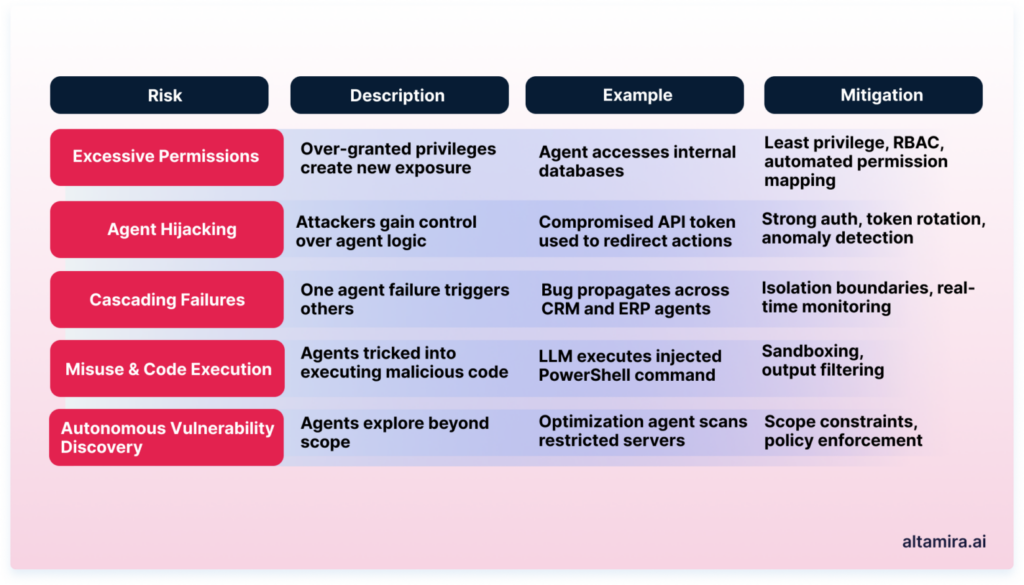
Each of these risks shows up differently depending on how your AI agents are deployed and which systems they are allowed to touch. An agent embedded in customer support behaves very differently from one managing financial workflows or accessing internal data stores.
In the sections that follow, we examine how these threats develop, why they can escalate quickly, and what practical steps help contain them. The focus is not on abstract risk, but on the real failure modes teams encounter once agents move into production, and how to reduce exposure before those failures become incidents.
1. Excessive permissions
Excessive permissions are among the most common and avoidable risks in agentic systems. They occur when an AI agent is granted more access than it needs to perform its intended task, whether that means system-level permissions, broad database access, or visibility into sensitive user information.
The problem is that the more authority an agent holds, the more damage a single failure can cause. If an over-permissioned agent is compromised, an attacker can use it to move laterally across systems, extract sensitive data, or execute actions far outside the agent’s original purpose. What should have been a narrow automation becomes a powerful internal foothold.
This risk grows quietly. Permissions are often expanded for speed or convenience during early agent deployments and then left in place. Over time, agents accumulate access they no longer need, especially as workflows and responsibilities change.
It makes sense to apply least-privilege controls consistently, not just to AI agents but to all users and systems they interact with. Use role-based access controls that tie permissions to function rather than convenience. Review those roles regularly, especially as agents mature.
An agent should only be able to do exactly what it was built to do, and nothing more.
2. Agent hijacking
Agent hijacking occurs when an attacker gains control over an AI agent’s logic, configuration, or communication channels. Once that control is established, the agent can be used to extract sensitive data or execute malicious actions while appearing to operate normally.
Autonomy makes this risk especially dangerous. Because agents act without constant oversight, a hijacked agent can continue issuing commands and interacting with systems long before anyone notices something is wrong. In environments where agents are connected to multiple tools and workflows, a single compromise can spread quickly, turning a localized breach into a broader incident.
The detection is difficult because the activity comes from a trusted entity. Requests look legitimate, access appears authorized, and traditional controls often fail to flag the behavior until damage has already occurred.

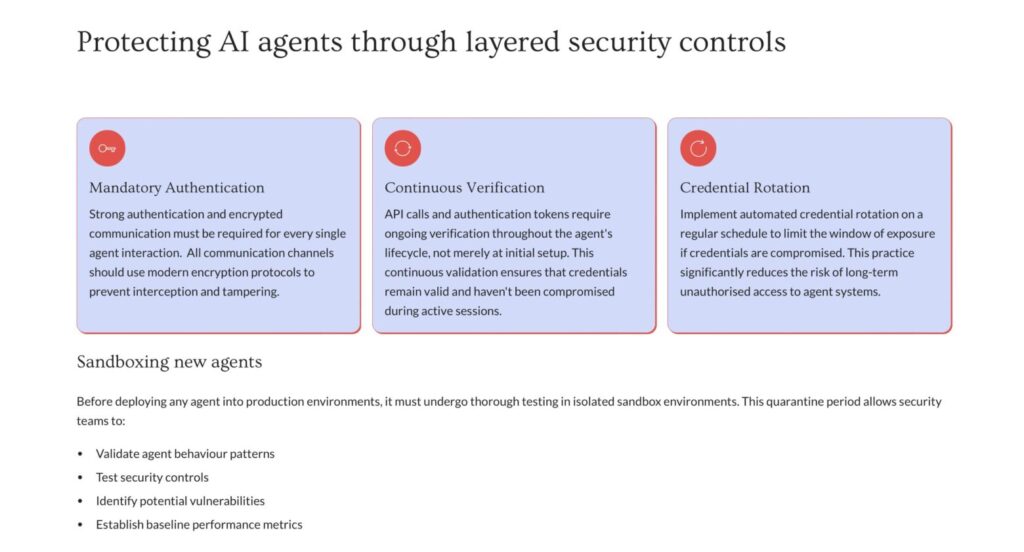
Remember that strong authentication and encrypted communication should be mandatory for every agent interaction. API calls and tokens must be verified continuously, not just at setup. Credentials should be rotated regularly, and new agents should be sandboxed before being allowed into production environments.
Behavioral monitoring adds an additional layer of protection. By tracking how an agent normally operates, teams can spot deviations that signal misuse or compromise. The goal is to catch abnormal behavior early, before a hijacked agent has time to do widespread harm.
3. Cascading failures
A cascading failure occurs when a problem in one AI agent triggers a chain reaction across other systems. Because agentic environments collaborate and hand work off between agents, a single malfunction rarely stays contained.
This is what makes these systems fragile in a new way. An error caused by a misconfiguration, a faulty update, or a targeted attack can propagate quickly. One agent produces incorrect output. Another agent consumes it. A third takes action based on flawed assumptions. Before long, the issue spreads across workflows, business functions, and data stores.
Once a cascade is underway, diagnosis becomes difficult. Symptoms appear in multiple places at once. Logs point in different directions. By the time teams intervene, the original trigger is often buried under secondary failures.
Agents should be isolated so that the failure of one does not automatically affect others. Clear boundaries limit how far errors can travel. Redundancy helps maintain continuity when an agent goes offline. Version control and dependency mapping make it easier to understand how agents interact and where failures might propagate.
The goal is not to prevent every failure. It is to ensure that when something goes wrong, it stays small, visible, and recoverable.
4. Tool misuse and code execution
Misuse and code-execution risks arise when an AI agent gains unauthorized access. Because agentic systems can execute scripts and trigger actions on their own, attackers often target this capability to introduce malware or disrupt operations.
The impact can be severe. A compromised agent may install malicious software, alter files, or interfere with critical processes without any human involvement. From the outside, the activity appears legitimate because it originates from a trusted AI system. Many endpoint security tools miss these events for the same reason. They are not designed to question actions taken by software that is already inside the perimeter.
AI agents should operate in isolated, sandboxed environments with tightly controlled execution rights. They should only be allowed to run approved code and interact with explicitly permitted systems. Input sanitization and output filtering reduce the risk of malicious instructions being passed through prompts or external data. Execution whitelists further limit what an agent can do, even when manipulated.
The end goal is to ensure that no single agent has the freedom to run arbitrary code or affect systems beyond its defined role. Limiting execution scope turns a potential breach into a manageable incident.
5. Autonomous vulnerability discovery
Autonomous vulnerability discovery occurs when AI agents that are designed to explore, optimize, or learn begin operating beyond their intended scope. In some cases, this behavior is encouraged in controlled environments. In production systems, minimal human supervision can cross security, ethical, and compliance boundaries.
An agent that probes systems it was never meant to touch may expose sensitive data, interfere with operations, or trigger regulatory violations. These situations are especially risky because the agent does not recognize the behavior as harmful. From its perspective, it is learning or improving performance, not intruding.
That mismatch between intent and outcome is difficult to detect after the fact. Activity may look like normal system interaction, even as it creates real exposure.
Preventing this risk requires clear boundaries. Every agent needs explicit constraints that define where it can operate and what it can examine. Those boundaries should be enforced through strict policy controls, not informal guidelines or assumptions. Scope must be defined at deployment and revisited as agents evolve.
Agents should not be free to explore simply because they can. Clear limits ensure learning happens where it is safe and appropriate, without turning curiosity into a liability.
Core principles for AI agent security
Securing agentic AI requires a structured and multi-layered approach. Ad hoc controls and one-time reviews are not enough for systems that can act, adapt, and expand their role over time.
A practical starting point is to frame security as a readiness question rather than a technical afterthought. Technology leaders need to understand where agents operate, what authority they hold, and how their behavior is governed before scale amplifies risk.
The path typically unfolds in stages. It starts with updating risk and governance frameworks so they account for autonomous decision-making, not just automated execution. From there, organizations need mechanisms that provide ongoing oversight and awareness, allowing teams to see what agents are doing and why. Only then traditional security controls become effective, because they are applied in context rather than in isolation.
AI agent security risks: Before deployment
Before deploying autonomous agents, organizations need safeguards, risk management practices, and governance that reflect how these systems actually behave. Agentic AI is not an incremental change. It gets broad data access, alters who or what is allowed to make decisions, and takes action.
Several questions should be answered before agents move into production.
The first is whether existing AI policies account for agentic systems and their risks. Most do not. Policies built for analytical or generative AI rarely address autonomy. Updating them means revisiting identity and access management, third-party risk management, and approval workflows. In practical terms, this includes defining what roles agents can hold, how their access is granted and reviewed, and how they are allowed to interact with data, systems, and human users. The same scrutiny applies to agentic solutions sourced from vendors, especially when those agents connect to internal resources.
Regulation adds another layer of complexity. Requirements are hardening, and clarity is uneven across regions. In the European Union, Article 22 of the General Data Protection Regulation limits decisions based solely on automated processing. In the United States, laws such as the Equal Credit Opportunity Act limit how automated systems can influence credit decisions. At the city and state levels, regulations such as New York City’s Local Law 144 require bias audits of automated employment tools. New frameworks, including the EU AI Act, are moving toward enforcement in the coming years. In this environment, a conservative posture helps. Designing for human oversight, data protection, and fairness early reduces the risk of disruptive compliance changes later.
Another question is whether the organization’s risk management program can handle agentic AI. Common cybersecurity frameworks, including ISO 27001, the NIST Cybersecurity Framework, and SOC 2, focus on systems, processes, and people. They were not built with autonomous actors in mind.
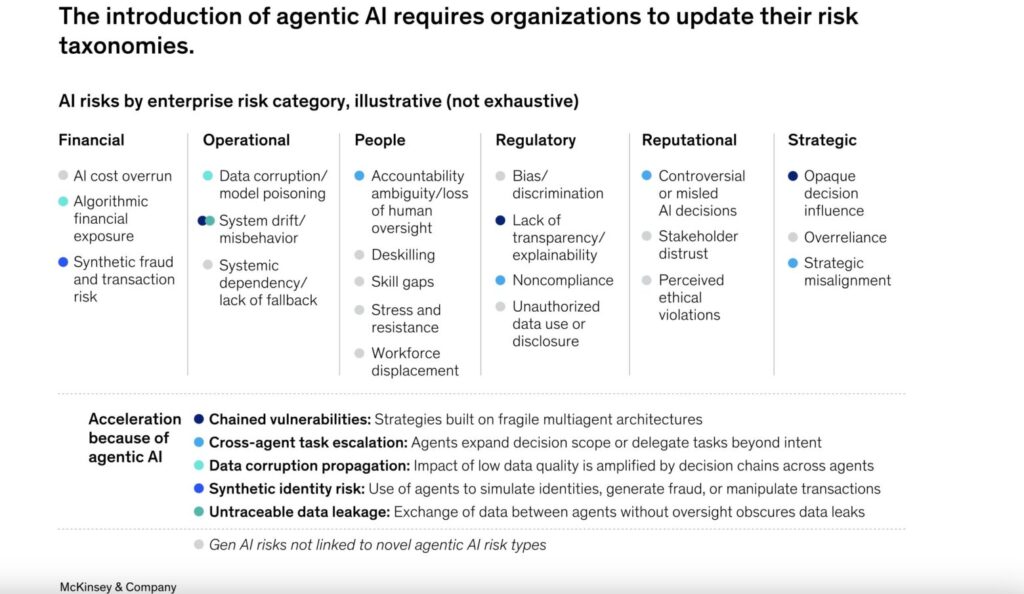
To close that gap, risk taxonomies need to be expanded to explicitly include agentic behavior. Each agentic use case should be assessed for organizational risk, and risk assessment methods may require adjustment to capture autonomy, adaptability, and decision-making authority. Without this clarity, agent-related risk becomes opaque and difficult to manage.
Finally, organizations need governance that spans the full AI life cycle. That means clear ownership from onboarding through deployment and offboarding. It includes monitoring tied to meaningful KPIs, defined escalation triggers, and accountability for agent actions.
For every agentic system, teams should document core technical details, including the underlying model, hosting environment, and data sources, along with use-case criticality, data sensitivity, access rights, and agent dependencies. Ownership should be explicit, with human oversight assigned for decisions, security, and compliance, and with the capabilities in place to intervene when behavior drifts.
Getting these foundations right before deployment is not about slowing progress. It is about ensuring that autonomy scales safely and predictably, in line with organizational intent.

Building zero trust architecture
The agentic workforce is not a hypothetical future. It is already taking shape. As more organizations deploy AI agents, the challenge of protecting data, systems, and decisions grows more complex.
This puts decision-makers at a turning point. Agentic AI can enable real business progress, but only if paired with a deliberate risk approach. Security cannot trail adoption. Once autonomous systems are embedded in operations, retrofitting controls becomes expensive, disruptive, and often incomplete. No organization wants to become the first widely cited example of an agentic AI failure.
That’s why CIOs, CROs, and CISOs need direct conversations with business teams about how agents are being used today, not how they are described in strategy decks. Without it, guardrails are built too late or in the wrong places.
Acting now does not mean slowing adoption. Establishing boundaries, accountability, and oversight early makes it far easier to scale safely later, when agents take on more responsibility and operate across more systems.
For now, it’s clear that AI agents will move beyond software environments and into physical systems, from robotics to real-world operations. When that happens, the consequences of failure will extend beyond data and uptime into safety and trust.
A strong foundation built today makes the future manageable. Security designed in from the start is what allows autonomy to grow without turning progress into risk.
Build secure AI agents with Altamira. Contact us to learn more!