

As systems age, they tend to lose reliability, introducing errors, vulnerabilities, and operational inefficiencies that can restrain public-sector organizations from achieving their core missions. To stay effective, organizations must rethink how new solutions fit into their existing technology stack.
Legacy modernization is an ongoing effort to support outdated systems and refresh aging data infrastructures. The goal is to improve data consistency, reduce the complexity of IT environments, and streamline day-to-day operations. Done well, it allows organizations to benefit from the flexibility and responsiveness of modern technology while retaining the value embedded in their existing systems.
What is legacy modernization market in 2026?
Legacy modernization has moved beyond a passing trend and is now a fundamental transformation in how enterprises allocate IT budgets.
According to research, the legacy software modernization market increased from $13.02 billion in 2024 to $15.14 billion in 2025, reflecting a 16.2% CAGR, and is projected to reach $27.3 billion by 2029 at a 15.9% CAGR.
Other estimates from Data Horizon Research place the broader legacy application modernization market at around $24.8 billion in 2024, with forecasts pointing to $64.4 billion by 2033, representing an 11.2% CAGR.
North America remained the largest market, generating 37.50% of total revenue. At the same time, Asia Pacific recorded the fastest growth, with a 15.89% CAGR, supported by large-scale digital transformation efforts across India, China, and Southeast Asia.
Re-platforming accounted for the largest share among modernization approaches at 32.45% in 2025. Meanwhile, re-architecting is expected to see the highest growth, with a projected CAGR of 23.10% between 2025 and 2030.
Services continued to dominate the market, representing 58.60% in 2024, which reflects the complexity and long-term nature of transformation initiatives. However, software tools, particularly AI-assisted code analysis and automated pipeline generation, are gaining momentum, growing at a 16.37% CAGR as organizations seek to reduce dependence on costly consulting engagements.
Why is legacy modernization important?
As technology matures, organizations that rely on outdated systems often struggle to maintain efficiency and remain competitive.
Modern platforms improve adaptability, lower operating costs, and deliver better user experiences, all of which support long-term growth and relevance.
While many teams begin by updating individual legacy applications, in practice, a broader transformation is often required to streamline workflows and support more advanced, AI-driven operations.
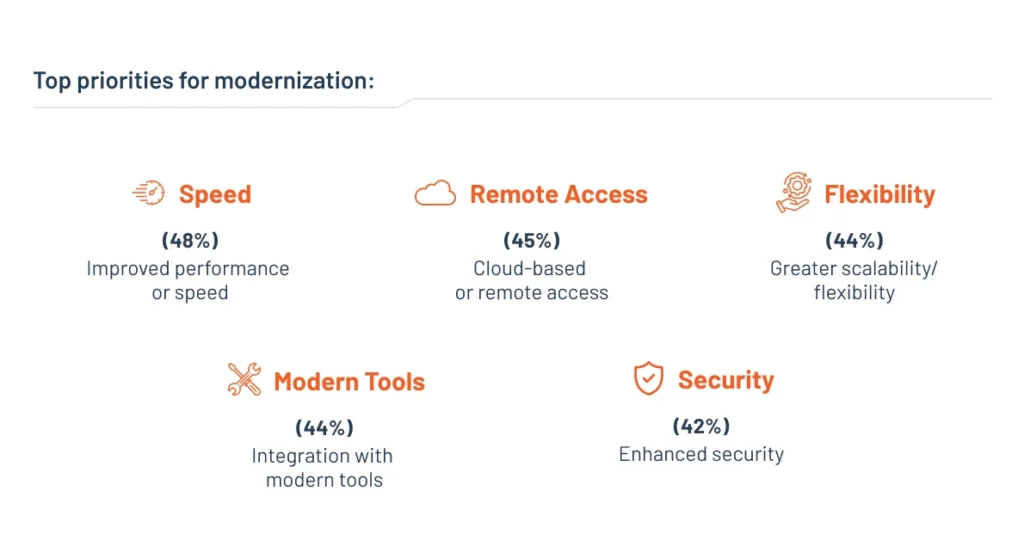
Image source: Saritasa
Why do organizations hold on to legacy systems?
Before looking at how modernization happens, it helps to understand why so many organizations remain tied to existing systems.
The most common reason, highlighted in the Saritasa survey, is straightforward: “the current system still works.” Half of the respondents identified this as the main factor holding them back.
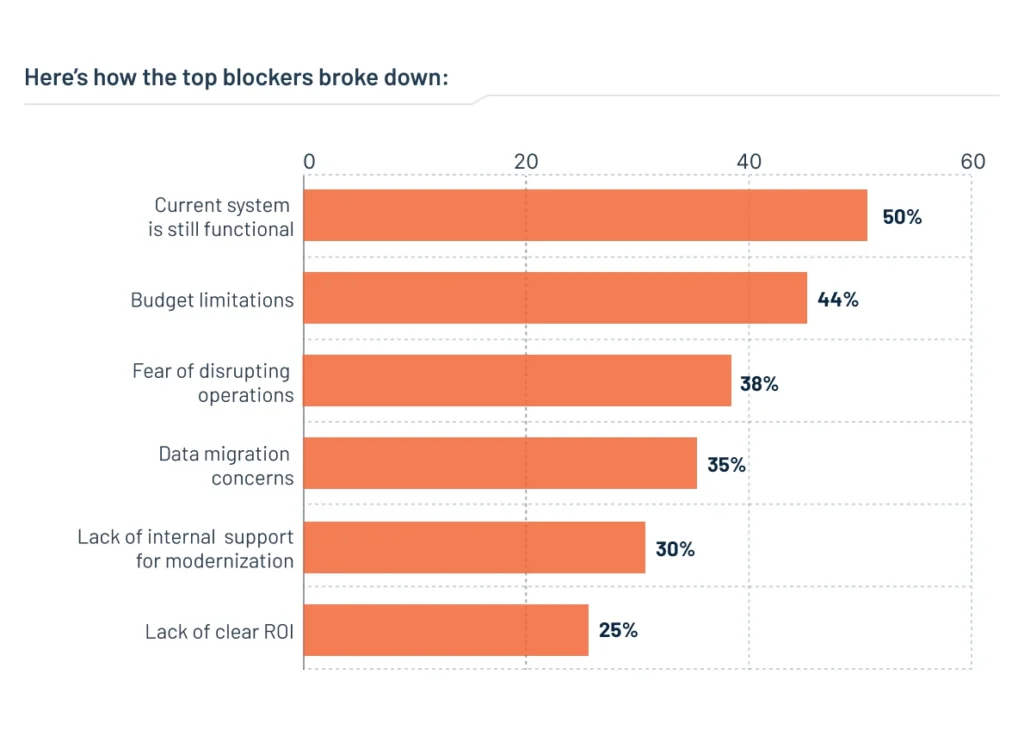
Image source: Saritasa
At first glance, this seems reasonable. If a system handles transactions, produces reports, and supports daily operations, there is little urgency to replace it. The “if it works, don’t fix it” mindset is deeply rooted in enterprise IT.
However, functioning is not the same as performing effectively. A system may continue to operate while quietly increasing maintenance costs, exposing security gaps, frustrating internal teams, and limiting the ability to adopt technologies such as AI, automation, and advanced analytics that competitors are already using.
Other factors also contribute to the delay in modernization. Organizations often face high upfront costs and view migration as a high-risk effort.
There is frequently a shortage of specialists who understand both legacy environments and modern technologies. In addition, business logic built up over the years can be difficult to untangle and replicate, while the risk of disrupting daily operations during the transition adds another layer of hesitation.
These concerns are valid. At the same time, the cost of postponing action continues to increase.

The real cost of keeping legacy systems alive
Legacy systems are costly to maintain, and those costs tend to rise over time.
The U.S. Government Accountability Office reported that federal agencies allocate around 80% of their IT budgets to maintaining legacy systems, with some critical platforms exceeding 30 years in age. The ten systems most in need of modernization alone account for roughly $337 million in annual operating and maintenance costs.
The private sector faces a similar challenge. Industry data shows that enterprises typically spend between 60% and 80% of their IT budgets on sustaining outdated systems, leaving limited resources for innovation. Gartner projected that by 2025, companies would direct up to 40% of their IT budgets toward managing technical debt.
And the financial burden is only part of the picture. Here is what else legacy systems cost you:
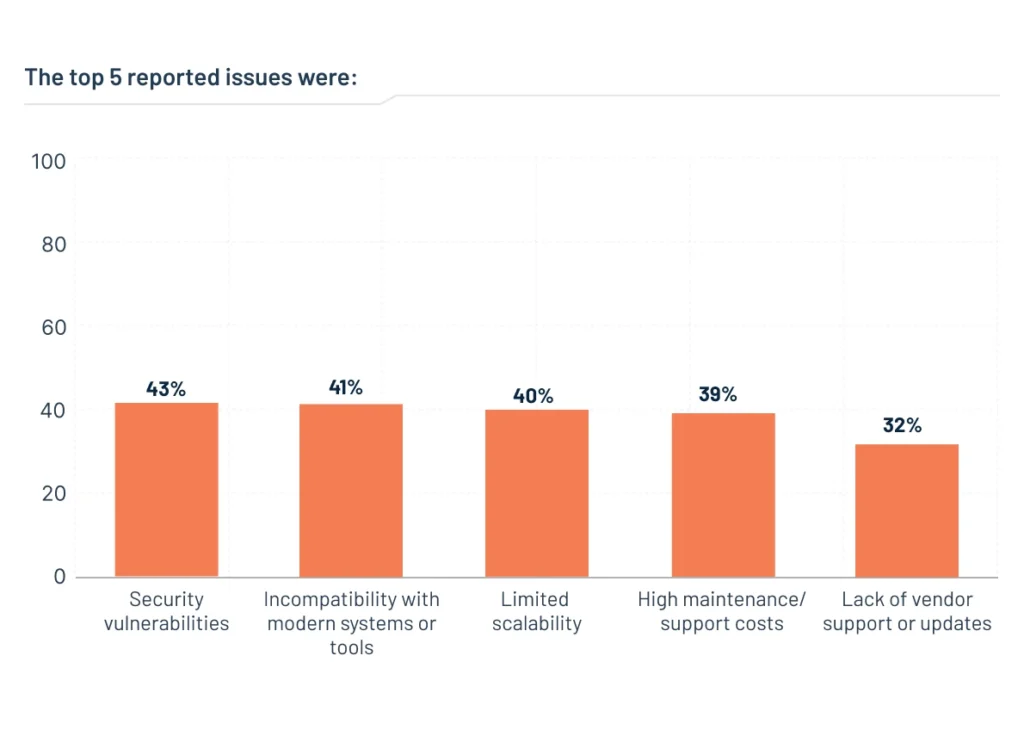
Image source: Saritasa
- Security exposure. Legacy systems are frequent targets for cyberattacks, largely because they rely on unsupported software that no longer receives patches or updates. Research from IBM’s Cost of a Data Breach report found that the average cost of a financial data breach reached $6.08 million in 2024, the highest across industries. Outdated systems were also shown to have three times as many vulnerabilities as modern environments.
- Talent drain. The pool of specialists who can maintain legacy systems is shrinking. By 2025, the average COBOL programmer was expected to be around 70 years old, with most projected to retire by 2030. In 2024, fewer than 2,000 new COBOL developers graduated worldwide. When critical knowledge depends on a handful of individuals nearing retirement, continuity becomes a real risk.
- Productivity loss. A survey by Stripe found that developers spend an average of 13.5 hours per week, nearly one-third of their time, dealing with technical debt. When asked how much time is effectively lost to maintaining poor legacy code, the average estimate rose to 17.3 hours per week, or more than 40% of the workweek spent maintaining existing systems instead of building new capabilities.
- Compliance risk. Regulations such as GDPR and HIPAA continue to evolve, introducing stricter requirements for data handling, privacy, and security. Most legacy systems were not built with these standards in mind, and adapting them to meet current expectations is both complex and unreliable.
- Missed opportunity. The highest cost is often what remains out of reach. Capabilities such as AI, machine learning, advanced analytics, and real-time data processing depend on well-structured, accessible data. Legacy environments, with fragmented databases and rigid architectures, struggle to support these needs. Each delay in modernization gives competitors more time to move ahead.
Benefits of legacy modernization
Modernizing legacy systems creates a more resilient and adaptable technology foundation, enabling organizations to operate more efficiently while preparing for future demands.
Risk management: Reduces exposure to security vulnerabilities and helps maintain compliance with current regulations and standards.
Business agility: Enables faster response to changing market conditions and evolving customer expectations.
Cost reduction: Reduces the ongoing costs associated with maintaining and supporting outdated systems.
Enhanced user experience: Introduces more intuitive interfaces, improves user satisfaction, and ensures smoother integration across systems.
Signs your organization needs legacy modernization
Not sure whether your systems fall into the “legacy” category? There are clear indicators that IT leaders should pay attention to.
If your systems rely on technologies such as COBOL, FORTRAN, or Visual Basic - languages that are no longer widely taught or supported, it is often an early warning sign. Maintenance costs may also be steadily increasing, taking up a disproportionate share of your IT budget.
Other signals include difficulty integrating with modern tools, APIs, or cloud services without relying on fragile and costly workarounds, as well as dependence on a small number of individuals who fully understand how the system works.
If vendor support has ended, scalability is limited, or the system cannot keep up with growing data volumes and user demands, the risks become more pronounced.
You may also notice that employees bypass the system to get their work done, or that introducing capabilities such as AI, automation, or advanced analytics is not feasible due to underlying constraints. Frequent compliance issues during audits and long delivery cycles, in which simple changes take months rather than weeks, are further signs that modernization is overdue.
If three or more of these sound familiar, modernization is urgent.
How AI is accelerating legacy modernization projects
AI is not only a driver for modernization. It is increasingly part of how modernization gets done, reducing both timelines and risk.
AI-powered code analysis tools can review legacy codebases, surface dependencies, detect security gaps, and recommend practical refactoring paths. In October 2025, Red Hat introduced AI capabilities within its Migration Toolkit for Applications to help streamline the modernization of legacy systems.
These tools also support automated code translation, converting languages such as COBOL into modern alternatives like Java or Python with greater speed and consistency than manual approaches. In addition, they can generate test suites, map data flows across complex environments, and help determine the most effective sequence for modernizing interconnected components.
For IT leaders, this translates into shorter timelines, lower costs, and reduced risk across modernization initiatives. Efforts that once took years with traditional approaches can now be completed in a matter of months. As a result, getting started is no longer as complex or resource-intensive as it once was.
How Altamira helps with legacy modernization
Altamira is an AI-native partner that helps organizations modernize legacy processes without the complexity and long timelines typically associated with traditional development.
How do we approach legacy software modernization?
- Rapid application development. Rebuild legacy applications in a matter of weeks using AI-assisted tools that enable fast collaboration.
- Workflow automation. Move away from manual and paper-driven processes by introducing structured, trackable digital workflows.
- Integration-ready architecture. Connect with existing ERP, CRM, HRMS, and cloud platforms through pre-built connectors and APIs, enabling step-by-step modernization rather than all at once.
- Governance and control. Maintain full oversight of applications, access, and data flows, ensuring that development remains structured and aligned with IT standards.
- Scalable and secure. Rely on enterprise-grade security, built-in compliance, and a cloud-native foundation designed to support growth.
For organizations managing a mix of legacy applications, spreadsheet-based processes, and custom-built tools on outdated technology, Altamira offers a more direct and lower-risk path to modernization.
What once supported the business now dictates what’s possible? Legacy application modernization is about regaining control. Get in touch to learn more.


