In boardrooms everywhere, AI is pitched as the shortcut to a smarter company. Add a chatbot to customer support, let Copilot handle the boilerplate code, buy a subscription, and you’re “AI-powered.”
But the reality inside most organizations looks different. The tools may dazzle in demos, yet most of the time they sit awkwardly on top of broken workflows. Teams end up spending as much time fixing the work of AI tools as they once did doing the work themselves. A few hours saved here, but more headaches added there. The net effect is often disappointing. Early on, we also realized that we can’t credibly solve a Client’s AI challenges if we haven’t solved our own. So we turned inward first by optimizing and automating everything from coding workflows to documentation and compliance checks. Starting to treat AI as the operating model, we’ve achieved some meaningful results:- 2,438 tasks completed by AI agents in September
- 612 hours handed back to teams
- 41% of recurring tasks are fully automated
- 35% time reduction achieved for a client in EdTech
What “AI-native” means
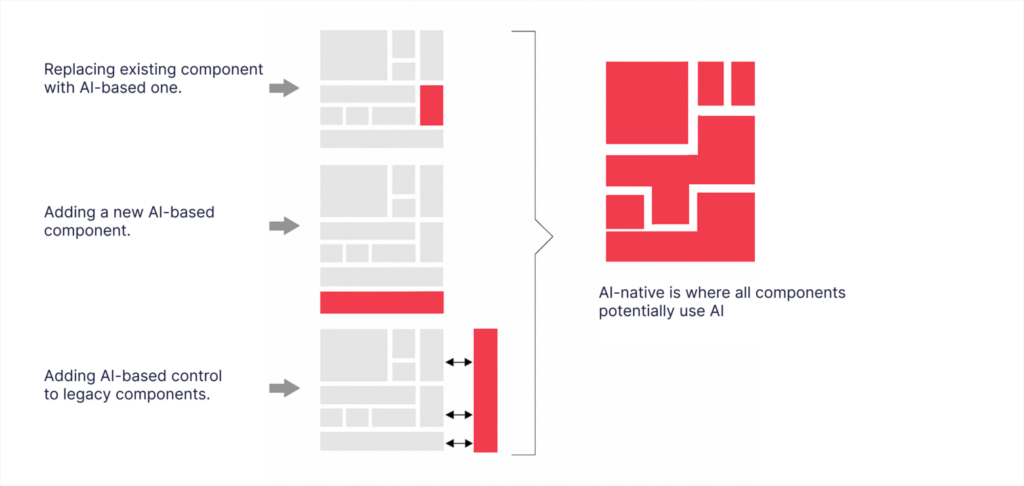
An AI-native company is architected from the ground up with artificial intelligence as a foundational layer. It operates through AI, rather than layering it on top of legacy systems. Data is treated as infrastructure, automation is embedded across operations, and continuous feedback loops ensure that systems learn and adapt with every interaction. This approach forms so-called intelligent infrastructure, AI technology and data-driven foundation that allows AI native systems to monitor, process, and respond dynamically in real time. So, an AI-native company, by contrast:- Builds data pipelines as infrastructure, not afterthoughts.
- Treats workflows as living systems, with feedback loops that learn.
- Embeds AI in the decision-making layer, not just the task layer.
Why legacy approaches fail
These days, we witness the huge gap between AI-native companies and incumbents, and it keeps widening fast.| Area | AI-Native | Incumbents |
| Decision-making | AI is the default decision layer. | AI limited to pilots, rules, and add-ons. |
| Data culture | Clean pipelines, governed, continuous learning. | Fragmented data, slow, and costly to use. |
| Agility | Modular, cloud-native, quick to adapt. | Technical debt makes change slow. |
| Customer experience | Real-time, hyper-personalized interactions. | Broad segments, delayed relevance. |
| Operations | Automated end-to-end workflows. | Manual steps, partial automation. |
| Learning | Instant feedback, continuous improvement. | Periodic updates, siloed feedback. |
Decision-making
AI-native: AI serves as the default decision layer, powering underwriting, forecasting, and customer support in real time. Incumbents: AI is limited to pilots or add-ons, constrained by siloed data and manual rules.Data culture
AI-native: Data is a strategic asset from day one with clean pipelines, strong governance, and continuous model training. Incumbents: Data is fragmented across departments, making real-time insights expensive and slow.Agility
AI-native: Modular, cloud-native systems make change routine. Incumbents: Burdened by technical debt, even minor updates take months.Customer experience
AI-native: Hyper-personalized, real-time recommendations and interactions. Incumbents: Broad segmentation, slow to adapt, relevance lags.Operations
AI-native: End-to-end workflows automated by default: onboarding, risk, compliance, servicing. Incumbents: Manual steps dominate, with automation isolated to pockets.Learning
AI-native: Every interaction feeds back instantly into the system. Incumbents: Improvements depend on periodic upgrades and cross-department coordination. The difference is huge. AI-native companies are built to compound intelligence. Incumbents still preserve legacy. Learn more about the recommendation engine we've delivered for a large eCommerce company.The common traps of AI strategy
Why do so many companies miss this change? First, they treat AI like cloud adoption, a procurement exercise. Buy licenses, roll out training, call it done. But AI is not just infrastructure. It changes how work is defined. Second, they underestimate the friction of legacy. Old workflows have layers of patchwork logic, compliance checks, and hidden dependencies. Drop AI into that tangle and you create headaches and risks. Third, they misjudge trust. A test suite that looks solid in the lab collapses when exposed to the messy, distribution-shifting input of real customers. Without constant evaluation and feedback loops, reliability suffers fast.
How we rebuilt and became an AI-native company
Before we ever spoke to clients about AI, we had to face a contradiction: we were advising companies on automation and intelligent systems, while much of our own work still ran on manual effort. Documentation was handled manually. Compliance checks were repetitive and error-prone. Developers spent hours reviewing boilerplate code. In theory, we were helping others prepare for the future. In practice, we were still operating as in the past. That gap became impossible to ignore. We realized credibility would only come if we lived by the same rules we were teaching. So we started with ourselves. The first step was culture. We began reshaping the way teams thought about work: every repetitive task was flagged, every bottleneck was mapped, and every workflow was questioned. This mindset shift laid the groundwork for automation. Next came small but deliberate changes. We introduced AI-powered assistants in development, testing, and operations, not to replace people, but to take the edge off the most repetitive tasks. Over time, these tools stopped being optional helpers and became embedded checkpoints. A coding assistant suggested tests, a documentation tool generated summaries, and QA bots categorized bugs. Each addition reduced manual overhead and created space for teams to focus on judgment. Only after those foundations were in place did we connect everything together. We orchestrated assistants, IDEs, and dev tools into a single layer. Every output was logged, every outcome turned into a training signal. Data pipelines were cleaned, governance strengthened, and feedback loops introduced so the system could learn continuously. By then, automation was no longer an experiment but an infrastructure. Code reviews, compliance checks, and delivery gates all had built-in learning loops. If quality dipped midweek, the system surfaced it by Friday. This wasn’t an overnight glow-up. It was years of building culture, making incremental changes, and then weaving them into a coherent operating model. Today, our toolset package includes everything we need to work faster and better:- GitHub Copilot accelerates development with contextual code suggestions.
- Cursor with Claude and Gemini extends IDE capabilities into scaffolding, testing, and DevOps.
- Google Vertex AI and AI Studio let us reason about architecture and scale prototypes.
- TestRail and PractiTest streamline QA with AI-enhanced coverage and bug tracking.
- Builder.io translates designs into deployable components.
- ChatGPT + Perplexity supports research and spec-writing with traceable sources.
- DeepL and Notion AI automate documentation and cross-language collaboration.
- Miro with AI instantly maps processes and flows.