
It’s an odd truth, but the more companies study AI’s impact on business, the less confident they become. Everyone agrees AI is reshaping how teams operate, yet when leaders try to measure that change, the business case blurs.
More teams are putting AI agents into their 2026 budgets, and most now treat them as a standing line item rather than an experiment. What still trips people up is where the money actually goes. Teams price the build and the model, then get caught out by integration, monitoring, and governance, the parts that quietly decide whether an agent survives contact with production.
That gap is why ai agent development cost is so hard to pin down. Human work is easy to price with hourly rates, salaries, and benefits. Agents run on tokens, credits, and API calls that don't map cleanly to business output, so the value is real but the pricing hides it.
The direction of travel helps. AI is getting cheaper fast: since 2020, ai infrastructure cost has dropped by nearly 70%. What used to need a six-figure setup can now run on a $50 to $60 monthly plan. Most projects we see take 10 to 12 weeks from first idea to live deployment, enough time to define the use case, train and test the agent, and wire it into real workflows.
So let's break down what drives the cost of an AI agent project in 2026, how to budget for it, and where smart teams cut spend without cutting corners.
What an AI agent cost estimate usually includes
Before planning a budget, it helps to know what you're paying for. "AI" covers a wide range of systems, and each carries a different price tag. A useful estimate separates two things: how you build the agent, and how you pay to run it.
How you build it shapes most of the upfront number, and the deployment model you choose sets the range.
No-code platforms ($0 to $200 setup). Tools like ChatGPT Builder let you build simple agents without writing code. Most setups take 2 to 10 hours and need only light configuration, so your main expense is the ongoing subscription. This works for small teams that want quick results and low maintenance.
Low-code solutions ($1K to $10K). These give you a head start but require some technical work: custom scripts, API connections, workflow integrations. Most agencies charge $50 to $150 per hour, and projects run 20 to 100 hours depending on complexity. It's a practical middle ground for teams that want customization without a full engineering build.
Custom development ($10K to $100K and up). The full-scale route, tailored to your business logic, data, and systems. Expect around $50K for backend development, $10K to $20K for interfaces, and 20 to 30% of the build cost per year for maintenance. You own the agent and pay for performance: a system that scales with the business rather than just supporting it.
How you pay to run it is the second half of any ai agent pricing conversation, and it usually follows one of two models. Explore our web development services.
Usage-based pricing. You pay for what you use. It's flexible and easy to start, but costs climb as volume grows. If your agent runs on large language models, LLM usage cost depends on the tokens processed: a standard support chat might use 500 to 2,000 tokens, which adds up fast across thousands of daily conversations. Message-based tools like Zendesk charge roughly $0.05 to $0.50 per conversation, so 10K conversations a month lands around $500 to $5K. Action-based tools like Zapier charge per operation, from $0.01 to $0.02 for simple transfers up to $0.10 and beyond for multi-step workflows.
Subscription tiers. If you prefer predictable ai agents pricing, flat monthly tiers unlock more features and higher limits as you climb:
- Starter ($0 to $50/month): 1K to 5K interactions, basic integrations, community support. Good for proving value.
- Professional ($50 to $500/month): 10K to 50K interactions, custom workflows, CRM integrations, API access, priority support.
- Enterprise ($500+/month): 100K+ interactions, dedicated support, SLA guarantees, advanced security, on-premise options.
Most providers offer 10 to 20% annual discounts for upfront payments.
Which factors change pricing the most
Two agents with the same job description can cost very differently. Three factors move the number more than anything else. See what's possible with AI strategy consulting services.
Scope and workflow complexity
The biggest driver is what you're actually asking the agent to do. Chatbots sit at the low end: they follow pre-set rules and decision trees, match patterns, and respond with scripted text, which makes them fast and cheap. Copilots land in the middle, acting as assistants inside a tool or workflow (GitHub Copilot for cleaner code, Microsoft Copilot for Dynamics 365 for sales forecasting) while a human still makes the final call.
Agentic AI is the bigger investment. These systems combine large language models, real-time data, and built-in logic to make decisions, adapt, and carry out multi-step tasks on their own, then improve from experience. That autonomy is why agentic ai development cost runs higher: you're paying for deeper reasoning and ongoing learning, not just a scripted reply. Demand backs it up, with 82% of companies planning to adopt AI agents within the next three years.
The practical takeaway: define agent scope tightly. A narrow, well-bounded task keeps the ai agent cost predictable. A vague "handle everything" brief is what turns a mid-range build into a six-figure one.
Tool and system integrations
Connecting an agent to your existing systems often costs more than the agent itself, not because of the technology, but because every system speaks a slightly different language. Integration cost is where projects quietly run over budget.
Linking an agent to a CRM involves API development, data mapping, and extensive testing, usually $2K to $5K depending on how customized or outdated the setup is. Custom workflows tailored to your processes range from $1K to $5K for simple automations up to $20K to $30K for multi-system integrations that coordinate across tools and departments. Most agents also lean on third-party APIs: roughly $10 to $100/month for CRM APIs, $20 to $200/month for email tools, and $50 to $500/month for data enrichment. A typical sales agent relies on 3 to 5 of these, adding $800 to $900 a month. Explore our AI process automation services.
Security and compliance requirements
For enterprises, this is non-negotiable. Security requirements like audits, data protection, and compliance with GDPR, HIPAA, or SOC 2 add another $10K to $25K, plus ongoing monitoring to stay compliant. Testing and quality assurance across user types, data variations, and edge cases usually adds 20 to 30% to total project time and cost. It's the difference between an agent that mostly works and one your team can rely on.
What teams forget to budget for
The price tag you see upfront rarely tells the whole story. Two categories get missed most often, and both hit after launch.
Monitoring and analytics
Large-scale deployments need real-time monitoring to protect performance and uptime. Tools like Datadog or custom dashboards run $500 to $2,000 to set up, and that monitoring cost is what catches drift, latency, and accuracy problems before customers do. Underneath it sits the rest of your ai infrastructure cost: cloud compute billed by usage on AWS, Google Cloud, or Azure, plus data storage at $0.02 to $0.10 per GB per month, which becomes a real line item once you're handling terabytes of logs and training files.
Human review and optimization
Technology drives the agent, but people keep it effective, and the human side can account for close to half of the total investment. Human oversight cost shows up in a few places. Teams spend 20 to 40 hours on training and onboarding, learning to work with the agent rather than around it. During rollout, companies assign half an FTE to one FTE for supervision, up to 3 FTEs for complex enterprise systems. Prompt engineering and optimization is ongoing, often up to 20 hours a month refining prompts and testing responses. And keeping everything current as APIs and data shift runs 5 to 15% of the initial cost each year. Learn more about SaaS AI agent.
How ROI Differs by Use Case
AI agents don't just promise returns, they deliver measurable ones, usually within the first few months. The payback profile depends on the use case.
- Customer support delivers the most predictable ROI: many companies report 300 to 500% returns within five to six months, backed by McKinsey research. The drivers are 50 to 60% fewer support tickets, 55% faster response times, and 24/7 availability that lifts retention by around 25%.
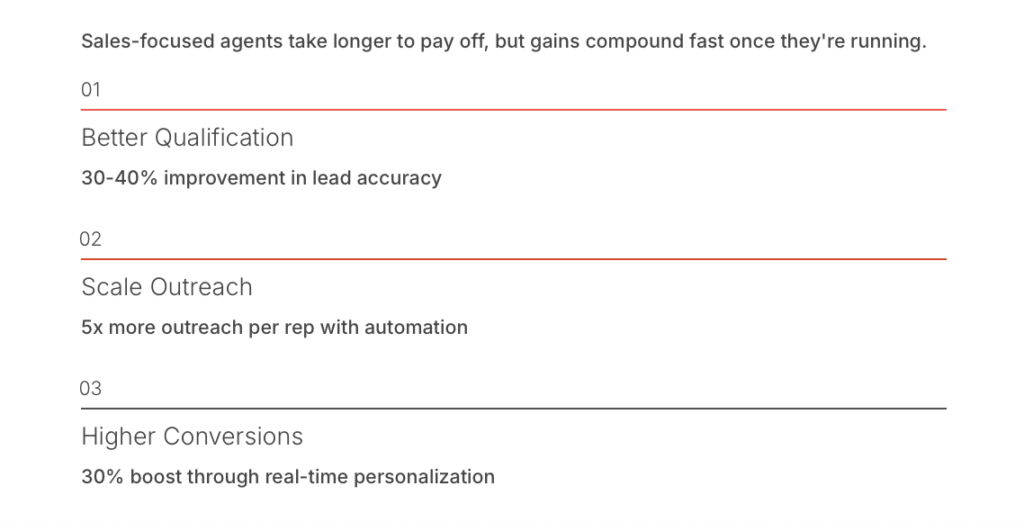
- Sales automation takes a little longer but compounds: 30 to 40% better lead qualification, 5x more outreach per rep, and 30% higher conversion through real-time personalization.
- Content creation depends on volume: teams that publish often see 70 to 80% less time on writing and editing, consistent brand voice, and up to 10x output without adding headcount.
- Voice agents often show savings immediately: 80 to 90% lower call-handling costs, round-the-clock coverage, and 60% faster resolution that frees people for complex cases.
How Altamira Scopes AI Agent Projects More Accurately
Most cost overruns trace back to fuzzy scope, not expensive engineering. Altamira starts every AI agent engagement by narrowing the problem before writing any code: reviewing your systems, scoring use cases by impact versus effort, and tying each agent to a single measurable KPI, whether that's cost, time, accuracy, or revenue. If an agent won't move a number, that surfaces in the assessment instead of six months into the build.
From there the work runs in phases. A working pilot goes against a safe slice of real data, so you get accuracy and latency figures and a rollout plan you can actually price. Then the pilot moves into production with the integrations, permissions, logging, and monitoring already accounted for, which is exactly where most budgets slip when they're planned late. Consulting and phased rollout planning keep the estimate honest, because the integration cost, monitoring cost, and human oversight cost sit on the table from week one rather than getting discovered after go-live.
If you want a scoped estimate for your own use case, Altamira's team can map it against your systems and data before you commit to a build.
How to reduce AI agent development costs
You don’t have to overspend to build a capable AI agent. The key is knowing where to invest and where to simplify. With the right focus, you can cut costs without cutting performance.
Start with one high-impact use case
Most teams waste money trying to build all-in-one systems. A better approach is to start small: pick one process with a clear boundary and measurable outcome. This keeps your scope tight and your resources focused on what actually moves the needle.
Use open-source and pre-built components
Frameworks like TensorFlow, PyTorch, LangChain, or LlamaIndex can save weeks of work. They’re reliable, community-tested, and designed to plug into existing systems. You get full functionality without paying enterprise software prices.
Prototype before you build
Create a Minimum Viable Product (MVP) before full rollout. It’s faster to validate your idea, gather feedback, and refine early, instead of fixing expensive mistakes later. The goal is proof of value, not perfection.
Optimize token usage
If your agent uses large language models, prompting efficiency directly affects your bill. Rewriting a verbose prompt like “Generate a detailed list of startup names based on the theme of artificial intelligence” into “List startup names: theme = AI” can reduce token usage by up to 40% without losing clarity. Small changes, big savings.
Choose flexible infrastructure
Running on AWS, Azure, or Google Cloud gives you scalability without heavy upfront costs. Many teams cut infrastructure expenses by up to 75% by switching from proprietary setups to these on-demand cloud options.
Other smart ways to save:
· Use model quantization to lower compute requirements
· Deploy lightweight agents on edge devices to cut cloud fees
· Apply transfer learning instead of training from scratch
· Mix affordable models for simple tasks with premium ones for advanced reasoning
Cutting costs isn’t about doing less, it’s about doing smarter. Build for outcomes, use what already works, and evolve your system as the returns prove themselves.
The final words
The companies seeing real returns from AI agents aren’t the ones spending the most. They’re the ones treating AI as a process of constant learning, not a single project to “finish.”
They start small. A focused use case. A clear metric. Something they can measure, refine, and either scale or shut down fast. They move quickly, learn from each iteration, and apply what works. That cycle is what separates early adopters from actual winners.
This approach demands a cultural shift. It’s not just new tools; it’s a new rhythm of work. Teams have to be comfortable with testing, failing, and trying again, all while tying results directly to business outcomes. The payoff is worth it: faster insight, clearer ROI, and less waste.
That’s also why pricing matters. The total investment goes beyond development. Integration, data management, and maintenance all shape the long-term cost of ownership. Planning for these from the start prevents surprises later.
The good news: you can build smart without overspending. Focus on one high-impact use case. Leverage open-source tools. Prototype early. Optimize how your system consumes tokens and compute power. Teams that use these tactics regularly cut costs by up to 75% while maintaining high performance.
AI agents aren’t just getting cheaper, they’re getting smarter to build. The companies that plan with clarity and precision will see the fastest payback, not just in savings, but also in speed, accuracy, and decision-making power. Contact us for technology product consulting.
Frequently Asked Questions
How much does it cost to build an AI system?
It depends on scope, but there are three broad tiers. A no-code build runs $0 to $200 in setup plus a monthly subscription, a low-code build lands around $1K to $10K, and a fully custom system starts at $10K and climbs past $100K: roughly $50K for backend, $10K to $20K for interfaces, and 20 to 30% of the build cost a year for maintenance. The final number depends less on the model than on scope, integrations, and compliance, since connecting to a CRM adds $2K to $5K and security work like GDPR or SOC 2 can add $10K to $25K. Define one clear use case first, because a narrow agent scope is what keeps the ai agent development cost predictable.
What AI support agent is the most cost-effective?
Customer support agents deliver the most predictable ROI, often 300 to 500% within five to six months, because they take over high-volume, repetitive work: 50 to 60% fewer tickets, 55% faster responses, and 24/7 coverage. The cost-effective route is to start narrow, handling routine FAQs with a chatbot or low-code build, then move to agentic AI only for the cases that justify deeper reasoning. Cost-effectiveness comes from matching the system to the workload, not from buying the cheapest option or the most autonomous one.