
The moment of truth
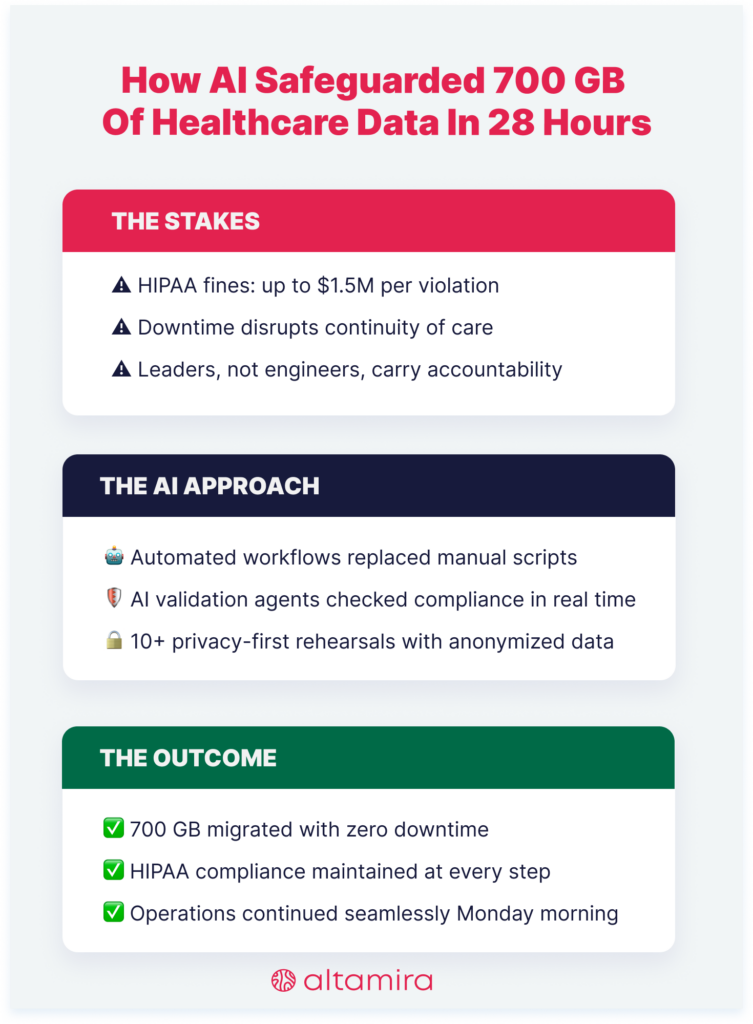
In healthcare, data isn’t just data. As per the recent survey, 87% indicated that AI can help reduce human errors in healthcare delivery. When we think of data, we refer to patient histories, diagnoses, lab results, insurance records, everything that makes up the trust between a provider and the people they care for. Mishandle it, and the consequences are personal, not just operational. Lives are impacted. That’s why the stakes were so high when a healthcare provider faced the challenge of migrating 700 gigabytes of sensitive patient and business records. Every file represented someone’s story. Every error risked breaking compliance, breaking trust, or breaking continuity of care. The window was 28 hours over a single weekend. By Monday morning, the new Know Your Customer (KYC) and Know Your Business (KYB) system had to be live. No downtime. No data loss. No breach of HIPAA standards. For leadership, the risk wasn’t just technical, it was existential. If they failed, they wouldn’t just be explaining to regulators. They’d be explaining to patients why their data, their privacy, or their care had been compromised. That’s when they came to Altamira, with the problem every leader recognizes. Data migration is rarely just about “moving files.” For leaders, the real issues are:- Regulatory exposure: HIPAA doesn’t allow mistakes. A single compliance gap can cost millions and destroy trust.
- Continuity of care: downtime isn’t an IT inconvenience, it impacts patients directly.
- Leadership accountability: when a migration process goes wrong, it’s not the scripts that get blamed. It’s the executives who approved the plan.
Why AI was the only safe path for data migration
Traditional migrations are heavy. Teams of engineers run scripts, check logs, and step in when something looks off. That’s fine for ordinary systems. But when the data is sensitive patient records, and the timeline is 28 hours, human error becomes the biggest risk.Our approach reframed the problem:
- Automation over intervention: Data migration process was orchestrated by automated workflows, not manual actions. Humans designed the system, but AI ran it.
- AI validation agents as guardians: At every stage, AI agents checked data integrity, compliance alignment, and system readiness. Instead of people catching errors after the fact, AI caught anomalies in real time.
- Privacy, first rehearsals: More than ten full-scale rehearsals were executed using anonymised data, ensuring the workflows were safe, compliant, and repeatable, without exposing real patient records.
“We built compliance into the architecture itself.”
The weekend that mattered
By the time Friday night arrived, everything had been rehearsed. The workflows were proven. The AI validation system had already shown it could deliver zero errors. Data migration began- 28 hours of execution.
- 700 GB of healthcare records moved.
- HIPAA compliance maintained at every step.
- Zero downtime. Zero disruption.
What the executives gained
The outcome was more than a smooth migration. For decision makers, it delivered three things that matter most:Confidence in compliance
By using AI as a real, time validator, the organization reduced compliance risk to near, zero. Leaders could stand in front of auditors with certainty, not excuses.Continuity of business
Operations didn’t skip a beat. The migration didn’t become a Monday morning crisis, it became a Monday morning milestone.Proof that AI is a governance tool
Too often, AI is positioned as an innovation toy, chatbots, copilots, and new features. This data migration project showed AI as something else: a strategic safeguard that protects against risk in critical operations.Why this matters to every C-level leader in healthcare
This case wasn’t unique. Healthcare leaders everywhere face the same collision of pressures:- The need to modernize systems.
- The demand to meet regulatory obligations.
- The expectation to do both faster, cheaper, and without disruption.
A shift in mindset: AI as compliance infrastructure
What changed for this client wasn’t just a database, it was a mindset. Instead of treating compliance as something to check after a project, they treated it as the architecture itself. AI made that possible.- AI didn’t just move data. It guarded integrity.
- AI didn’t just run scripts. It enforced HIPAA standards automatically.
- AI didn’t just speed things up. It created a foundation where leaders could move faster without sacrificing trust.
What we learned from this migration process
Every project teaches us something. From this one, we learned:- Risk and compliance can’t be delegated down the org chart. They’re leadership responsibilities, and the right tools make those responsibilities manageable.
- AI’s role in healthcare isn’t just patient-facing. Sometimes its most valuable role is invisible: guarding compliance, enforcing standards, and ensuring business continuity.
- When compliance is designed into the workflow, leaders can move faster. The false choice between “safe” and “fast” disappears.
For leaders considering their own migrations
If you’re a healthcare executive, here are the questions worth asking before your next migration:- Can you honestly say your current process eliminates human error?
- If an auditor asked, could you prove compliance was built into your architecture, not just checked after the fact?
- What would happen to your operations if downtime stretched beyond the planned window?