
The build-or-buy debate is the wrong place to start a CTRM software decision. By the time a commodity trading firm gets there, the outcome is mostly set by something duller than features. The real variable is how much of the firm's entire trade lifecycle falls outside any system's data model. That gap is what turns a nine-month rollout into a three-year one, whichever vendor wins the demo.
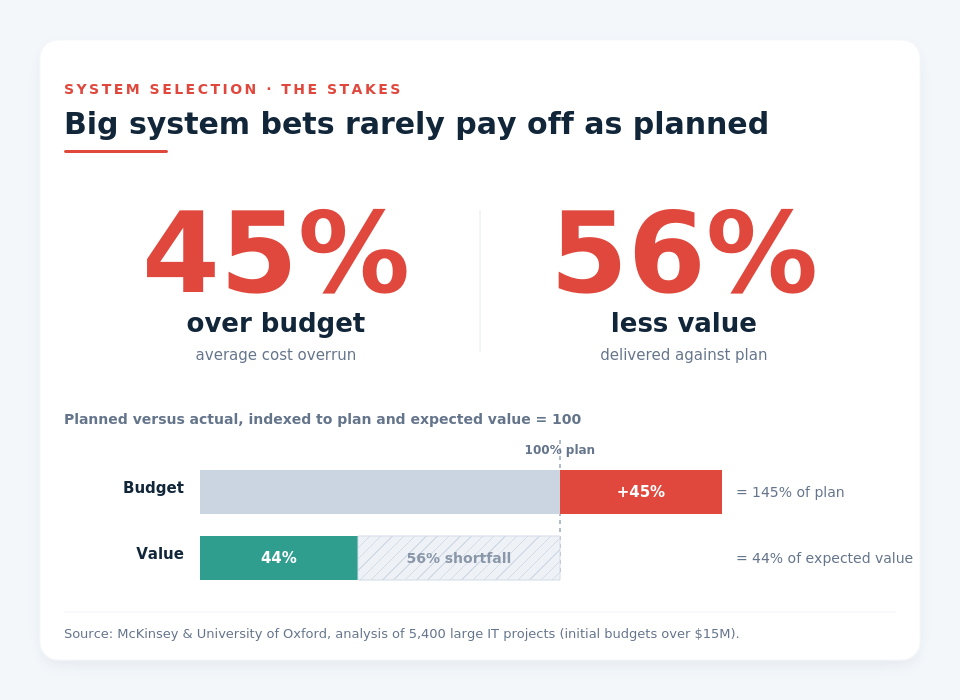
McKinsey and the University of Oxford tracked 5,400 large IT projects. On average they ran 45% over budget and delivered 56% less value than planned. A CTRM sits under trading, market risk, and settlement at once, so the firm absorbs that overrun across the whole business, not one department.
The market itself is not the bottleneck. ComTech Advisory counts roughly 90 commercial E/CTRM products, so building a shortlist is rarely where firms struggle. They struggle later, over which of their actual trades a shortlisted product has never seen.
What CTRM software covers and where the boundaries blur
CTRM software, short for commodity trading and risk management, runs the operational spine of a trading business. It captures deals, tracks positions, measures risk, schedules physical movement, and settles the money.
Patrick Reames of ComTech Advisory has called CTRM software "incredibly complex, reflecting the global commodities markets" it exists to manage. The boundaries get blurry because neighboring systems cover pieces of the same ground.
Trade capture, position, risk, logistics, settlement
A CTRM system connects five workflows that usually live apart. Trade capture records every physical and financial deal in one place. Position and risk functions value those deals against live market curves and flag exposure. Logistics handles scheduling, transport, and inventory for physical commodities. Settlement covers invoicing, payments, and the audit trail regulators expect. When these sit in one system, month-end close shortens and exposure numbers stop disagreeing between desks.
CTRM vs ETRM
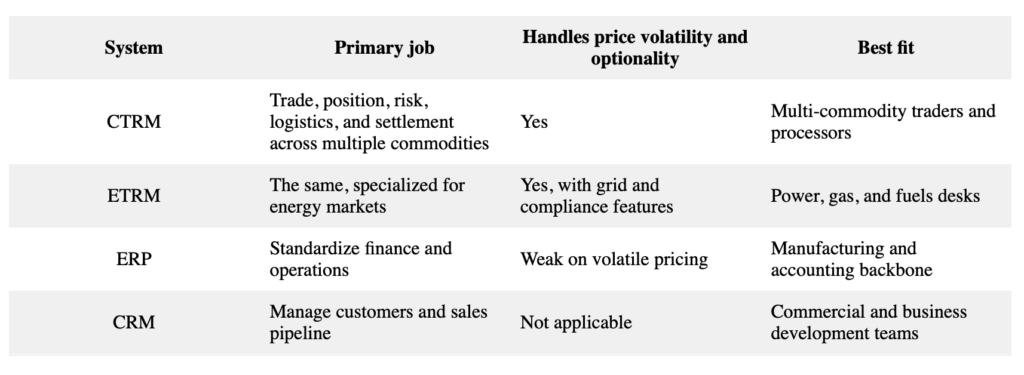
ETRM stands for energy trading and risk management. It is a specialized branch of CTRM built for power, gas, and fuels. An ETRM adds energy-specific needs like scheduling against grid operators, environmental compliance, and generation forecasting. A broad commodity trading system instead covers metals, agriculture, softs, and energy under one roof. Energy-only firms often pick a purpose-built ETRM, while multi-commodity firms need the wider CTRM scope.
Explore how our team helped a largest diversified energy holding in Europe that needed to enhance and maintain their Energy Trading and Risk Management (ETRM) platform. Their internal team lacked the capacity to scale development and support efficiently while meeting evolving user expectations and ensuring uninterrupted service.
As a result, we deployed a tailored team of experts with experience in digital energy solutions, and provided continuous development, maintenance, and consultancy services, focusing on improving platform functionality, user experience, and operational transparency.
CTRM vs ERP and CRM
ERP and CTRM pull in opposite directions. An ERP standardizes business processes to reduce variation, which suits manufacturing and accounting. A commodity trading system does the reverse, and is built to capture value from variation in price, quality, and delivery. ERP systems can hold a fixed price, but it strains against volatile curves, optionality, and mark-to-market. CRM is a different tool again. It manages customer relationships and sales pipelines, not positions or risk. Some firms run all three and connect them, with the CTRM owning the physical and financial trade and risk layer.
Why off-the-shelf CTRM implementations overrun
Packaged software promises a shorter path, and often it delivers one. Overruns start when a firm assumes the product already models how it actually trades. Three gaps cause most of the damage.
Commodity-specific workflows the product does not model
Every commodity carries its own quirks. Grain has grades and shrink, crude needs blending rules, metals require assay handling, and power markets add imbalance charges. Each of these bends the standard trade model a product ships with. A generic commodity trading software package covers the common cases well. The edge cases are where trading firms make or lose margin, and they are the ones a product tends to miss. Mapping those gaps before signing avoids a mid-project scramble.
Configuration that quietly becomes customisation
Vendors sell configuration as low-risk, and inside the product's design it usually is. Trouble starts when configuration runs past what the product expected. At that point a firm is writing custom code around a packaged core. That code has to be retested and re-integrated at every upgrade. ComTech Advisory has watched this pattern for years in ERP-for-commodity projects. Heavy customization produces a system that resists upgrades and grows more expensive to maintain over time. The same trap applies to an over-configured CTRM.
Market data and counterparty integrations priced separately
The licence is rarely the whole bill. Live market data feeds, exchange connections, credit and counterparty data, and links to your ERP often sit outside the base price. Each integration adds build time and a recurring fee. A demo runs on sample data and hides this. Ask for the full integration list and its cost before comparing quotes.
When buying is the right answer
Buying wins more often than trading-floor pride admits. For standard books and conventional operations, a packaged system reaches a working middle office faster and cheaper than a build.
Standard commodities and conventional contract structures
If a firm trades liquid commodities with standard contracts, the product already models the work. Vanilla futures, standard physical deliveries, and common hedging structures are what packaged CTRM software solution was built for. Building your own here repeats work a vendor has already done across dozens of clients. The market pays nothing extra for a custom version of a solved problem.
Regulatory reporting you do not want to own
Regulatory compliance changes, and keeping pace is a standing cost. Reporting regimes like Dodd-Frank, EMIR, REMIT, and MiFID II change on their own schedule. A vendor spreads that maintenance across its whole client base and ships the updates. Owning that burden in-house means a permanent team watching rule changes. For most firms, renting the compliance updates is the cheaper and safer call.
Speed to a working middle office
Time-to-value usually decides the business case. According to Mobius Risk Group, a licensed platform typically goes live in three to nine months. An in-house build runs 12 to 24 months or longer. Oliver Wyman notes that even a bought CTRM can take up to 18 months to deploy once integrations and testing are counted. For a firm that needs risk numbers this quarter, the packaged route is often the only realistic one.
When building is the right answer
Building earns its cost in a narrow set of cases. The test is whether a custom commodity trading system protects something the market cannot sell you.
A trading strategy the market has no product for
Some desks trade in ways no vendor has packaged. A novel arbitrage, a proprietary pricing model, or an unusual structured book can be the core edge. If off-the-shelf software would force that edge into a generic mold, custom development protects it. The build has to defend a real and durable advantage, not a preference for bespoke screens.
Physical operations with unusual quality, blending, or logistics processes
Physical trading gets specific fast. A firm blending fuels to a custom spec, or running a niche logistics network with its own rules, may find that no product fits. When the physical operation is the differentiator, forcing it into standard workflows loses the thing that makes money. Here a targeted build, or a heavy extension, can pay for itself.
Existing systems worth keeping and extending
Sometimes the best system is the one already running. A firm may have years of logic, data, and hard-won trust built into its current tools. Ripping that out to fit a new platform can destroy value that works today. In these cases, building around what exists beats replacing it. That leads to the option most selection processes skip.
The third option most firms miss: Extend, don't replace
Selection is often framed as buy or build. A third path fits many firms better: keep the core that works and modernize around it. This costs less than a rebuild and carries less risk than a rip-and-replace.
Wrapping a legacy CTRM with APIs and a modern front end
A dated CTRM often still calculates positions and risk correctly. The pain is usually the interface, the reporting, and the difficulty of connecting newer tools. An API layer and a modern front end can fix the experience without touching the engine. Traders get faster screens and better reports, and the firm avoids a multi-year replacement.
Automating the spreadsheet layer around the system
Most trading operations run on spreadsheets that fill the gaps the core system leaves. Those sheets carry real risk, since one broken formula can misstate a position. As Mobius Risk Group puts it, past a certain point spreadsheets "become a source of risk rather than a tool for managing it." Automating that layer, feeding it from the system and validating it, removes a common failure point without a full replacement.
An evaluation framework that survives the demo
Vendor demos are built to impress, not to stress-test. A CTRM system selection that scores against your own reality, rather than the vendor's script, is what separates a good choice from a regretted one.
Score against your own trade lifecycle, not the vendor's script
Write down your real trade lifecycle before any demo. List every step from deal capture to settlement, including the messy exceptions. Then make each vendor run your cases, not their polished sample book. A product that stumbles on your edge cases in a demo will stumble worse in production.
Questions on data model, extensibility, and exit
Three questions expose more than a feature list. First, how does the data model handle your commodities and contract types? Second, how do you extend the product without breaking upgrades? Third, how do you get your data out if you leave? Vendors who are comfortable with exit questions tend to be the ones worth keeping.
Reference calls with firms trading your commodity
A reference call with the wrong firm tells you little. Ask to speak with a client trading your commodity, at your rough scale, on a recent implementation. Ask what overran, what the vendor missed, and what they would do differently. The useful answers come from the problems, not the praise.
Total cost of ownership over five years
The licence quote is the smallest number in the decision. Total cost of ownership over five years is where buy, build, and extend really separate. Two line items catch firms by surprise most often.
| Cost area | Buy (off-the-shelf) | Build (custom) | Extend (wrap and automate) |
|---|---|---|---|
| Upfront licence or build | Licence fees | High development cost | Low, reuse the existing core |
| Implementation | 3 to 9 months of services | 12 to 24+ months of effort | Weeks to months |
| Integrations | Priced per feed and system | Built and owned in-house | Added where needed |
| Internal effort | Configuration and testing | Full product ownership | Focused engineering |
| Ongoing | Subscription and upgrades | Maintenance and roadmap you own | Lower incremental upkeep |
Licence, implementation, integration, and internal effort
Four buckets make up most of the five-year cost. The licence or build cost is the visible one, and often the smallest. Implementation services usually cost more than the licence in the first year. Integrations add build time and a recurring fee for every feed. Then there is internal effort, your own people's time, which is real money that rarely lands on a vendor quote. Add all four to get a number worth comparing across options.
The upgrade treadmill and customisation debt
Every customization you add is a bill you pay again at each upgrade. Vendors ship new versions, and heavily modified systems have to be retested and reworked to keep pace. This is the upgrade treadmill, and it compounds quietly. The Standish Group has found that 45% of features in a typical software system are never used. Another 19% are rarely touched. Paying to maintain custom work around features no one uses is how a five-year budget doubles.
How Altamira supports commodity trading technology decisions
With our tailored energy trading and risk management expertise, your business can easily manage, monitor, and mitigate financial, market, operational, and credit risks associated with energy trading.
- Calculate possible portfolio losses over time from market changes
- Get real-time or periodic valuation of open trading positions based on market prices
- Check if your trading partners meet their financial obligations and set credit limits
- Estimate the maximum loss that could occur due to counterparty default
A short discovery session usually settles the buy, build, or extend question in weeks rather than quarters. Contact us
A CTRM selection checklist
Run through these before signing anything.
- A written trade lifecycle, including the exceptions where margin is made or lost
- A gap list of workflows the product does not model out of the box
- The full integration scope and its cost, not just the licence
- A five-year total cost of ownership for buy, build, and extend
- Data model, extensibility, and exit answers in writing
- Reference calls with firms trading your commodity at your scale
- A clear owner for regulatory reporting updates
- An honest read on whether custom work protects a real edge
Conclusion
CTRM system selection rewards honesty over ambition. For a firm trading standard books, buying is usually the stronger call. A firm with a working core often gets more from extending it than from a rebuild. Custom development earns its place only when a genuine edge has no product behind it. Score every option against your own trade lifecycle and its five-year cost, and the right path is usually easier to defend than to argue with.
Frequently asked questions
What is CTRM software?
CTRM software, short for commodity trading and risk management, runs the entire lifecycle for firms that buy and sell commodities. It captures deals, tracks positions, measures market and credit risk, schedules physical logistics, and handles settlement. Traders in energy, metals, agriculture, and softs use it to replace spreadsheets with one system that keeps exposure numbers consistent across desks.
What is the difference between CTRM and ETRM?
ETRM, energy trading and risk management, is a specialized branch of CTRM solution built for power, gas, and fuels. It adds energy-specific features like scheduling against grid operators, environmental compliance, and generation forecasting. A broader commodity trading system covers metals, agriculture, and softs alongside energy. Energy-only desks often choose an ETRM, while multi-commodity firms need the wider CTRM scope.
What is the difference between CTRM and ERP?
An ERP standardizes finance and operations to reduce variation, which suits manufacturing and accounting. Commodity risk management software does the opposite, capturing value from variation in price, quality, and delivery. An ERP can hold fixed market prices but strains against volatile curves, optionality, and mark-to-market valuation. Many firms run both and connect them, with the CTRM owning the trade and risk layer.
When should a trading firm buy an off-the-shelf CTRM instead of building one?
Buy when your book is standard and your contracts are conventional. Packaged CTRM software already models vanilla futures, common physical deliveries, and standard hedging, so building repeats solved work. Buying also makes sense when you want regulatory reporting maintained by a vendor and a working middle office in months. For most firms trading liquid commodities, buying is the faster and cheaper route.
When does custom CTRM development make more sense?
Custom development makes sense when a real trading edge has no product behind it. A novel strategy, a proprietary pricing model, or unusual physical operations with specific blending or logistics rules can justify a build. It also fits when existing systems hold valuable logic worth extending rather than replacing. The test is whether the build protects a durable advantage, not a preference for bespoke tools.
How long does a CTRM implementation usually take?
Timelines vary with scope and integrations. Mobius Risk Group puts a licensed platform at three to nine months and an in-house build at 12 to 24 months or more. Oliver Wyman notes that even a purchased CTRM can take up to 18 months once data migration, integrations, and testing are counted. Fast-start packages for narrow scopes can go live in weeks.
What are the hidden costs in a CTRM project?
The licence is rarely the biggest cost. Implementation services often exceed it in year one, and market data feeds, exchange connections, and integrations with your ERP are usually priced separately. Internal staff time is real money that never appears on a vendor quote. Then there is the upgrade treadmill, where every customization must be retested and reworked at each new release.
How should firms evaluate CTRM vendors?
Score vendors against your own trade lifecycle, not their demo script. Make each one run your real cases, including the exceptions where margin is made or lost. Ask how the data model handles your commodities. Also ask how you extend the product without breaking upgrades, and how you get your data out if you leave. Then call references trading your commodity at your scale.
Can a firm extend an existing CTRM instead of replacing it?
Often yes, and it is the option most selection processes skip. A dated CTRM that still calculates positions correctly can be wrapped with an API layer and a modern front end. That fixes the interface and reporting without touching the engine. Automating and validating the spreadsheet layer around it removes hidden risk. This costs less and carries less risk than a full replacement.