
You’ve probably seen it in action already: emails writing themselves, invoices processing in the background, and tasks getting ticked off while you sleep. It’s hard to ignore how much work is done in the background, without human intervention.
That’s where the confusion starts. Is this AI? Is it automation? Or both? Both terms are used so often together that the distinction between them begins to blur. Understanding the difference isn’t about semantics, but about making better investment decisions, what tools to choose, and which tasks require AI versus optimised speed.What is automation?
Think of automation as a system that follows clear instructions, like a checklist, but faster and more reliable. It doesn’t learn or adapt, it just executes.
This is the technology behind tasks such as scheduling posts on social media or handling monthly subscription billing. When is automation the right choice? It works best for tasks that are:- Repeated the same way every time
- Time-consuming, but simple
- Prone to human error if done manually
What is artificial intelligence?
Artificial intelligence takes things a step further.
Instead of following a static checklist, it works with data, patterns, and probabilities. It learns from experience, adapts to new inputs, and improves outcomes over time. Here are some real-world examples of how AI automation adapts and delivers smarter decisions:- Intercom’s Fin chatbot, powered by OpenAI, learns from customer conversations, internal help articles, and feedback to provide increasingly accurate and context-specific support.
- Mastercard uses AI to analyse transaction patterns in real time and flag anomalies that indicate potential fraud, learning and evolving as fraud tactics change.
- Spotify’s recommendation engine uses techniques like collaborative filtering and natural language processing to suggest music that aligns with your evolving tastes and listening behaviour.
See also: Understanding AI basics: types, terminology, and uses
AI vs automation: similarities and differences
AI and automation serve distinct roles in digital systems, each suited to different types of tasks.
Automation is designed for efficiency and consistency, executing repetitive actions according to predefined rules without variation. It excels in static, narrow applications like manufacturing or data entry, but needs reprogramming to adapt to change. Artificial intelligence can learn from data and adapt over time. It tackles complex, context-aware tasks that require decision-making, often employing advanced algorithms and neural networks. Unlike automation, AI evolves through new data, making it perfect for dynamic environments such as data analysis or natural language processing. Both aim to boost productivity, but they differ fundamentally in their approaches and the complexity of tasks they can handle. See also: Automating business processes: Real-world success storiesIntelligent automation: How AI automation changes the game
When you combine automation’s speed with AI’s adaptability, you get a much more capable system. Some of the benefits include are the following.
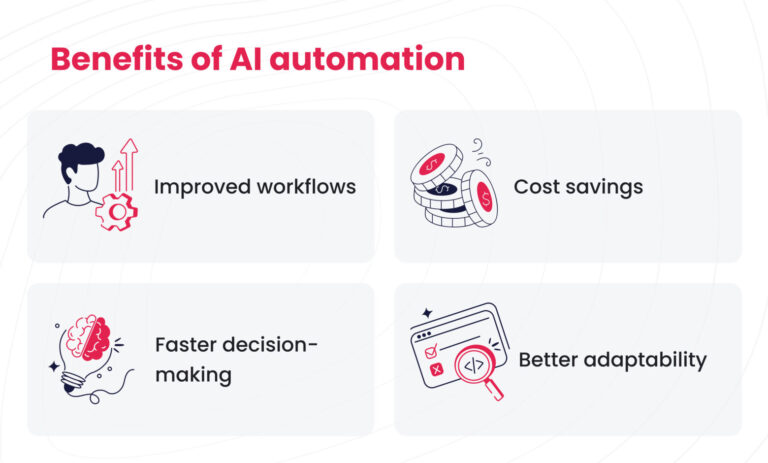
Improved workflows
AI actively detects bottlenecks in your processes, suggests targeted improvements, and dynamically reroutes tasks based on urgency and historical patterns.
Faster decision-making
Instead of waiting for human approval or escalation, AI makes real-time decisions using predefined criteria combined with insights learned from past data.
Cost savings
By identifying inefficiencies and autonomously adjusting workflows, AI reduces manual interventions and lowers operational overhead.
Better adaptability
Unlike traditional automation, AI continuously adapts to changing conditions without requiring new rules from humans, so when customer preferences evolve, your systems keep up seamlessly.
When to use automation
Despite the benefits of AI-powered automation, traditional methods still have their uses. Not every task benefits from AI, just as you wouldn’t use a power saw to cut bread.
Traditional automation still holds up when tasks are:- Repeatable and rule-based
- Not requiring decision-making but benefiting from improved efficiency
- Unlikely to gain from real-time learning or adaptation
- ADP (Automatic Data Processing) automates payroll by calculating salaries, taxes, benefits, and deductions, then processing payments on a recurring schedule.
- Mailchimp automates email campaigns triggered by user actions or dates, such as appointment reminders, post-purchase follow-ups, and abandoned cart nudges.
- Microsoft Power Automate enables users to create rule-based workflows that sync data between apps like Excel, SharePoint, Outlook, and Dynamics, such as automatically copying new customer records from Excel to a CRM.
Simply put, if your tasks follow a consistent pattern every time, traditional automation is likely the best fit. Choosing between AI and automation requires understanding your processes and applying the right tools accordingly.
See also: How to choose the right AI partner: Questions to ask before you commit
Final words
Nowadays, the line between AI and automation is becoming increasingly blurred, especially for those outside the tech industry.
Understanding the difference and knowing when to use AI versus traditional automation can save costs, improve workflows, and better address your business needs. Automation helps you scale up routine tasks. AI helps you manage the unexpected. Together, they unlock smarter, more resilient systems that go beyond just working faster.- Use automation when the task is known and repeatable
- Use AI when the task involves nuance, data, or decision-making
- Use AI-powered automation when you want the best of both
How Altamira can help
If you’re exploring AI automation but unsure where to start, partnering with a focused technology expert can make all the difference. At Altamira, we help businesses move beyond basic automation toward solutions that adapt, learn, and improve over time.
Whether it’s integrating AI into your existing workflows or building custom systems that go beyond routine tasks, our approach is straightforward:- Understand your true needs
- Identify where AI can add measurable value
- Build practical, explainable, and scalable solutions
FAQ
What is the difference between AI and automation?Think of automation as a set of instructions, and AI as something that learns.
Automation follows fixed rules: do A, then B, then C. It’s great for repetitive tasks with minimal variation (such as invoice processing or sending email alerts). AI, on the other hand, works with patterns and data. It can adapt to new inputs, learn from outcomes, and handle more complex or less predictable tasks, like sorting customer reviews by sentiment or identifying fraud in real time. Is AI the same as simple automation?They overlap, but they’re not the same.
Automation is about consistency and speed with tasks that rarely change. AI adds a layer of decision-making and adaptability. For example, a chatbot that gives the same response every time refers to automation. One that adjusts its answer based on how a customer phrases a question? That’s AI. What cannot be automated by AI?Tasks that require human judgment, context, or empathy are still out of reach.
AI struggles with ambiguity, ethical nuance, and anything that depends heavily on the real-world context. It can write an email, but it can’t understand the context behind it. It can analyse trends, but it can’t weigh the emotional impact of a decision on a team. Also, if your data is limited, biased, or constantly changing in unpredictable ways, AI won’t be much help. Can AI replace automation?In most cases, the two work together.
Automation handles the predictable parts of a workflow, and AI is used when the task benefits from flexibility. For example, AI can classify incoming emails by intent, and automation can route them to the right department. Together, they create smarter systems, but one doesn’t cancel out the other.