
Just imagine: it is 11pm on a Sunday. A customer sees an unfamiliar charge on their account - £340 from a retailer they have never heard of. They open the bank's app, tap the chat icon, and start typing. The chatbot responds within seconds. It asks them to choose from a menu. They do. It loops them to another menu. They try again. After the third dead end, it offers a phone number to call during business hours.
By Monday morning, that customer has filed a complaint. By Monday afternoon, they will be comparing current accounts.
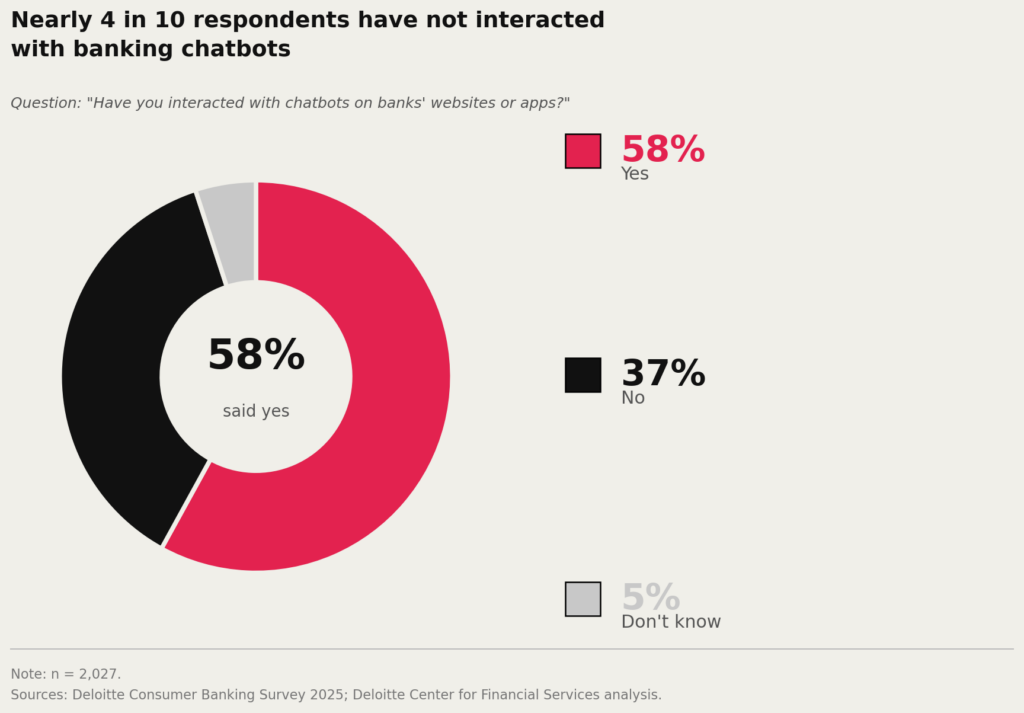
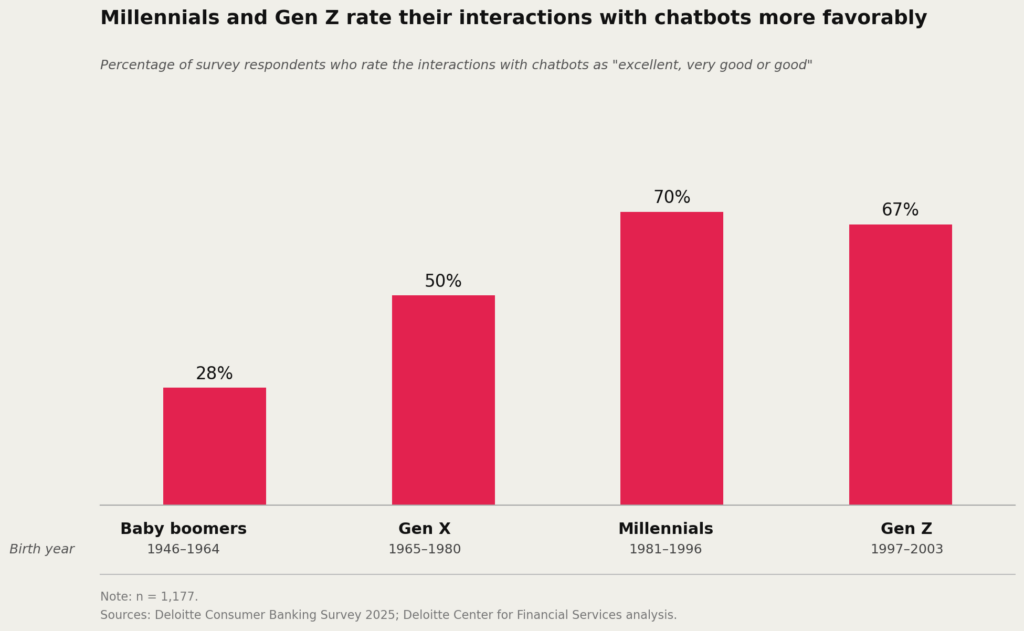
This is not an edge case. According to a CFPB review of consumer complaints, 80% of customers who interacted with a banking AI chatbot left feeling more frustrated than when they started and 78% still needed a human agent after the chatbot failed them. Meanwhile, UK financial services firms received 1.85 million complaints in H1 2025, with banking and credit cards alone accounting for nearly 900,000 of those, a 7.2% rise on the prior half-year.
The problem is that chatbots are put in situations they were never built to handle, with no designed exit. The UK leads Europe in deployment: 85% of banks now use at least one chatbot in customer-facing operations.
However, when it is done right, chatbots truly reduce support load materially and the numbers are say a lot.
| 70% Potential drop in call center costs from chatbots | $7.3B Projected global cost savings from chatbots in banking | 40,000+ Average monthly interactions handled per chatbots in banking | 65% Reduction in response time vs. human-only support |
Those numbers depend entirely on using automation where it works, and routing customers to humans when it does not. This article maps both sides of that line.
Where banking chatbots reduce support load
The deployments that move the needle share one characteristic: they handle interactions that are high in volume, low in complexity, and do not require human judgment to resolve. Modern AI chatbots for banking can handle 80–90% of routine client requests without agent involvement when properly scoped. That last part is the entire argument. Three areas consistently sit within that scope.
Explore our AI agent development services.
Routine account questions
Balance inquiries, transaction history, statement requests, branch hours, interest rate lookups: these make up a large share of daily inbound contact at retail banks. None requires human reasoning. A chatbot connected to core banking systems answers all of them instantly, at any hour, without a queue.
The consistency advantage is underrated. A chatbot gives the same answer at 2 am on a bank holiday as it does at 9 am on a Tuesday. Human agents vary in accuracy, in tone, in patience, especially during high-volume periods. For factual queries, that consistency is what customers actually want.
| Scale in context: If a mid-sized UK retail bank's chatbot handles 40,000 interactions per month and deflects even 60% of those from the agent queue, that is 24,000 contacts per month, roughly 800 per day, that agents no longer need to handle. |
WHAT CHATBOTS HANDLE RELIABLY HERE
- Account balance and available credit checks
- Recent transaction history and statement generation
- Direct debit and standing order listings
- Branch and ATM locations
- Interest rates and fee schedules for existing products
- Contact preference and notification setting updates
Card and payment support
Temporarily freezing a card, checking whether a direct debit cleared, or understanding why a payment was declined: these interactions need to be resolved quickly and do not require a conversation with a trained agent. The process is defined, the data is available. The resolution does not require judgment. A well-integrated chatbot closes the loop without agent involvement.
The proactive side of this category is where the real volume reduction happens. AI-powered tools can detect suspicious transaction patterns in real time and alert customers before they have even noticed the charge. That single capability removes an entire class of inbound contact. The customer does not call in a panic because their bank already told them.
| By 2027, 95% of banks are expected to use AI chatbots to notify clients about potential fraud - up from 38% in prior years. Each unprompted alert is a support call that never arrives. |
WHAT CHATBOTS HANDLE RELIABLY HERE
- Temporary card freeze and unfreeze
- Payment cleared/pending status checks
- Explaining unfamiliar transaction descriptions
- Contactless limit adjustments
- Lost or stolen card reporting and replacement
- Real-time fraud alert delivery and acknowledgment
- Low balance and payment failure notifications
See what's possible with large language models.

Onboarding guidance
New customers opening accounts or applying for products ask predictable questions: what documents are needed, how long verification takes, what the difference is between product tiers, and how to add a payee. Because the questions are standardized, they are well-suited to AI process automation.
A virtual assistant can collect applicant information, run a preliminary eligibility check, and route the application to a human agent where review is needed. This removes the back-and-forth that delays account opening and builds up queue pressure. The customer gets immediate answers rather than having to wait to confirm what is already on the FAQ page.
There is a conversion benefit too. Customers who encounter a question that they cannot answer during the application frequently abandon the process. A chatbot that answers in the moment keeps them moving, and that has a direct impact on new account acquisition, not just support load.
Where human handoffs still win
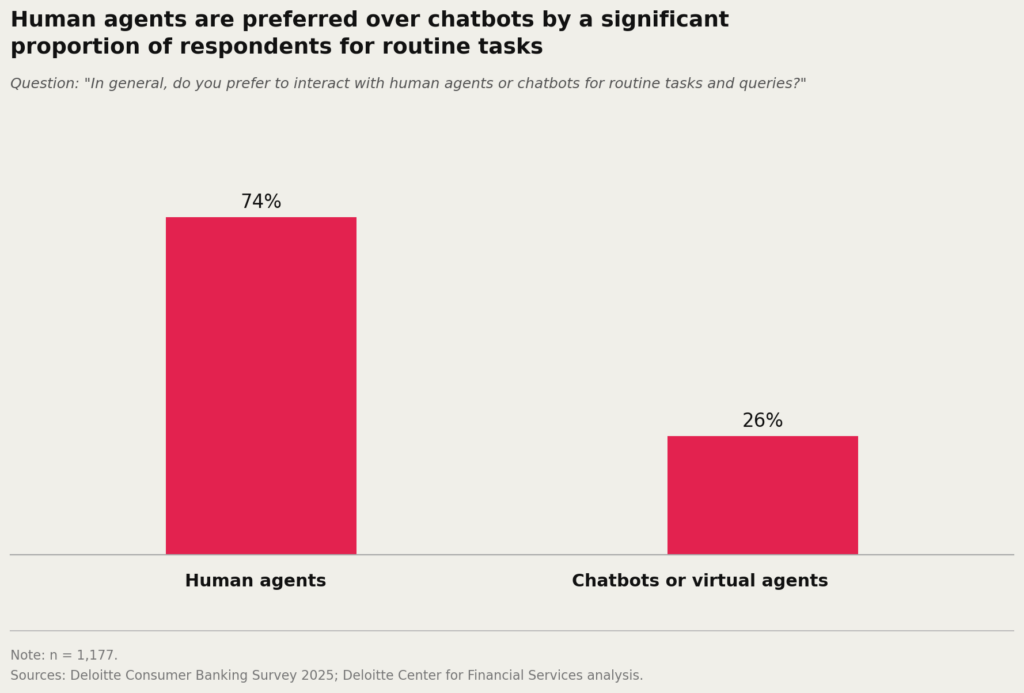
Knowing where chatbots work is only half the picture. The other half is being precise about where they fail and making sure that failure does not result in a customer trapped in an automated loop with no visible exit. Three categories reliably fall on the wrong side of the line between automation and human judgment.
Vulnerable customer situations
The FCA's Consumer Duty, in force since July 2023, extended to closed products in July 2024 - places a direct obligation on UK retail banks to deliver good outcomes for customers in vulnerable circumstances: financial hardship, bereavement, serious illness, domestic abuse, and mental health challenges.
A chatbot cannot meet that obligation on its own. It cannot detect distress from the phrasing of text, adjust its tone in response to emotional content, or make a judgment about what a customer in crisis actually needs. When someone writes that they are struggling to make rent and need to discuss their overdraft, they are not submitting a support ticket. They are reaching out to an financial institution they trust with their finances.
| The FCA's own Consumer Duty review cited firms that programmed vulnerability-related keywords to trigger immediate high-priority routing to a human agent as examples of good practice. The Bank of England's 2024 artificial intelligence machine learning survey found that Consumer Duty and FCA conduct requirements rank among the top regulatory constraints firms cite when deploying AI in customer-facing roles. |
Banks that treat this as a limitation to be designed around, rather than a requirement to be built to, are accumulating regulatory and reputational risk, failing the digital transformation.
SIGNALS THAT MUST TRIGGER IMMEDIATE ROUTING TO A HUMAN
- Any mention of a deceased account holder or bereavement
- References to debt, arrears, or inability to make payments
- Language indicating financial distress or urgency around financial loss
- Questions about domestic abuse or financial coercion
- Mental health disclosures of any kind
- Repeated failed chatbot attempts on the same issue
Fraud and disputes
A customer reporting an unauthorized transaction is already distressed. They need to know someone is acting on their behalf now and they need to be walked through a process with legal and financial consequences: reporting the fraud, blocking the card, initiating a dispute, and understanding the resolution timeline.
Scripted chatbot responses in this context do not reassure. They delay. The customer needs someone with the authority to act, who can respond to specifics that fall outside a decision tree, and who can give a clear account of what happens next. That is a human conversation.
Automated systems add genuine value in the fraud context when they alert proactively, flagging suspicious activity before the customer asks. The investigation and resolution that follows is a different matter entirely. The same applies to disputed charges, incorrect direct debits, and international transaction queries. The detail varies too much for a chatbot to manage reliably, and an incomplete answer has direct financial consequences.
Complex product conversations
A customer asking whether to fix their mortgage rate, whether an offset account makes sense given their savings, or how their ISA interacts with a cash account is not looking for a product fact sheet. They are asking for help thinking through a decision that depends on their circumstances, their goals, and often details they have not yet fully articulated.
Chatbots can surface product information accurately. What they cannot do is work through a decision with a customer, asking follow-up questions, identifying what they are actually trying to achieve, and giving a considered response that accounts for their full situation. That requires a human.
Routing these conversations through a chatbot first does not reduce support load. It delays the real conversation and means the agent who eventually joins has to rebuild trust before addressing the actual question.
How to design a safe chatbot-to-agent flow
The handoff between chatbot and agent is where most deployments lose the value they built earlier. The customer repeats themselves. The agent has no context. The customer experience confirms the sense that the chatbot was an obstacle. Good handoff design requires deliberate choices at the build stage, not patches applied after complaints arrive.
| Design element | What good looks like | What poor design looks like |
| Context transfer | Full chat history, intent, and escalation trigger passed to the agent before they join | Customer explains their issue from scratch; agent sees only "chat escalated." |
| Escalation triggers | Built into conversation logic at launch — covers failure states, frustration signals, and vulnerability keywords | "Speak to an agent" option buried in a sub-menu |
| Sensitive topic routing | Proactive detection of bereavement, hardship, and fraud keywords — routes before the customer asks | Customer must explicitly request a human while already distressed |
| Channel continuity | Live chat handoff within the same window | Customer directed to call a phone number |
| Handoff timing | Escalates after two failed resolution attempts on the same intent | Loops continue until the customer disengages |
| Queue prioritization | Fraud and vulnerability cases route to a high-priority queue automatically | All escalations join the same standard queue regardless of urgency |
Three principles govern every element of the handoff:
- Context is non-negotiable. The agent needs to see what the customer asked, how the chatbot responded, how many times the customer restated their issue, and what triggered the escalation. Without this, the handoff creates work instead of removing it.
- Proactive routing for sensitive topics. Customers in distress should not have to navigate a menu to reach a person. One UK firm used non-stigmatizing language inside the chat interface to prompt vulnerability disclosure, making clear that no issue is too small to affect how someone manages their money. The FCA cited this as a positive practice example.
- Same-channel continuity. If the conversation started in chat, it stays in chat. Redirecting a distressed customer to a phone number is not a handoff. It is an abandonment.
What UK banks should measure first?
Before expanding chatbot coverage or defending the current deployment internally, banks need an honest picture of how the existing system is actually performing. Headline metrics are easy to game. The five measures below are harder to inflate and more useful.
| Metric | What it measures | Red flag | Status |
| Containment rate | % of chats resolved without human involvement | High containment + rising complaints or low CSAT | Cross-reference always |
| Escalation rate by intent | Which query types the chatbot is failing to handle | Any single intent driving more than 25–30% of all escalations | Most actionable metric |
| Time to handoff | Wait between requesting a human and reaching one | Over 2 minutes in a text channel; any delay for fraud or vulnerability cases | Highest customer impact |
| Post-handoff resolution rate | Whether escalated contacts resolve in a single agent interaction | Low rate = context transfer is broken or handoff is too late | Proxy for handoff quality |
| Repeat contact rate | Customers returning about the same issue after a chatbot interaction | High rate = chatbot gave an incomplete or incorrect resolution | Often missed entirely |
A few interactions between these metrics are worth understanding:
- Containment rate without CSAT is misleading. A chatbot can achieve high containment by never surfacing an escalation option. Always cross-reference containment with satisfaction data and complaint volumes.
- Escalation rate by intent is where the actionable findings live. The aggregate escalation rate tells you a number. Intent-level breakdowns tell you what to fix. If 40% of escalations originate from payment dispute queries, that is a specific design gap, not a general chatbot limitation.
- Post-handoff resolution rate is a proxy for handoff quality. When agents spend the opening of every escalated conversation re-establishing what the customer needs, the context transfer is not working. A low post-handoff resolution rate usually points there first.
| Salesforce data shows 30% of service cases in 2025 were resolved by AI, expected to reach 50% by 2027. As that trajectory continues, the banks that benefit most will be those building measurement discipline now, while the baseline is still visible and the gaps are still fixable. |
How Altamira can help banks build custom chatbot solutions
Most off-the-shelf chatbot products are built for generic customer service environments, not retail banking. They lack the integration depth to connect with core banking and card management systems in real time. They do not include compliance-aware escalation logic designed for FCA Consumer Duty obligations. And they cannot be tuned to the specific query patterns and failure modes of a UK retail banking customer base.
The result is a chatbot that handles the easy cases and quietly fails the ones that matter most, often the ones involving the customers at greatest risk.
Altamira builds custom chatbot solutions for financial services organizations, starting from the bank's actual operational reality: real query volumes, real escalation patterns, real regulatory requirements, and the interactions where automation creates value versus the ones where it creates risk.
WHAT THAT MEANS IN PRACTICE
- Containment logic built from the bank's actual contact data, not generic industry templates
- Escalation rules designed for Consumer Duty compliance, including proactive vulnerability detection and immediate routing to high-priority queues
- Live integrations with core banking and card management systems, so the chatbot returns accurate, real-time data rather than holding responses
- Full context transfer to agent platforms, every escalation arrives with conversation history, detected intent, and escalation trigger already surfaced
- Measurement infrastructure from day one, containment, escalation rate by intent, time to handoff, and post-handoff resolution tracked from launch, not retrofitted
The gap between a chatbot that damages customer trust and one that builds it is not the underlying model. It is the quality of the decisions made at the design stage.
Conclusion
The economics behind banking chatbots are real: automated interactions cost around $0.50 per contact versus roughly $6 for a human-handled one. As of 2025, 73% of global banks have deployed at least one customer-facing chatbot. In the UK, 85% are already using them.
But as of late 2024, only 2.7% of banks had chatbots capable of handling genuinely complex queries with AI. The vast majority are covering a narrow slice of interactions and in many cases, the wrong slice.
The banks that see sustained return from chatbot investment do three things consistently: they define clearly which interactions chatbots should own and which they should not; they treat the handoff as a designed experience rather than a fallback; and they measure what is actually happening in those conversations, not just how many the chatbot technically responded to.
Broader deployment without that discipline does not reduce support load. It shifts the complaints from the phone queue to the regulatory inbox. Better scoping, better handoff design, and honest measurement, those are what move the number that matters: customers who got the help they needed, on the first try, through whatever channel they chose.
Contact us to learn more about AI in banking customer service.
FAQ
What are chatbots in banking?
Banking chatbots are automated conversation tools built into a bank's app, website, or messaging platform that handle customer queries without involving a human agent. They connect to core banking systems to retrieve real account data: balances, transaction history, payment statuses — and respond instantly, around the clock.
In UK retail banking, chatbots are now standard. 85% of UK banks use them in some form.
How to use AI chatbots in the banking industry?
The starting point is query mapping. Before deploying a chatbot for banks, you need to analyze their actual contact center data: what customers ask, how often, and which query types follow predictable resolution paths. That analysis determines where a chatbot adds value and where it will fail.
Chatbots handle high-volume, low-complexity interactions: balance checks, card freezes, payment status queries, onboarding questions, and direct debit listings. They integrate with live banking systems so responses are accurate, not generic. They're configured with escalation logic: specific triggers that route customers to a human agent when the conversation moves into fraud, financial hardship, product decisions, or any situation requiring judgment.
The handoff is as important as the automation itself. A chatbot that handles 10,000 routine queries a month but fails to transfer context when it escalates will generate complaints that offset the efficiency gains.
How can AI improve customer service in banking?
AI improves banking customer service in two distinct ways: by removing friction from routine interactions, and by giving human agents better context when they're needed.
On the automation side, AI handles the interactions that don't require human judgment: account queries, card management, payment confirmations, onboarding guidance, instantly and consistently, at any hour.
On the agent-support side, AI surfaces relevant customer history, flags vulnerability signals, and pre-populates case details before an agent joins a conversation. The agent arrives informed rather than starting from scratch. That reduces handle time, improves first-contact resolution, and makes escalated interactions less frustrating for the customer.