
Agentic AI has shaken up enterprise operations across the board in 2025, but nowhere has the shift been more pronounced than in software engineering. By 2026, companies that put AI to work across coding, A/B testing, and documentation stand to double their productivity.
Meanwhile, those still trapped in pilot limbo, nursing polished demo projects that never touch their production stack, will find themselves watching competitors ship faster, at lower cost, and with cleaner code.
Companies that treat AI-assisted development as a natural extension of their existing workflow are far more likely to carry that adoption mindset into the rest of the organization. Yet confidence in AI investments remains shaky.
MIT research puts the failure rate of corporate AI projects at 95%, the average enterprise AI maturity score fell nine points over the course of 2025, sliding from 44 to 35.
Together, these figures paint a picture of organizations that cannot keep pace with the rate of change, launching pilots with genuine enthusiasm but rarely seeing them through to meaningful integration. What this really exposes is how much behavioral and cultural adjustment is required before modern AI coding tools can take root and deliver consistent value inside a large enterprise.
Over the past few years, businesses have been on the receiving end of no shortage of promises from a wave of AI vendors that have materialized seemingly overnight, each competing for a slice of what amounts to billions of dollars across virtually every sector of the economy.
Many of these companies have a credible case to make, but most have yet to clear the most critical threshold in the AI maturity curve: getting their technology into production. That gap matters enormously because for businesses to derive any real benefit from AI assistance, the tools cannot live in a staging environment or a slide deck; they have to be running in production.
What is AI-assisted software development?
At its core, AI-assisted software development brings together human intent and machine learning models that can generate, refactor, and validate AI-assisted code in seconds. The closest analogy is having a pair programmer who never needs a break, has worked through every public repository, API document, and security advisory ever published, and is ready to contribute the moment you are.
Tools like GitHub Copilot, Amazon CodeWhisperer, and JetBrains AI have become the recognizable face of this shift, but they represent only a fraction of what is actually happening. In most hyperscale cloud environments, service catalogs now include pretrained language, vision, and graph models that can be called directly from build scripts.
A software development organization moving quickly in this space might wire those models into purpose-built microservices that monitor Jira tickets, generate pull requests, surface gaps in test coverage, and produce release notes without anyone asking.
What this produces is not a system that displaces the engineer, but one that removes the lower-order work so that engineers can concentrate on domain logic, product differentiation, and understanding what users actually need. And because these models improve with every interaction, that effect compounds over time.
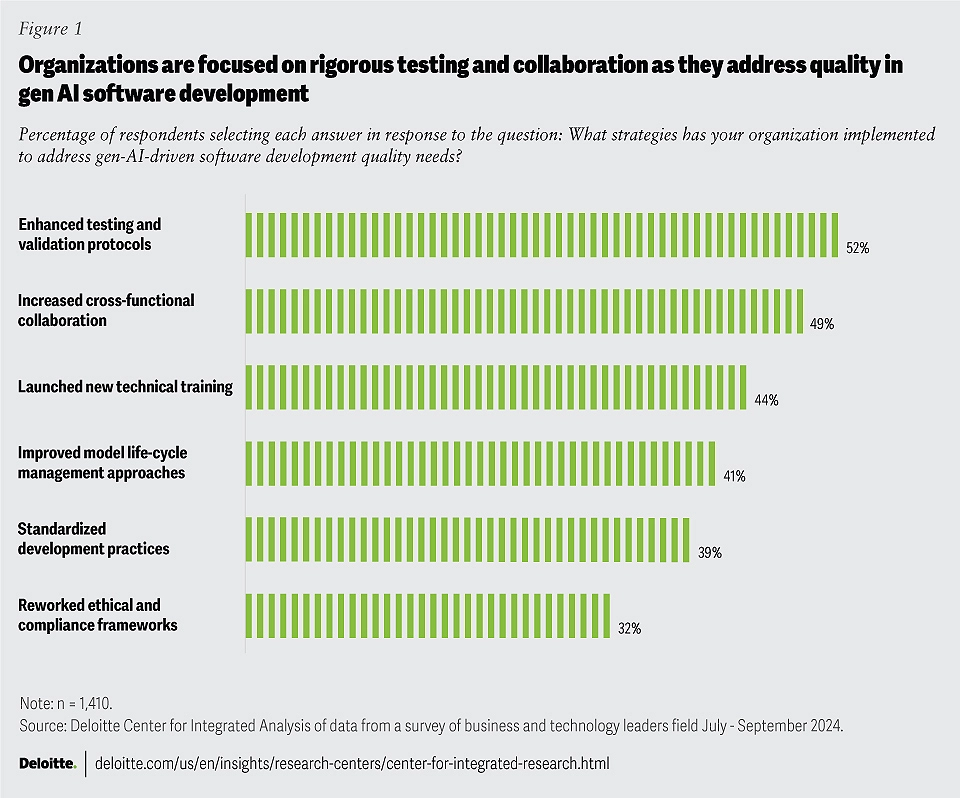
It’s already happening
This is not a thought experiment. Enterprises are deploying AI-powered coding tools at scale, and the results are showing up in real numbers.
- Deloitte has observed that AI-assisted development is rewriting the economics of software modernization, bringing the cost and complexity of bespoke solutions down to a level that no longer demands large teams and multi-year timelines.
- Walmart has reported saving more than 4 million developer-hours per year through AI-driven automation, equivalent to putting 2,000 full-time developers on the payroll.
- National Australia Bank expanded its adoption of Amazon CodeWhisperer from 20 engineers to over 1,000 in just a few months, recording a 40% gain in productivity and a 45% improvement in code quality, with its New Zealand subsidiary, BNZ, positioned to follow suit.
Across all three cases, the pattern is consistent: AI is not standing in for engineers; it is making them more capable. The strongest developers are evolving into orchestrators - people who review, refine, and steer AI-generated output rather than writing every line from scratch.
“Within the next year or two, the role of the software engineer will look different again in ways that are difficult to fully anticipate today. That is precisely why engineers cannot afford to stand still.”
- Yevgen Balter, CEO at Altamira
AI-augmented software development vs. traditional approaches
Placing the two approaches side by side makes it easier to understand why the shift feels less like a choice and more like an inevitability.
Traditional development encodes knowledge in documents and checklists: static artifacts that depend on someone remembering to update them. AI-augmented development captures that same knowledge in executable models that operate at machine speed.
Take compliance reporting as an example. An AI model can pull dependency trees, CVE data, and license clauses, then assemble the finished document in minutes. Under a traditional workflow, a team might burn an entire sprint gathering the same evidence. Debugging follows a similar logic: log aggregation combined with anomaly detection can identify an edge-case memory leak days before it ever surfaces in a customer support ticket.
The numbers are hard to ignore. Controlled research on GitHub Copilot shows that developers working with AI coding assistants complete tasks considerably faster - in some studies, up to 55% faster -on routine work and code generation, lending real weight to the argument that AI can meaningfully cut the time spent on boilerplate and repetitive development.
Benefits of AI-enabled engineering
Bringing generative AI in as a coding assistant and documentation aid represents a meaningful redistribution of responsibilities, giving software engineers the opportunity to add prompt engineering to their professional toolkit. For companies that embed AI-enabled development into their operations, the advantages are tangible.

A productivity gain
AI-enabled engineering can cut the time engineers spend on repetitive work in half or, looking at it the other way, double how much they get done.
AI agents generate code and documentation in minutes, and even standard IDE integrations now ship with AI assistants that behave like intelligent feature editors.
These tools can identify orphaned functions, raise pull requests from existing repositories, and steadily chip away at accumulated technical debt. They can stand up sandboxed environments and push gated changes through CI/CD pipelines without manual intervention. All the while, the development team remains free to concentrate on system design, validation, and the edge cases that genuinely require human judgment.
3x faster time to market
AI-enabled engineering compresses the software development lifecycle to the point where products can realistically reach market well ahead of schedules that would have seemed ambitious just a few years ago.
10x faster prototyping
With AI-assisted development in the workflow, the journey from idea to working prototype shrinks from days to hours. Given the right guardrails, an AI system can produce a complete proof of concept within a single work session, making it far more practical to validate product ideas early and course-correct before significant resources are committed.
5x higher A/B testing bandwidth
AI-native engineering also opens up considerably more room to experiment. AI systems can generate multiple variants of a program in short order, enabling engineers to run A/B tests and determine which approach performs better for a given task.
Beyond generating the variants themselves, these systems can prepare test conditions and support rapid side-by-side comparisons, delivering cleaner analytical results to product teams without slowing delivery speed.
Where to start
For CIOs and software engineering leaders trying to figure out where to begin, a few practical principles can help cut through the noise.
Start with low-stakes ground. Applying AI tools to unit test generation or documentation on non-critical systems is a sensible first move. It builds familiarity without putting anything important at risk. From there, invest in developing real fluency across your engineering team, which means training developers not just to use AI tools but to work alongside them effectively, covering prompt engineering, output validation, and the judgment required to know when to trust a suggestion and when to push back.
At the same time, take a hard look at your DevOps infrastructure. If AI can produce 10 times the volume of code, your testing and deployment pipelines need to be built to handle that throughput; the tooling that served you well before may become the bottleneck.
It is also worth revisiting your build-versus-buy calculus with fresh eyes, because AI augmentation has shifted the economics in ways that make some things worth building internally that would have been easier to procure a year ago.
Finally, put governance in place before you need it, rather than after something goes wrong. Clear boundaries and consistent practices around AI-generated code are far easier to establish early than to retrofit later.
The final word
A decade ago, cloud computing reduced hardware procurement from weeks to minutes. AI-enhanced software development is doing something comparable to human cognition within the software lifecycle, compressing what used to require sustained manual effort into something that happens in the background, continuously and at scale.
The teams that have made this shift are already developing faster, with fewer defects and at lower cost than those still anchored to manual pipelines. The tools are mature, the return on investment is no longer a matter of speculation, and the engineering labor market is already moving in favor of developers who know how to work with prompts and orchestrate models effectively.
If your roadmap still relies on the handoff patterns from a few years ago, the window to close the competitive gap is narrowing. The time to pilot these capabilities, measure what they deliver, and scale what works is now, before competitors, partners, or regulators make the decision for you.
Get in touch to learn more.