
Your core banking system was built for a different era. Since then, it's been patched, extended with middleware workarounds, and wrapped in custom integrations: each one a response to a regulation, a product request, or a vendor deadline. It still runs. But "still runs" is no longer enough to stay competitive or compliant.
Compliance deadlines don't wait for internal roadmaps. Your customers compare your app to fintech products built on modern infrastructure. Competitors, neobanks in particular, ship new features in days. Meanwhile, your IT team spends up to 70% of its budget on keeping legacy systems transformation in banking operational. That leaves little room to build anything new.
The cost of delay is huge. Between January 2023 and February 2025, UK banks logged 158 IT failures, totaling 33 days of downtime. In January 2025, a single outage at Barclays froze payments and transfers for over 20 million customers. Every incident traced back to aging core systems held together with patches.
Banking legacy modernization is the work of replacing that risk not with a single disruptive rewrite, but through deliberate, module-by-module migration that keeps operations running throughout.
This article covers where to start, how to reduce delivery risk, and what a well-scoped modernization program looks like in practice.
Why legacy banking systems hold back growth
Legacy banking infrastructure doesn't fail all at once. Problems accumulate as delivery delays, compliance backlogs, and integration failures, and become visible only when they show up in outage reports and regulatory fines.
Learn more about AI strategy consulting services.
Slow release cycles create business risk
Legacy core systems were built for stability in a world where regulatory updates arrived annually, and digital channels didn't exist. They were never designed for frequent change.
Even minor updates now require extended testing cycles, specialized knowledge of outdated technologies, and system freezes that carry real operational risk. While 62% of banks planned to offer real-time payments in 2025, up from 49% in 2024, many remain tied to core systems that can't support the load. Fintechs and neobanks already offer those services.
Compliance changes are harder to implement
Regulatory requirements like AML transaction monitoring, PSD2 open banking standards, and GDPR data handling now arrive as a continuous flow, not a periodic event. Legacy systems weren't built to absorb that cadence.
Each new requirement requires custom code written against a system that its original authors no longer support.
The workarounds compound. Global banks paid $10.4 billion annually in non-compliance fines, with legacy limitations directly contributing to AML monitoring failures. When audit trails are fragmented, and reporting pipelines require manual intervention, every compliance cycle becomes a fire drill.
Learn more about our trading platform legacy modernization efforts.
Data and channel integrations stay fragmented
Core banking software requires data to flow in real time among core platforms, digital channels, fintech partners, analytics tools, and customer interfaces. Legacy monoliths weren't built for that. They were designed as closed systems with proprietary data formats and limited external interfaces.
A 2024 industry study found that 55% of financial institutions can't support real-time payments due to legacy limitations. The problem isn't only payments. It's the broader inability to connect core transactional data to the channels and tools that customers and regulators now expect.
What banks should modernize first
Not everything needs to change at once. A well-scoped modernization program isolates the highest-risk areas, addresses them without disrupting operations, and builds from there. Three areas consistently surface as the right starting points.
Core transaction logic
Account management, payments processing, and ledger operations sit at the center of any banking platform. They're also the most likely source of outage risk, compliance exposure, and release bottlenecks because changes to core logic require touching systems that were never designed to be modified.
Modernizing core transaction logic means decoupling that logic from the surrounding monolith. It becomes testable, deployable, and auditable in isolation. This is the work that makes everything else possible.
Integration and API layer
Most legacy banking systems don't have a clean integration layer. They have a tangle of point-to-point connections built up over years of product additions and vendor agreements. A structured API layer provides your bank with a standard way to connect to digital channels, fintech partners, and analytics tools without triggering cascading changes to the core system whenever a connection changes.
This is also what enables open banking compliance. PSD2 requires banks to expose account data to authorized third parties through secure APIs. Without a modern software integration layer, that's either impossible or requires building something temporary that creates more technical debt.
Audit trails and reporting flows
Audit and reporting are often treated as secondary concerns: infrastructure to update after the core work is done. In practice, they carry significant regulatory risk on their own. Fragmented audit trails, manual reporting processes, and batch-based compliance pipelines are direct causes of regulatory failures.
Modernizing these systems: building automated audit trails, real-time reporting pipelines, and structured control mechanisms, directly reduces compliance risk. It also makes it easier to absorb future regulatory changes faster and at lower cost.
How banking legacy modernization reduces risk
The instinct to avoid touching a legacy system is understandable. The risk of a failed migration is real. But inaction compounds that risk every year: in maintenance costs, compliance exposure, and the growing gap between what your system supports and what the business needs.
The right modernization approach doesn't require a risky rewrite. It requires methodical, risk-managed change.
Refactoring high-risk modules
We start by identifying which parts of your existing system carry the most risk: modules with the highest failure rates, the most regulatory exposure, or the most complex dependencies. Those get refactored first.
Refactoring at the module level means improving code structure, separating concerns, and adding test coverage without replacing the underlying system all at once. It reduces the blast radius of future changes and gives your engineering teams the visibility they need to plan deeper migration work.
Explore our legacy code refactoring service.
Moving from monoliths to modular services
The Strangler Fig Pattern, building new services alongside the existing monolith and gradually replacing it, module by module, is now the standard approach to banking modernization. It avoids the catastrophic risk of a big-bang migration while delivering incremental improvements in delivery speed and system stability.
Moving to independently deployable microservices reduces release cycles and minimizes the risk of system-wide failures during critical updates. Each module that moves to a modern service reduces the overall fragility of your platform.
Preparing banking platforms for cloud readiness
Cloud adoption in banking has moved from "if" to "when and how." Comfort with cloud-based solutions across the financial industry has risen from 11% in 2014 to 93% in 2024. The barrier is rarely strategic intent, it's the practical difficulty of moving systems that weren't designed for cloud deployment.
Containerizing applications, decoupling infrastructure dependencies, and redesigning deployment models before migration reduces risk and gives your bank flexibility in how and when you move. Cloud migration also lowers infrastructure costs: it generates approximately 13% in annual operational savings through automated scaling and reduced downtime.
Why Altamira is a strong fit for banking modernization
Altamira is a software development company with over 10 years of experience in custom software development and digital product development, with a strong focus on banking legacy app modernization service.
Our approach is scoped rather than open-ended: they take responsibility for clearly defined modernization tasks: refactoring high-risk modules, modernizing integration layers, or stabilizing compliance-critical workflows, rather than positioning every engagement as a full platform replacement.
The core of our banking modernization offers four areas:
- Modernizing account, payments, and ledger systems without disrupting daily operations, by decoupling critical logic and reducing release risk
- Updating audit trails, reporting pipelines, and control mechanisms to support continuous compliance, reducing the manual overhead of each regulatory cycle
- Unlocking data trapped in legacy systems so core platforms can connect with digital channels, fintech partners, and analytics tools in real time
- Redesigning infrastructure and deployment models to prepare systems for secure cloud adoption, reducing infrastructure costs and removing vendor lock-in
Our Ckients report faster delivery and up to 30% cost reduction once modernized solutions go live.
Our team also works with organizations in healthcare, commodity trading, and fintech: sectors where data security, regulatory compliance, and system reliability are non-negotiable. That cross-sector experience with compliance-sensitive environments translates directly to banking contexts.
A practical checklist before starting modernization
Before beginning any modernization engagement, complete a baseline assessment. These items are the minimum foundation for a well-scoped program.
System inventory and risk mapping
- Document all active legacy systems, their dependencies, and integration points
- Identify which modules have the highest failure rates or regulatory exposure
- Map data flows between core systems and external channels or partners
Compliance and regulatory baseline
- Audit current audit trail completeness and reporting pipeline reliability
- Identify pending regulatory requirements (e.g., PSD2, AML updates, GDPR) and assess readiness gaps
- Confirm which compliance functions are manual versus automated
Delivery and release capacity
- Measure current release cycle length for core system changes
- Identify which teams hold critical knowledge of legacy components and assess key-person risk
- Document existing test coverage for core transactional logic
Architecture readiness
- Assess API layer maturity: structured or point-to-point
- Evaluate infrastructure for cloud readiness: containerization, dependency coupling
- Identify vendor lock-in risks in current infrastructure contracts
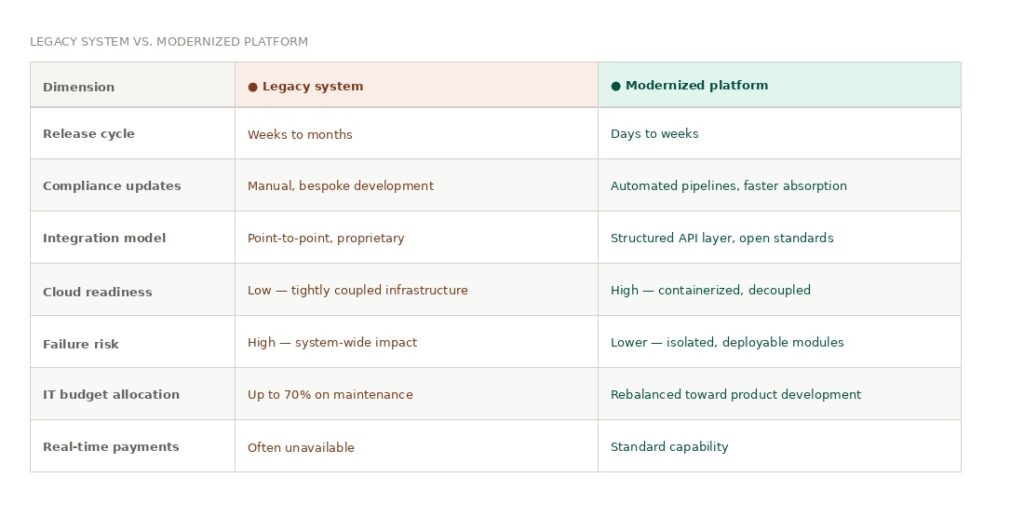
Comparison: Legacy System vs. Modernized Platform
| Dimension | Legacy System | Modernized Platform |
|---|---|---|
| Release cycle | Weeks to months | Days to weeks |
| Compliance updates | Manual, bespoke development | Automated pipelines, faster absorption |
| Integration model | Point-to-point, proprietary | Structured API layer, open standards |
| Cloud readiness | Low - tightly coupled infrastructure | High - containerized, decoupled |
| Failure risk | High - system-wide impact | Lower - isolated, independently deployable modules |
| IT budget allocation | Up to 70% on maintenance | Rebalanced toward product development |
| Real-time payments support | Often unavailable | Standard capability |
Conclusion
Banking legacy modernization isn't a single project with a clear end date. It's a shift in how your bank manages technology, from treating the core system as something to protect from change, to treating it as something you can change safely, incrementally, and with predictable results.
Maintenance spending that crowds out product investment, compliance failures driven by fragmented audit trails, and outages caused by systems never designed for today's demands: these are the real costs of waiting.
The alternative isn't a high-risk rewrite. It's a scoped, module-by-module program that delivers measurable risk reduction at each stage. The banks that start this work now will have infrastructure in place to absorb the next wave of regulatory change and rising customer expectations. The ones that wait will manage the same risks, only at greater cost.
Ready to scope your modernization program? Contact us
FAQ
What is core banking software?
Core banking software is the back-end system that manages a bank's essential operations: account management, deposits, withdrawals, loan processing, payments, ledger records, and regulatory reporting. It runs centrally, so customers can access accounts and execute transactions from any branch or digital channel: mobile apps, ATMs, or online banking, with balances and histories updated in real time. The acronym "core" is sometimes parsed as Centralized Online Real-time Environment, though the term now applies broadly to any system that handles these foundational banking functions.
Who provides full-suite core banking software?
The leading full-suite providers include Temenos Transact, Oracle FLEXCUBE, Finastra Fusion Essence, Infosys Finacle, FIS, Fiserv, and TCS BaNCS. These platforms cover retail, corporate, and often investment banking functions within a single system and are used by large, established financial institutions globally. Cloud-native platforms such as Mambu and Thought Machine offer modular full-suite coverage and are more commonly adopted by digital-first banks and neobanks.
What are the top legacy core banking systems?
The most widely evaluated platforms in 2025–2026, based on market adoption and analyst reviews, are Temenos Transact, Mambu, Thought Machine Vault, Oracle FLEXCUBE, Infosys Finacle, FIS Profile, Fiserv/Finxact, Finastra, and TCS BaNCS. The right platform depends on institution size, business model, geographic coverage, and architecture goals. Mambu and Thought Machine are generally preferred for fintech-native or digital-first contexts. Temenos, Oracle, and Finacle are better suited to large, established banks with complex regulatory requirements.
How do you choose a core banking software provider?
Provider selection comes down to five criteria: functional coverage, API maturity, deployment model (cloud, on-premises, or hybrid), regulatory coverage in your operating regions, and total cost of ownership, including implementation, licensing, and migration. Evaluate the provider's upgrade track record and the level of customization your operating model requires. High customization often signals a poor product-to-process fit and increases long-term maintenance costs.
How does core banking software work?
When a customer initiates a transaction: a payment, transfer, or balance check, the request travels from their channel (mobile app, ATM, branch terminal) to the core banking platform. The system validates the transaction, checks account balances and applicable limits, applies fees or interest where relevant, and updates the central ledger. That updated state is reflected consistently across all connected channels. Every branch and digital interface operates from the same real-time data, rather than maintaining separate local records that require periodic reconciliation.
How do banks modernize legacy systems without replacing everything at once?
The standard approach is incremental migration using the Strangler Fig Pattern: new services are built alongside the existing system and gradually replace individual modules, while the legacy core continues handling everything else. Each module like payments processing, customer onboarding, reporting pipelines is migrated, tested, and stabilized in isolation before the next piece of work begins. Daily operations continue uninterrupted throughout. This avoids the operational and reputational risk of a big-bang rewrite.
What is the safest starting point for banking legacy modernization?
The safest entry point is the integration and API layer: the part of the system that connects the core platform to digital channels, fintech partners, and internal tools. Modernizing this layer doesn't require touching core transaction logic directly. It immediately reduces the risk of fragmented data flows and gives your engineering teams visibility into how the broader system behaves under change. Once the integration layer is structured and observable, modernizing higher-risk components: audit trails, compliance reporting, and eventually core transaction logic - becomes significantly less likely to cause unplanned failures.