
If you ask us what makes any company successful, we’ll say: “its employees”. It is hard to underestimate the true power of a great team. That’s why so many businesses these days pay special attention to employee hiring, onboarding and further management.
However, it is not an easy task to be in charge of all processes when you are responsible for human resources. And if your company doesn't have all the necessary tools for HR managers, then they definitely work too hard and are not productive enough, their resources can be allocated more effectively.
Without a custom HR management system it gets so hard for HR managers to keep all information in order and centralized, control billing and perform efficient management of all business processes. On top of that, companies that still do not have functional HR tools have issues with productive hiring, motivational programs for employees, and progress monitoring. And all these issues can be easily eliminated with one thing - custom software.
It is hard to imagine how a modern company can function without custom HR solutions that are fully adjusted to all business processes. Therefore, we decided to share our own development experience in this post, covering all important questions related to custom HR tools. We will describe key types of HR tools, their must-have features, major benefits and development specificities. So, without further ado, let’s get started.
 If you give some good thought to each of these trends and take into consideration the challenges we’ve named above, you will conclude that a software for HR managers becomes a must-have for a business of any size. And now is the right time to invest in it!
The total cost is $46,688 and 1791 h. If the budget that you are willing to spend on the development of your HR solution is tight, you should not give up the idea of custom development. There is one great option called MVP that will let you build a basic version of the desired solution from scratch and then keep investing in it and improving it with time as per the availability of resources for the project.
MVP will cost you less and yet it will be better than using a ready-made solution (that may lack some crucial features or integrations and not be flexible enough for your company).
Key HR challenges custom solutions can solve
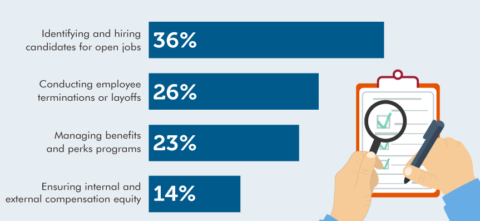
Robert Half company has recently conducted a survey among HR managers to identify what areas of their work and what routine operations they find the most challenging and tiresome. Here is what the survey helped to discover:
Image source: Robert Half
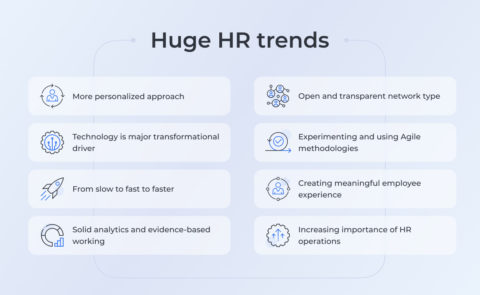
This infographic shows that there are four key challenges that every HR specialist encounters on a daily basis. And we presume that this happens mostly because companies either do not have special software for HR management, or they use ready-made tools that are not fully adjustable and suitable for their business. And now let’s take a closer look at all HR challenges that can easily be dealt with if you incorporate necessary software into your business environment. We have asked our own HR specialists and consulted with several recruiters from other companies and they’ve named the following problems they’ve experienced before they started using HR solutions: [user-stories] [user-story title="Decentralized data storage"]Many companies still don’t have a holistic database that lets you save all information related to each separate employee in one place (and then easily find any piece of that information). On top of that, HR managers may experience difficulties with tracking applicants and reviewing candidate profiles and data. [/user-story] [user-story title="Old-fashioned appraisal system"]Unfortunately in 2021, some companies don’t pay enough attention to employee reviews, feedback and performance metrics. In some companies, there is even no appraisal or performance review system at all. So they offer employees to complete questionnaires in Google sheets, and then all collected information is often left forgotten, unanalyzed or just gets lost. [/user-story] [user-story title="Payroll management is too tedious"]When it comes to salaries, every employee appreciates transparency and hates delays. But is it possible to ensure transparency without a special system for payroll management? Unfortunately not, businesses need such systems that help to insert all employee payroll adjustments in one centralized system and avoid any misunderstandings. For example, if an employee wants or feels that they deserve a salary raise, they should be able to request it in the form of e-query for the review of the head HR manager and then the company owner. [/user-story] [user-story title="Managing absences and leaves is complicated"]We all remember the times when before planning a holiday,an employee had to pay HR a visit, ask about leave possibilities and then write an official request with pen and paper. There was no online company calendar, there was no absence management system available. And it was a catastrophe for big companies. Today, however, this is all but history. To ease the management of leaves and absences, every business needs a system where all requests will be stored and visible for review. Additionally, every employee will be able to see who is absent from the office and when to expect that specialist back. Otherwise, absence management will make HR lives a nightmare and the company in general is always scrambling to pinpoint who is working on a given day and who isn’t. [/user-story] [user-story title="Reporting and audit require much time"]Every company these days strives to make data-driven decisions, and it is impossible to achieve this if one of the departments lacks information or cannot provide real insights. It is more efficient to do reporting and audit using an app than handling dubious amounts of paperwork. Plus, it is easier and faster to retain, check and change information if it is stored in electronic form. [/user-story] [user-story title="Employee onboarding is not good enough"]Needless to say that after hiring a person you need to help that person with integration into the working environment, showing them the ropes of where to start and where to go and what to do from there. Also, all employees, old or new, need to refresh or improve their qualifications from time to time. Therefore, corporate learning needs to be thoroughly integrated into the company structure and be relevant to necessary underlying business activities. In most cases, HR managers experience difficulties with scheduling and monitoring training sessions and then checking their real progress. [/user-story] [/user-stories] According to the HR Trend Institute, digitalization should become a major transformational driver of the HR industry in the coming years. Among the mega HR trends that experts point out are:
If you give some good thought to each of these trends and take into consideration the challenges we’ve named above, you will conclude that a software for HR managers becomes a must-have for a business of any size. And now is the right time to invest in it!
Major benefits and value custom HR tools bring
It is understandable that you may have some doubts whether you really need your own custom solution. Does it really bring as much value as it costs? Will your company benefit from custom HR tools development? We cannot leave you with all those questions. So to dispel all your doubts, let’s speak about the true benefits and value of custom HR solutions. [user-stories] [user-story title="Improve recruitment quality"]advanced HR management system will let your managers formulate better vacancy announcements, monitor and select the most qualified and suitable candidates, check their contacts and add to your system. You can even form your own candidate list and contact a needed person whenever there is an open position corresponding to that person's skills. [/user-story] [user-story title="All data in one place"]it is hard to underestimate the power of a centralized HR management system where all employee profiles are up to date, all sick leaves and vacations are properly scheduled and displayed in a company calendar, where every single crucial document related to hiring, onboarding and layoffs is readily accessible. [/user-story] [user-story title="One solution for many purposes "]what can be worse and less productive than having to juggle between several solutions to find all necessary data or perform several different tasks? With a custom multifunctional HR tool, your managers can forget about that mess and focus on their tasks that really matter and on their personalized approach to each employee, which in turn improves the overall efficiency. [/user-story] [user-story title="Reduce operational costs"]with one custom software you can forget about monthly fees or additional payments for ready-made services. You will have a broadly functional tool that works for you and saves you time, money and stress. Plus, automation can unleash the productive potential of HR managers, which means that you do not need to hire additional specialists or interns to help support your HR department operations. [/user-story] [user-story title="Better control over processes"]when you have one centralized system, you can monitor all key performance indicators by yourself. This leads to a more data-driven approach, fair evaluation of employees' work performances, and the creation of realistic business goals. [/user-story] [user-story title="All finances are in order"]thanks to the HR management solution, your managers can handle taxes, payroll, sick leaves and vacations, and set up a system for merit-based bonuses or performance-based compensation. And at the end of the month or even a whole year it is easier to process all financial data, reconcile, perform estimations for the future working periods and understand how your company is doing. [/user-story] [user-story title="Better communication with employees"]in most cases the success of the company depends on employees. If they are satisfied - they are productive and motivated. If they aren’t - they should be able to leave grievances, make suggestions for changes or communicate about their desire for lateral movement within their roles or to make a pivot into an entirely different position or capacity at the company. And this can all be done within an HR system. Employee feedback can be left online and then you can easily review it and attend to all issues that you deem necessary. [/user-story] [user-story title="Form your corporate culture"]The way employees interact with each other and receive all fresh news influences your corporate culture. For example, a custom HR system can send your employees reminders about big events or special dates of their colleagues (Birthdays, company anniversaries, new hires, completion of internship or probation). Also you can set up email alerts or even create daily to-dos and share them with your employees to strengthen team spirit and always keep colleagues updated on everything meaningful and important in your company. [/user-story] [/user-stories]Main types of HR solutions
HR departments in companies are responsible for endless tasks related to specialist assessment, hiring, onboarding, training and professional development. So to handle all those tasks and improve efficiency, HR managers may need a special set of solutions. There are so many kinds of HR tools in the world today that it’s easy to get overwhelmed, so we have decided to break it down and describe the main ones and what tasks they can help automate in your company.HR management system
The HR management system is probably one of the best tools that a company can incorporate. This is a holistic multifunctional system that helps manage human resources and all related processes throughout the employment lifecycle. What’s even more exciting about this software is that it encourages employee self-service, self-organization and significantly increases engagement. Among the best options that different HR management systems can be summarized as having are:- Easy candidate management and progress monitoring.
- Employee engagement and control.
- Calculation and line-item breakdown of salary from gross to net and vice-versa.
- Performance tracking and individual development plan setting.
- Overall company workforce management.
- Centralized storage of training and corporate learning materials.
- Reporting, feedback and analytics.
- Time and attendance checking/tracking.
- Advanced planning and scheduling options.
Job board
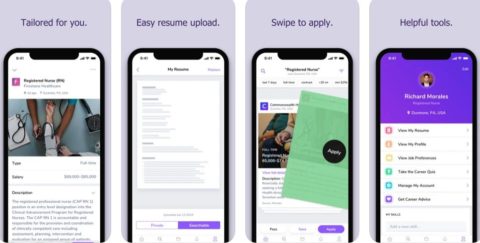
It is hard to imagine a more useful solution for recruiters than a custom job board. This software lets your company search for certain specialists you require at a given moment, and even post your own job ads based on your specific business needs to best fill a position. Sometimes companies build small job boards that with time transform into huge networking platforms. So it can be said with certainty that job boards are highly scalable making them a great investment. Job boards can have incorporated advanced analytic tools, built-in tools for creating microsites of companies with available vacancies, social media integration, smart search that helps find candidates with similar skills or experience and many more. Also job boards can have a huge CV database where everything is in order and easy to access (depending on user roles and permissions). Job boards can decrease time spent on looking for a suitable candidate, speed up job posting and improve applicants management (no application or message will get lost). One of the good job board examples is a platform called Monster. It is available in web and mobile format and it has a range of very useful features such as personalized job recommendations, easy work with CV creation and posting, career quizzes, option letting to apply to multiple jobs and much more.
Image source: Monster
Applicant tracking system
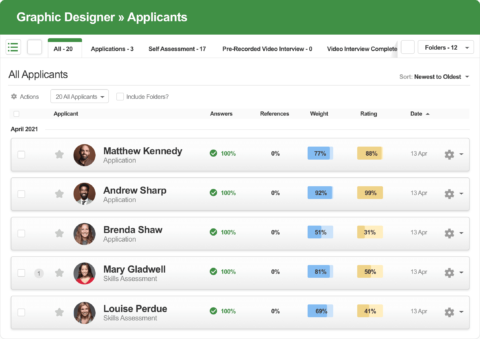
The companies that still struggle with the hiring process should pay special attention to applicant tracking systems, since this solution can automate a lot of useful operations. Applicant tracking system can either be a separate desktop application or an online service with numerous functions. The type of ATS depends on the company size and key needs. Most ATS can process huge amounts of data, help you filter applications according to specific requirements or filters, match vacancies with candidates, collect lots of information about each separate applicant and then store, analyze and process it easily. Applicant tracking systems help free up HR managers’ time, raise awareness of the hiring company or its brand, and use collected data to increase hiring quality, and form future strategies of hiring and onboarding. Let’s take VidCruiter as an example of an applicant tracking system. This solution helps you to organize a high class candidate pool, sort through an enormous amount of CVs, perform collaborative hiring, and even complete interviews with interested candidates. Here is what VidCruiter interface looks like:
Image source: VidCruiter
Performance review software
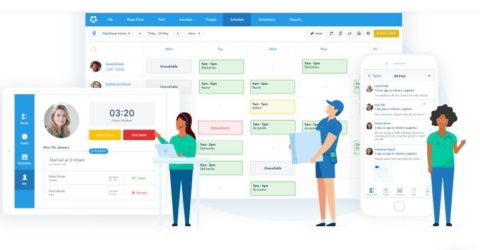
Performance review software is one more tool that can help your company achieve a whole new level. If your business lacks visibility when it comes to performance indexes, if you don’t have profound tools such as real-time feedback, personal employee growth plans, or reliable reporting systems, then you obviously need a performance review solution. With performance review software your employees can appraise their work and overall working atmosphere, and your HR specialists can set them personal goals, tasks, and set up an individual growth plan. On top of that, all metrics and indexes related to employee productivity can be collected, analyzed and stored in one place. And you can even compare the overall company or department performance between different years. And if current performance is lagging, devise a plan for remedying that. One of the most popular performance review solutions is Deputy. It is a ready-made solution that lets you easily monitor performance and productivity of your business. Employees can schedule tasks, communicate with each other or specialists from other departments, monitor live balances, send work related questions or requests, and monitor real productivity of each employee.
Image source: Deputy
We have also discovered one video that shows some more great HR solutions that can inspire you to build your own, maybe even better one. So hurry up and check out the video below: [youtube src="https://youtu.be/fRVJMdGIf-A"][/youtube]How to develop your own HR management software
Custom development of HR software is a holistic and complex process that requires a team of real professionals. Your future project will go through several key stages before it is all set and ready for active use. Whatever kind of HR tool you are developing, first of all you will need to find a developers team that includes the following specialists:- Business Analyst;
- Server Administration;
- Designer;
- HTML/CSS Developers;
- Back-end Developers;
- Manual/Automated QA Engineers;
- Scrum Master.
- A SaaS HR management system for businesses,
- A platform for recruitment cooperation,
- Several job boards and job search platforms;
- Tools for onboarding and corporate education;
- Mobile applications for employee management;
- Apps for employee experience management;
- Web systems for performance review and many more.
HRMS Development Life Cycle
We’ve already mentioned that developing such a solution includes several steps, and the main ones are: [user-stories] [user-story title="Discovery stage"]during the Discovery stage our Business Analyst explores the best HR tools, delves into your business model and suggests the best features, tech stack and practices for your custom software. After the discovery stage you will get all of the necessary technical documentation that will let you proceed into further stages.[/user-story] [user-story title="Prototyping and design"]that’s when your future HR solutions will be designed. The designer will create the concept, take care of all interfaces, sections and solution logic. After that stage you will be able to see how your future solution can look and suggest changes if needed. [/user-story] [user-story title="Coding"]this is the main part of the HR app development, our experienced tech takes will write high-quality code, perform integration of all necessary services and tools, implement all features. [/user-story] [user-story title="Quality Assurance"]when the coding is finished our testers need to check if everything is fine with the code and whether all options, APIs and other crucial elements function as they are supposed to. Here at Altamira we perform manual and automated testing of solutions, which helps us to make them highly efficient, running smoothly and very securely.[/user-story] [user-story title="Release and maintenance"]after the HR solution is all set and ready we perform its release and integration into your existing environment. We also offer maintenance options that will help you perform crucial app checks from time to time and update options or APIs. [/user-story] [/user-stories] [notify-widget title="PRO TIP" emoji="?"]While building an HR solution it is important to pay special attention to its security, since it is going to process and store information about your employees and business processes. Our team applies special security practices to ensure the highest level of security. Check out this post for more details. [/notify-widget]How much does custom development cost?
The final price of custom HR software will depend on its type, desired feature set, and overall complexity of work. We can say that the approximate development price of such HR tools as job boards and SaaS HR management platforms is $40,000 - $60,000. This may seem very pricey, however custom development cannot be cheap. After all, you are building a solution from scratch, and it will be fully adapted to your business and seamlessly integrated into its environment. Based on our experience, we created a table with prices and development hours for you. By taking a look at it you can understand what it takes to build your own HR software:| Stage | Dev Hours | Dev Cost |
| Specifications | 132 h | $3960 |
| Design | 127 h | $2794 |
| HTMLCSS | 120 h | $2160 |
| JS Development | 239 h | $7170 |
| PHP Development | 468 h | $14040 |
| Manual Testing | 183 h | $3660 |
| Automated Testing | 148 h | $3996 |
| Admin | 34 h | $748 |
| Scrum Master | 340 h | $8160 |