
A contact center handling 200 calls a day generates over 160,000 spoken words every 24 hours. That's more than a million words a week. This data is locked inside audio files that most operations teams never fully analyze. On top of that, they don't know what to measure or why. As a result, companies fail at data-driven decision-making.
So, vendors keep selling new voice AI tools as the answer. However, more technology doesn't fix a measurement problem.
This article is for operations leaders who want to make a secure decision about speech analytics software: what it does, which metrics matter before you go to market, and how to know whether an off-the-shelf product or a custom solution is the right call for your environment.
Why contact centers keep buying voice AI tools without fixing the core problem
The speech analytics market is growing fast, so the customer experience management software segment is projected to expand at roughly 15.8% annually through 2030. That growth reflects real demand. But it also masks a pattern: organizations invest in new tools while the foundational problems that limited their previous tools remain untouched.
Fragmented call data
Most US contact centers run a mix of telephony systems, IVR platforms, workforce management tools, and CRM databases that were never designed to share data with each other.
Call recordings sit in one silo. Customer history sits in another. When a voice AI tool is layered on top, it analyzes calls in isolation, without the context needed to make actionable insights. You end up knowing that a customer was frustrated on Tuesday without knowing they had three unresolved tickets in the prior month.
Explore what's possible with AI chatbots in your organization
Poor metric design
Organizations often deploy speech analytics software to capture what's easy to measure rather than what's useful. Word frequency counts and average call duration tell you something, but they don't tell you whether your agents are resolving problems or just ending calls faster.
Without a clear definition of what success looks like before implementation, the output from any natural language processing NLP system becomes a dashboard that people glance at and ignore.
Explore NLTK development
Agent adoption gaps
Even well-configured machine learning tools fail when agents don't trust or understand the output. If agents receive coaching based on AI-flagged calls but don't see a connection between that feedback and their actual performance, they treat the system as surveillance rather than support.
Adoption fails quietly because the tool runs in the background, reports get generated, and nothing changes.
Explore AI agent development services
What speech analytics measures
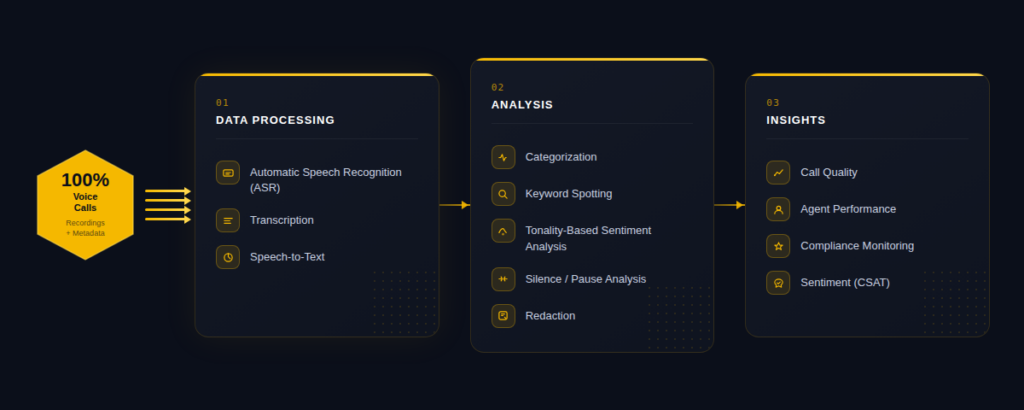
Speech analytics is the process of capturing, transcribing, and analyzing customer conversations using artificial intelligence and natural language processing. It converts raw audio into structured data that can be searched, categorized, and acted on.
Speech analytics software vs. voice analytics - key differences
| Dimension | Speech Analytics | Voice Analytics |
|---|---|---|
| Primary input | Transcribed text | Raw audio signal |
| Core technology | NLP, large language models | Acoustic modeling, neural network |
| What it detects | Keywords, topics, intent, compliance phrases | Tone, pitch, pace, emotional indicators |
| Real-time capability | Possible, with low-latency models | Yes, standard in modern platforms |
| Accuracy dependency | Transcription quality | Audio recording quality |
| Best use case | Compliance monitoring, topic trending, FCR analysis | Escalation detection, live agent guidance |
| Data output | Structured text, categories, scores | Acoustic scores, customer sentiment signals |
| Software integrationcomplexity | Moderate (requires CRM linkage for full value) | Low to moderate |
Transcription accuracy
Everything downstream depends on transcription quality. A neural network trained on general speech will struggle with industry-specific terminology, regional accents, or noisy call center audio.
In practice, transcription accuracy rates vary significantly, even leading platforms can produce word error rates above 20% on contact center audio without domain-specific tuning. Before evaluating any vendor, test their transcription accuracy against a sample of your actual recorded calls, not synthetic benchmarks.
See what you can achieve with a chatbot and recommendation engine development
Keyword and topic detection
Once calls are transcribed, the system scans for keywords and phrases tied to specific topics: complaints, product names, competitor mentions, and compliance language.
This is one of the most mature capabilities in the space and works well when topic taxonomies are well-defined. The risk is over-indexing on surface-level keyword hits while missing calls where the same problem is expressed differently.
Intent recognition
Intent recognition goes a level deeper than keywords. Rather than detecting that a customer said "cancel," it tries to determine whether they mean it, whether they're comparison shopping, or whether they're expressing frustration as a negotiating tactic.
This is where generative AI and large language model updates have made a meaningful difference: modern systems can interpret conversational context in ways that keyword matching cannot. That said, intent recognition accuracy drops sharply when call audio quality is poor or when conversations involve multiple overlapping topics.
What voice analytics adds
Voice analytics is distinct from speech analytics. While speech analytics software primarily works with transcribed text, voice analytics processes the audio signal itself: pitch, pace, volume, and other acoustic features. The two are often packaged together, but it helps to understand what each layer contributes.
Tone and emotion signals
Voice analytics uses acoustic modeling to infer emotional state from speech patterns. A customer speaking faster than their baseline, with rising pitch and shorter pauses, is likely agitated, even if their words are polite.
This signal can surface in real time, making it operationally valuable: supervisors can see live indicators without listening to every call. The caveat is that emotion inference from voice is probabilistic, not definitive. It should inform human judgment, not replace it.
Sentiment trends
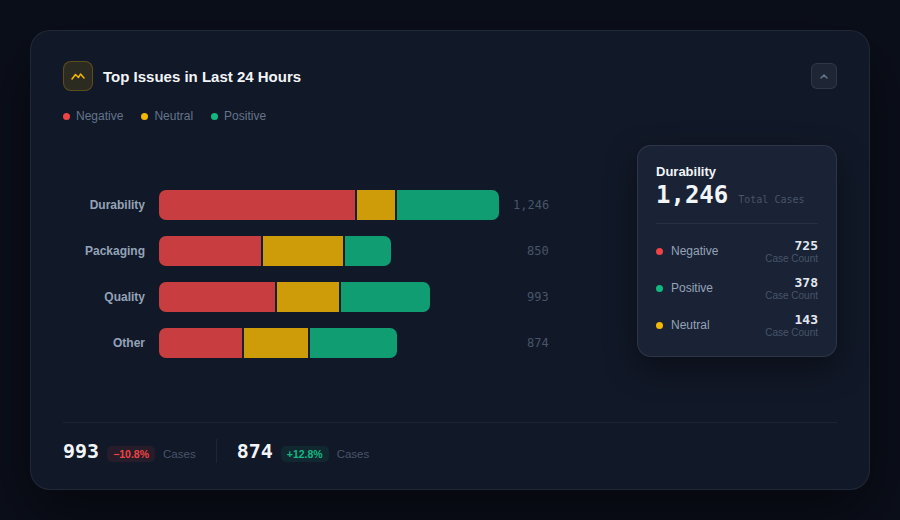
At scale, sentiment data across thousands of calls reveals trends that individual call reviews can't, which product lines generate the most negative reactions, which agent teams show consistent sentiment deterioration after certain script changes, and which hours of the day produce the highest customer frustration rates.
Agentic AI applications can now surface these trends automatically and trigger workflow actions based on sentiment thresholds.
Escalation risk detection
One of the more practical applications of voice analytics is real-time escalation detection. When a combination of acoustic signals and conversational cues suggests a call is heading toward a demand for a supervisor or a churn event, the system can alert a supervisor before the situation deteriorates.
According to industry data, companies using real-time analytics guidance report measurable reductions in escalation rates, but this only works if the alert thresholds are calibrated to your call population, not a vendor's generic model.
Metrics to define before vendor selection
The most important work in a speech analytics implementation happens before you talk to a vendor. Defining the metrics you need to influence, especially with target values and measurement baselines, determines whether you can evaluate any tool honestly.
Average handle time
Average handle time (AHT) is often the first metric cited in contact center speech analytics ROI discussions because it's easy to calculate and improve on paper.
The problem is that reducing AHT without understanding why calls are long frequently moves the problem rather than solving it. Long calls caused by unclear IVR routing are different from long calls caused by agents lacking product knowledge. Speech analytics tools should help you distinguish between these causes, not just flag the calls that ran long.
First contact resolution
First contact resolution (FCR) is a harder metric to measure, but more meaningful. A call that ends in three minutes and generates a callback two days later is worse than an eight-minute call that fully resolves the issue.
Machine learning models can be trained to predict FCR based on call content and outcome data, but this requires linking speech analytics output to CRM follow-up data, which most organizations haven't done.
Compliance risk rate
For US contact centers operating under regulations like TCPA, FDCPA, or HIPAA, compliance language detection is one of the clearest use cases for speech analytics tools.
The metric here is the percentage of calls where required disclosures were missed, prohibited language was used, or consent language was absent. This is measurable with high precision once compliance phrases are properly configured, and the cost of getting it wrong makes the configuration effort worthwhile.
Agent coaching impact
Most speech analytics platforms include some version of AI process automation coaching: flagged calls, performance scores, and suggested training content. The metric that actually matters is whether coaching changes agent behavior over time.
Track whether agents who receive AI-identified coaching on specific call behaviors show improvement in those behaviors within 30 and 60 days. If there's no measurable shift, the coaching model isn't working regardless of how sophisticated the underlying system is.
Data readiness for speech analytics
Call recording quality
Speech analytics accuracy is directly limited by recording quality. Calls recorded at low sample rates, with high background noise, or over degraded telephony connections will produce poor transcriptions regardless of the model used.
Before implementation, audit a representative sample of your recordings. If a significant portion doesn't meet basic audio quality thresholds, that problem needs to be fixed at the infrastructure level first.
CRM data linkage
Speech analytics in isolation produces call-level insights. Speech analytics linked to CRM history, ticket data, and purchase records produces customer-level insights.
The difference matters enormously for metrics like FCR and customer lifetime value. The integration work requires matching call records to customer identifiers across systems with different data models, but it's what separates surface-level reporting from genuinely actionable intelligence.
Consent and retention rules
In the US, call recording consent requirements vary by state. Two-party consent states, including California, Florida, and Illinois, require that all parties be notified and consent before a call is recorded.
Any speech analytics implementation must ensure that recording practices comply with state-specific requirements. Beyond consent, data retention policies need to specify how long transcripts and voice data are retained, who can access them, and what deletion obligations apply, particularly for calls that involve healthcare or financial information.
The build vs. buy decision
When off-the-shelf tools are enough
The list of large language models and packaged speech analytics platforms available today is endless. For most mid-market contact centers with relatively standard call types, an off-the-shelf tool will cover the core use cases: transcription, keyword detection, sentiment scoring, and compliance monitoring. The criteria for choosing off-the-shelf:
- Your call volume is under 500,000 calls per month
- Your compliance requirements are standard and well-documented
- Your CRM and telephony systems are common platforms with existing integrations
- You have internal resources to configure and maintain the tool post-deployment
The key question is whether you can configure it accurately for your environment without significant vendor dependency.
When custom AI integration is safer
Custom or hybrid builds make sense when your data environment or risk profile is complex enough that a packaged tool creates more problems than it solves. Specifically, custom integration becomes the safer choice when:
- Your call types involve sensitive regulated data (healthcare, financial services, legal) that can't route through a third-party cloud environment
- Your compliance language requirements are highly specific and change frequently
- You need LLM capabilities that go beyond call analysis — for example, using open source LLM models to build real-time agent guidance tools on top of existing infrastructure
- Your CRM data model is non-standard, and the integration effort for off-the-shelf tools exceeds the cost of building a targeted solution
Small language models like domain-specific models trained on a narrower vocabulary are increasingly viable for contact center use cases. Because they're smaller and faster than general-purpose models, they can run inference in real time without the latency that makes large model predictions impractical for live call guidance. Open source options like Mistral, Phi-3, and similar models have made cost-effective deployment of custom NLP pipelines more accessible than they were two years ago.
How Altamira can support voice AI implementation
Speech recognition in artificial intelligenceand NLP expertise
Altamira builds custom natural language processing systems for organizations where off-the-shelf tools have underdelivered. That includes domain adaptation of transcription models for industry-specific vocabulary, fine-tuning of intent recognition, and integration of generative AI capabilities into existing contact center workflows.
Our work is grounded in the engineering discipline rather than vendor positioning, if a packaged tool is the right answer for your situation, that's what the assessment will show.
Integration with CRM and analytics systems
The operational value of speech analytics depends almost entirely on how well its output integrates with the systems your teams already use. We specialize in connecting speech analytics data to CRM platforms, workforce management systems, and BI tools, building the data pipelines that turn call-level transcriptions into customer-level intelligence. This includes handling the identifier matching, data normalization, and schema mapping that make cross-system analytics reliable.
AI governance for sensitive customer data
Customer service calls frequently contain personally identifiable information, protected health information, and financial data.
Any AI system processing this data needs governance controls that are designed in from the start, not added on after deployment. Altamira implements data access controls, retention policies, audit logging, and consent verification mechanisms that satisfy both regulatory requirements and internal risk standards. For organizations considering open source deployments, this includes a security review of the model stack and infrastructure configuration.
Conclusion
Speech analytics is a mature enough field that the technology is rarely the limiting factor. The organizations getting value from it have done the harder work: auditing their recording infrastructure, defining metrics that connect to business outcomes, linking call data to customer history, and building agent adoption into the implementation plan rather than treating it as an afterthought.
The right sequence is to define what you need to measure, confirm your data is ready to support it, and then select the tool.
If you're working through a speech analytics evaluation or rebuilding a voice AI stack that hasn't delivered, we can help at any stage of that process.
FAQ
What is speech analytics in a contact center?
Speech analytics uses AI and natural language processing to automatically transcribe and analyze customer calls. It converts audio into structured data by flagging topics, keywords, sentiment, and compliance language at a scale no human review team can match.
How is speech analytics different from voice analytics?
Speech analytics works on transcribed text: it identifies what was said. Voice analytics processes the raw audio signal: pitch, pace, and silence to infer how something was said. Most modern platforms combine both, but they answer different questions.
What metrics should contact centers measure before buying a voice AI tool?
Define four metrics before you talk to any vendor: average handle time (and what's driving it), first-contact resolution, compliance risk rate, and coaching impact on agent performance. Without baselines on these, you can't evaluate whether any tool actually moves the needle.
How can speech analytics improve agent coaching?
It flags specific calls where behavior: talk time, missed disclosures, and escalation language deviates from the norm, giving coaches concrete examples rather than general feedback. The measure of success isn't how many calls get flagged. It's whether agent behavior shifts within 30 to 60 days.
What data privacy risks come with speech analytics?
Call recordings often contain PII, protected health information, and financial data. US contact centers also have to navigate state-specific consent laws: California, Florida, and Illinois all require two-party consent. Any implementation needs data retention policies, access controls, and redaction built in from the start, not added later.
How should contact seats evaluate vocabulary analytics accuracy?
Run vendor demos against your own recorded calls, not synthetic benchmarks. Transcription accuracy degrades with industry-specific terminology, regional accents, and low audio quality - problems that only surface on real data. Set a word error rate threshold before you evaluate, and hold every vendor to the same test.
When should a contact center build a custom speech analytics solution?
When off-the-shelf tools create more integration work than building a targeted solution, when regulated data can't route through a third-party cloud, or when your compliance language requirements are too specific and too frequently updated for a packaged product to keep pace.