
Wealth management platforms in North America are running into the same wall from different directions. Clients expect faster answers, more relevant advice, and a level of personalization once reserved for the ultra-high-net-worth tier.
At the same time, advisors spend the majority of their day on prep, compliance reviews, and manual data work, which leaves less time for the conversations that truly drive client retention and growth. Adding more staff is expensive and slow. Adding more platform features without the right data infrastructure just creates more headaches.
AI is not a shortcut around these problems, but it is a credible path through them. The firms moving fastest right now are not replacing advisors but giving them faster access to the information they need, automating the work that doesn't require human judgment, and building data pipelines that make every part of the platform more reliable. In this article, we break down where that value lives, what platform teams need to get there, and how to avoid the mistakes that stall most rollouts.
Where AI creates value in wealth management platforms
The clearest way to think about AI in wealth management is to separate it into three areas: what touches the client, what supports the advisor, and what happens in the data layer underneath both. Each has different timelines, different risk profiles, and different infrastructure requirements.
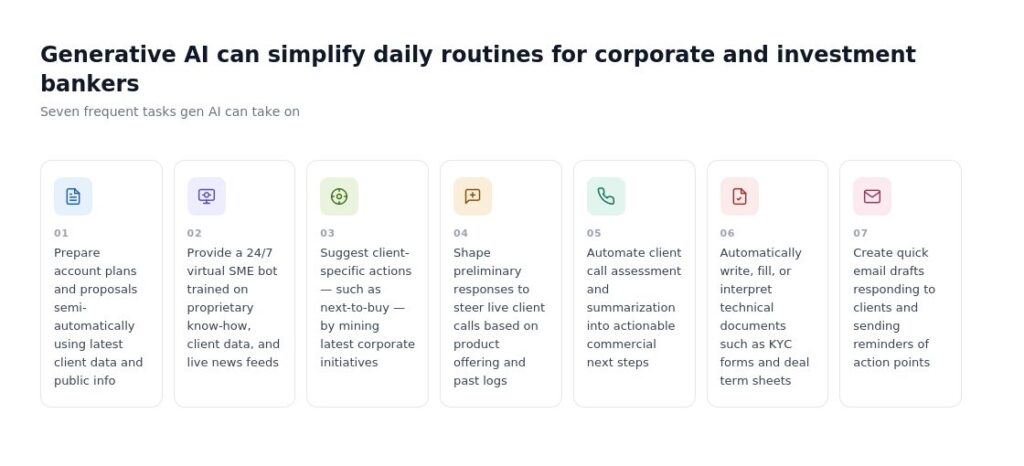
Client service support
Most client-facing AI in wealth platforms today centers on speed and coverage. Advisors can realistically provide consistent service to a finite book of clients, usually 100 to 250, depending on complexity.
AI-assisted service tools extend that range by handling the more routine interactions: account status inquiries, document requests, portfolio performance summaries, and basic educational questions.
What makes this work well is not just automation but a compliance-aware reasoning. A client asking why their portfolio dropped 4% last quarter is not looking for a generic market summary.
They want an answer tied to their specific holdings, in plain language, within whatever regulatory boundaries the platform operates under. AI assistants that can pull structured client data, apply compliance filters, and generate a coherent explanation reduce both advisor time and client wait time at once.
McKinsey research suggests that AI-driven client-facing tools can produce up to a 9% efficiency gain in client-facing roles, while also enabling more consistent engagement across client tiers that would otherwise receive minimal attention.
The platforms that do this well build in human escalation logic from the start. When a client question touches portfolio strategy, estate planning, or a complaint, the system routes to a human immediately. So, eventually, AI handles volume, and the advisor handles judgment.
Explore what you can get with Artificial Intelligence Consultancy in USA
Advisor workflow support
Advisors lose significant working time to tasks that are necessary but not advisory in nature: pulling together meeting briefs, reviewing compliance checklists, building proposals, and documenting follow-up actions. Studies put this figure at roughly 70% of total working time consumed by administrative and preparatory work.
AI changes this by automating the assembly work.
A well-integrated advisor copilot can pull portfolio data, flag recent market events relevant to a client's holdings, surface rebalancing opportunities, and generate a draft meeting agenda, before the advisor has opened their email. After the meeting, it can update the CRM, log the action items, and flag any compliance documentation that needs to be completed.
The downstream effect is huge. According to McKinsey, end-to-end workflow redesign powered by AI can deliver 25–40% efficiency gains across an organization's cost base.
One leading Asian bank that deployed an AI copilot for its wealth management division saw relationship managers grow their effective client capacity by 30%, without adding headcount, and their monthly client engagement rate doubled.
For platform vendors, this is where AI creates a durable competitive advantage. Platforms that reduce the manual burden on advisors become stickier because switching away means losing the workflow gains advisors have come to depend on.
Data workflow improvement
Client and portfolio data in most wealth platforms sits across multiple systems, like CRM, portfolio management software, custody feeds, compliance tools, and market data providers. Getting a clean, current view of a single client usually requires pulling from several of these simultaneously, often manually.
AI improves this at the pipeline level. It can standardize data from disparate sources, flag inconsistencies before they surface in a client-facing output, and maintain continuous portfolio monitoring rather than relying on batch processes. Platforms that invest in this layer first often find that it accelerates every AI initiative that follows — because the data feeding the models is actually reliable.
Document processing is another area with a clear return. AI-powered document extraction tools achieve accuracy rates above 99% for structured document types like tax forms, account statements, and KYC documentation, thereby reducing the manual review burden and speeding up onboarding cycles by 30–50%.
What platform teams need before rollout
Rolling out AI without the right foundation produces two outcomes: poor model performance and compliance exposure. Both are recoverable, but both are avoidable with proper preparation.
Before any AI capability goes to production, platform teams should confirm that the following are in place:
- Data infrastructure: All data sources that the AI will query must be accessible through a consistent API or data layer. Fragmented schemas, stale data feeds, or inconsistent identifiers across systems will degrade output quality regardless of how capable the underlying model is.
- Compliance and audit logging: Every AI-generated output that reaches a client or informs an advisor recommendation needs a traceable audit trail. Regulators in both the US and Canada expect explainability, platforms must be able to show what data informed a given output and under what rule set.
- Human-in-the-loop design: Identify upfront which decisions the AI can make autonomously, which it can recommend with human approval required, and which it should never touch. This is not just a risk management question, as it shapes the entire product architecture.
- Data governance policies: AI systems in wealth management will process sensitive personal and financial data. Governance frameworks must define who has access to what, how long data is retained, and how model outputs are monitored for bias or drift over time.
Teams that skip this preparation often find themselves six months into a rollout with a working prototype that cannot pass compliance review, or a model that performs well in testing but degrades quickly because the underlying data is inconsistent.
Build vs buy for wealth management AI
The decision between building AI in-house and buying from a vendor is more nuanced in wealth management than in most industries, because the regulatory environment, data sensitivity, and workflow specificity all raise the stakes of getting it wrong.
| Factor | Build | Buy / Partner |
|---|---|---|
| Time to production | 12–24 months typical | 8–16 weeks with an established vendor |
| Customization | High — full control over model behavior | Medium — depends on vendor flexibility |
| Compliance fit | Must be built from scratch | Look for pre-built regulatory guardrails |
| Data privacy | Full control | Requires vendor due diligence on data handling |
| Ongoing maintenance | Internal team required | Shared with vendor |
| Cost | High upfront investment | Lower initial cost, ongoing licensing |
| Best for | Large platforms with significant AI engineering resources | Mid-market platforms and firms scaling quickly |
The honest answer for most mid-sized platforms is that buying or partnering is faster and lower risk, provided the vendor has genuine wealth management experience, not just generic financial services AI. Pre-built accelerators that are designed for wealth management workflows (meeting prep, compliance checks, portfolio monitoring) reduce both build time and the risk of overlooking domain-specific requirements.
Larger institutions with complex proprietary workflows may find that building gives them more control over model behavior and data handling. But even in those cases, starting with a partner for a proof of concept dramatically reduces the cost of learning what actually works before committing to a full internal build.
How Altamira can support platform-side implementation
Altamira's work in wealth management AI focuses on the implementation layer, which is the part most vendors underinvest in.
Getting a model to work in a test environment is a solved problem. Getting it to work reliably inside an existing wealth platform, connected to live data, passing compliance review, and adopted by advisors who were skeptical of it to begin with, that is where most projects actually fail.
Altamira supports platform teams through three phases: scoping, which identifies the highest-return use cases given the platform's existing data maturity and architecture; build and integration, which covers API connections, compliance logic, and human escalation design; and enablement, which includes advisor training and feedback loops that allow the system to improve after launch.
For platforms that are early in their AI journey, Altamira typically recommends starting with the data layer and one high-impact advisor-facing feature, usually meeting preparation or portfolio monitoring alerts, before expanding to client-facing capabilities. This keeps the first rollout contained, auditable, and visible enough to generate internal buy-in for what comes next.
It's high time to check your AI readiness
Common rollout mistakes
Most AI rollouts in wealth management do not fail because the technology doesn't work. They fail for predictable, preventable operational reasons.
- Starting with the most complex use case. Personalized investment recommendations sound like the highest-value AI application. They also carry the most regulatory risk, require the most data, and are the hardest to explain to a compliance team. Starting there is almost always a mistake. Start with meeting prep or document extraction: lower risk, faster value, easier to audit.
- Skipping advisor adoption planning. Advisors who do not understand what the AI is doing, or do not trust its outputs, will work around it. Adoption is not a training problem; it is a design and communication problem. Advisors should be involved in defining what good output looks like before the system goes live.
- Treating data preparation as optional. Poor data quality produces poor AI outputs. If the CRM has inconsistent client records or the portfolio management system does not update in real time, the AI will quickly surface errors that erode advisor and client confidence.
- No clear ownership post-launch. Who monitors model performance after launch? Who handles client escalations that involve an AI-generated output? Who updates the compliance rules when regulations change? Platforms that do not answer these questions before go-live end up with a system that slowly degrades, and no one is accountable for fixing it.
A phased adoption model
A phased approach reduces risk and delivers visible results at each stage, which is important for both regulatory stakeholders and internal teams who need to justify continued investment.
Phase 1. Data foundation (months one through three):Clean and standardize data across core systems. Establish API connections between the platform's portfolio management, CRM, and compliance tools. Define governance policies. No client-facing AI yet.
Phase 2. Advisor tools (months four through eight):Deploy a meeting preparation copilot and portfolio monitoring alerts. Measure time saved per advisor per week. Gather structured advisor feedback. Run a compliance review of all AI-generated outputs.
Phase 3. Client-facing tools (months nine through fourteen):Launch an AI-assisted client query tool for routine inquiries, with human escalation logic for anything advisory. Monitor client satisfaction metrics and escalation rates. Expand to KYC document processing.
Phase 4. Continuous improvement (ongoing): Establish feedback loops between advisor use and model updates. Add use cases incrementally based on data maturity and demonstrated business value. Introduce cross-sell and portfolio optimization signals as the data layer matures.
This timeline is not rigid — platform size, data maturity, and regulatory environment all affect pacing. What matters is not moving to client-facing AI before the advisor layer is stable, and not skipping the data foundation regardless of how much pressure there is to show results quickly.
See how you can empower your business with AI Agent Development Services
The final word
Wealth management has always been a relationship business. The advisor who remembers a client's daughter is starting college, who calls before the market moves, who shows up prepared, that person wins. AI does not change that. What it changes is how much of an advisor's day is actually spent doing that work versus preparing to do it.
Most platforms are still losing that ratio badly. 70% of an advisor's time going to admin and prep is not a technology problem waiting for a fix, it is a structural drag that quietly compounds, quarter after quarter, through missed touchpoints and shallow client relationships.
The platforms that close that gap will do it by building the right foundation first, picking the right first use case, and giving advisors something that actually makes their day easier. That last part matters more than most teams expect. An AI that advisors trust and use daily is worth ten times a more capable system they route around.
North American wealth platforms are not short on ambition here. They are short on patience for the unglamorous work: the data pipelines, the governance frameworks, the advisor training that makes everything else possible. That is where most rollouts actually fail, and it is not a technology failure. It is a sequencing one.
Get the sequence right, and the compounding effect is real: better-prepared advisors, more consistent client service, and a platform that gets harder to leave over time. That is a durable business outcome, not because AI is doing something magical, but because it is finally giving advisors the time to do what they were hired for.
FAQ
How is AI used in capital markets?
AI in capital markets falls into four main categories: trading, risk management, research, and compliance.
In trading, AI models analyze market data in real time to identify pricing patterns and execute orders more precisely. In risk management, machine learning runs credit assessments and stress tests faster than rule-based systems. For research, large language models process earnings calls, filings, and news feeds to surface signals without an analyst reading every document. In compliance, AI flags suspicious transactions, screens for sanctions exposure, and generates audit trails.
The pattern across all of them: AI handles volume and pattern recognition, humans handle the judgment calls.
How do you use AI in investment banking?
Start with the work that consumes analyst time without requiring senior judgment: pitch book drafting, comparable transaction research, due diligence document review, and meeting summaries. Deloitte estimates AI-assisted productivity gains for investment banking divisions could reach up to 34%.
The right sequence matters. Begin with lower-risk, high-volume tasks: document review, data extraction, first-draft generation before applying AI for investment banking to anything that feeds directly into a client recommendation or regulatory filing.
Where can you find investment banking tools?
Three categories cover most of what's available:
- General-purpose AI platforms — good for drafting and summarizing, but not built with compliance constraints or financial data integration in mind.
- Financial data providers — Bloomberg, FactSet, and Pitchbook are embedding AI into tools analysts already use (LLMs for finance), which reduces adoption friction.
- Specialist vendors — built specifically for banking workflows like deal sourcing, document review, and compliance screening. More setup time, but outputs are closer to production-ready.
If you need something connected to proprietary data or internal compliance requirements, working with an implementation partner is usually faster than building from scratch.
How are leading companies using AI in capital markets?
The firms moving fastest are redesigning workflows, not adding single-point features.
JPMorgan applied to trademark an AI-powered investment advisory product and has deployed AI across coding, research, and client-facing functions. Goldman Sachs uses AI to help developers write and review code. Wells Fargo applies large language models to help clients structure regulatory reporting. Bloomberg launched a 50-billion-parameter model trained specifically on financial data.
What they share: they started with a specific, measurable problem, not a broad AI strategy, built or bought something to address it, measured the result, and expanded from there.