
An agent goes live, the dashboard fills with green, request volume climbs, and everything looks like it is working. Then someone in a scaling review asks whether the agent is actually reducing cost, improving decisions, or introducing risk, and the room goes quiet. Activity is visible and systems appear healthy, but that visibility does not translate into confidence.
Most teams measure what is easy to count: requests handled, messages sent, tasks started. Those numbers describe throughput, not value. They say nothing about whether an agent is safe, efficient, and worth scaling. Without the right performance framework, you can hardly tell whether an agent workforce is improving business outcomes or simply adding another layer of automation.
This guide covers how to measure AI performance in production: the core metrics, the safety signals that should never be optional, and a monitoring framework that connects agent behavior to outcomes the business cares about.
What makes AI agent measurement different from model evaluation
Model evaluation asks a narrow question: given a fixed input, does the model return the right output? It runs against static benchmarks, in controlled conditions, before anything ships. Agent evaluation asks something harder: does this system do useful work, consistently, within the rules, once it is loose in a live environment with real data and real consequences.
The difference comes down to how agents behave. Agents are nondeterministic, so the same input can produce several valid outputs. They call tools, chain steps, and make decisions that depend on context. They collaborate with one another and with human teams, and their behavior evolves as inputs shift over time. A benchmark score captured before deployment tells you little about any of this. Explore our web development services.
| Dimension | Model evaluation | Agent evaluation |
|---|---|---|
| What is tested | A model in isolation | A system acting inside a live workflow |
| Environment | Static benchmarks, controlled | Production, real data and tools |
| Expected output | One correct answer per input | Multiple valid paths per input |
| Timing | Before deployment | Continuous, after deployment |
| Primary risk | A wrong prediction | A wrong action, runaway cost, or policy breach |
Traditional metrics such as uptime, response time, and error rate still matter, but they only describe system health. They say very little about whether agents are reducing cycle time, improving decision quality, or letting teams operate with fewer handoffs. As deployments scale, leaning on those metrics alone creates blind spots that make it harder to justify expansion, set guardrails, and build trust.
That is why AI performance metrics for agents fall into three groups, and a serious evaluation framework has to cover all three. Performance metrics measure whether the agent completes its assigned work, through accuracy, speed, cost per task, and how much human intervention is still required. Reliability metrics measure consistency over time and across scenarios, including edge cases and upstream changes. Compliance and safety metrics measure whether the agent operates within legal, regulatory, and organizational boundaries. Engineering teams care most about the first group, product leaders about ROI and throughput, compliance teams about the third. A single metric rarely satisfies all three, which is why structure matters more than any one number. See what's possible with AI strategy consulting services.
Core metrics that matter most
Altamira's CEO, Evgen Balter, puts it this way: "Beside other best practices, smart business process decomposition enables your organization to identify KPIs and observability solutions that will allow you to see, manage, and optimize the performance of AI agent."
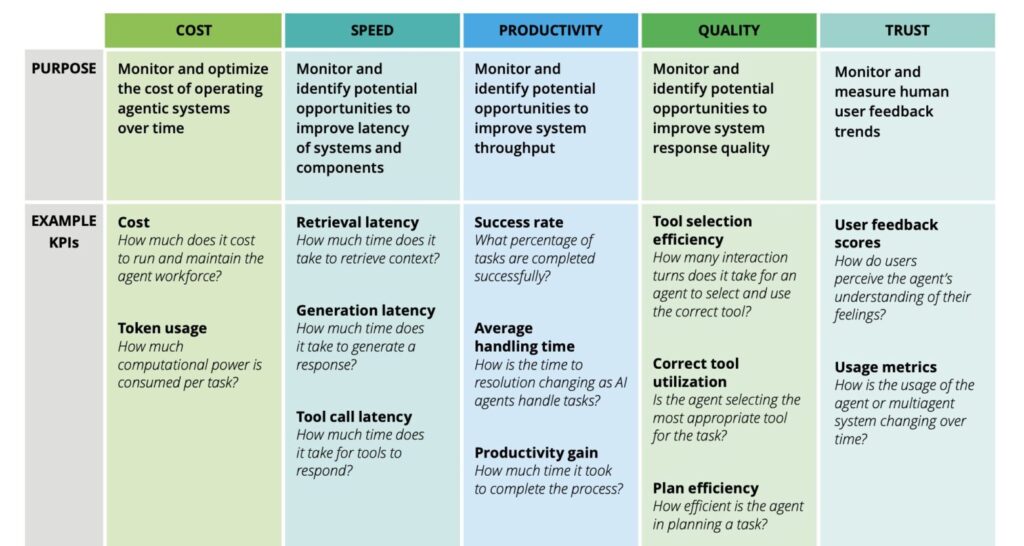
When teams start agent performance monitoring in production, technical performance is usually the first thing they look at. The goal is simple: understand whether the agent is doing the work it was introduced to handle.
Task success and completion quality
Task completion rate is the most useful starting point. It measures the percentage of tasks an agent finishes successfully without human intervention, and what counts as completed depends on the agent. For conversational agents, it tracks how often requests are resolved end to end without escalation. For task-oriented agents, it measures whether instructions are executed correctly. For decision-making agents, it evaluates whether decisions meet predefined criteria such as policy rules or outcome thresholds.
The rate ties directly to operational efficiency. Each completed task is less manual effort for human teams, and fewer escalations mean fewer handoffs and less context switching. In multi-agent systems, a drop in completion rate often reveals a coordination problem between agents rather than an individual failure.
Completion alone is not enough. Response quality decides whether a finished task actually helps or creates downstream cleanup work. Precision measures how many of the agent's positive predictions are relevant, so high precision means it is not surfacing information or triggering actions that turn out to be wrong. Recall measures how many relevant items it identifies out of all correct answers, which matters when missing a valid case is costly. F1 score balances the two into a single number for situations where neither false positives nor false negatives can be ignored. For classification-based agents, AUC-ROC shows how well the model separates classes across decision thresholds. In fraud detection, a weak score means suspicious activity slips through unnoticed. In clinical support, it means critical cases get missed. Explore our AI process automation services.
Cost and latency efficiency
Efficiency metrics show whether an agent does useful work without running up unnecessary cost as usage grows.
Latency is the first signal. Response time measures how quickly an agent returns an output after receiving input, and in customer-facing workflows anything above a few seconds drives drop-offs, lower satisfaction, and abandoned tasks. Slow responses also reduce the odds that an agent gets trusted with independent work. Computational resource consumption tracks the memory, CPU or GPU, and model context a task requires; for LLM-based agents, token usage becomes the main driver of both speed and spend. Cost per task then ties that consumption to outcomes, capturing the operational expense of each completed task across infrastructure, model access, and supporting services.
Agent efficiency problems stay invisible at low volume and turn into material cost once an agent handles thousands or millions of interactions. Small per-task inefficiencies compound fast, which is exactly why they belong in budget reviews rather than buried in an aggregate model bill. Learn more about SaaS AI agent.
Reliability and failure recovery
An agent that performs well in ideal conditions but degrades when inputs change or edge cases appear is not ready for production. Reliability metrics measure whether performance holds up beyond controlled scenarios.
Consistency scores assess whether an agent behaves predictably in similar situations. Small input changes can produce noticeably different outputs, and that variability is often what erodes trust. A practical test is to submit several slightly varied versions of the same query and measure the variance in responses; high variance signals the agent needs tighter constraints, better grounding, or a clearer task definition before it can be trusted at scale. In finance, an agent that gives different recommendations for nearly identical scenarios is hard to rely on regardless of average accuracy. In healthcare, consistent interpretation of similar cases is what makes decision support safe.
Edge case performance matters because strong average accuracy hides weak spots. Many agents handle common inputs well, then break on rare, ambiguous, incomplete, or slightly contradictory ones. Targeted test sets built to stress decision boundaries reveal not just whether an agent fails but how, and whether the failure is predictable. Simulation frameworks such as τ-bench recreate multi-step scenarios that resemble real operational complexity instead of testing a single response in isolation.
Drift detection catches the slower problem. Even a well-performing agent loses effectiveness as inputs diverge from what it was tuned on. Teams monitor shifts in input distributions, in response quality, and in user interaction patterns, using control charts to flag when key metrics move outside acceptable ranges. Automated drift monitoring lets teams respond early with retraining or tighter constraints, which costs far less than repairing trust after widespread errors.
Recovery metrics measure what an agent does at the edge of its competence. Does it acknowledge uncertainty instead of producing a confident but incorrect answer? Does it ask for clarification or escalate when information is missing? Does it recover after an error rather than compounding it? A well-timed "I don't know" is often safer than a fluent guess, and tracking how often an agent admits it lacks information is a direct reliability signal.
Which safety metrics should always be tracked
Performance and reliability tell you whether an agent works. Safety metrics tell you whether it is fit to run in a regulated business at all. These should be tracked from the first deployment, not added after an incident.
Hallucination risk
Hallucination is one of the most damaging failure modes in agent systems: confidently presenting incorrect information as fact. Fluent output masks the error, which is what makes it dangerous. Teams track hallucination rate with quantitative signals rather than subjective review, measuring coherence between responses and trusted knowledge bases, checking how closely a response matches the intent of the original query, and testing factual correctness against verified sources in high-risk workflows. Tracking hallucination rate over time also shows whether a change to prompts, model, or agent logic is improving factual grounding or quietly making it worse.
Policy violations
An agent that breaks policy is a liability even when it is accurate. Compliance testing should replay real interactions that carry known compliance risks, refreshed with every model update, because requirements shift as models change. The specifics vary by industry: fair lending tests in financial services, HIPAA in healthcare, consumer protection standards in retail. Ongoing red-teaming belongs here too. Teams should regularly try to push agents into unsafe or unintended behavior and measure successful manipulation attempts, detection time, and resolution duration. Both should be continuous and automated, not a quarterly checkbox.
Sensitive data exposure
Personally identifiable information needs real-time tracking, not periodic audits. Useful metrics cover exposure incidents, rule adherence, and remediation response time. Detection should trigger automatic flagging and containment before an issue escalates, and any mishandling should isolate the affected agent until a review is complete. In most regulated environments, this is the metric that decides whether an agent can scale beyond a pilot.
How to build a practical monitoring framework
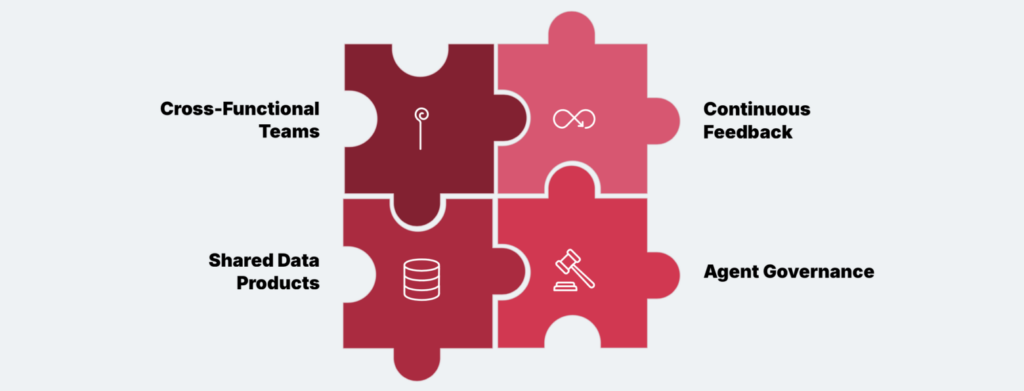
Metrics without a system around them are just numbers on a dashboard. A monitoring and feedback framework turns agent activity into something the business can manage, functioning like a performance review system for digital workers: it shows what is working, what needs attention, and where to intervene. Guardrails give the framework its credibility, since performance data means little if you cannot show the agent operated safely and within policy while producing it. Contact us for technology product consulting.
A workable framework usually includes a few components:
- Anomaly detection for early warning. Behavior that is normal in one workflow can signal a serious problem in another. Statistical process control accounts for expected variability and sets alert thresholds on business impact rather than raw deviation, so issues surface before users notice them.
- Real-time dashboards for unified visibility. Dashboards should present human and agent performance side by side and include accuracy, cost burn rate, compliance alerts, and satisfaction trends, readable at a glance by an executive or an engineer.
- Automated reporting in business language. Reports should translate technical signals into effects on results, cost efficiency, and risk posture, with clear summaries leaders can act on without parsing raw data.
- A continuous improvement loop. High-quality agent responses feed back into evaluation datasets, so good performance becomes the baseline for future measurement and improvement compounds instead of resetting.
Evaluation datasets sit at the center of this. Replaying recorded production interactions in a controlled environment lets teams measure accuracy against known outcomes, detect drift against historical baselines, and validate guardrails by intentionally replaying compliance-sensitive cases, all without touching live operations.
There is a cost dimension worth building in from the start. Tracking cost per successful outcome, calculated as total token cost divided by successful goal completions, filters out failed attempts and retries that hide inside average usage numbers. It also lets you benchmark an agent against the fully loaded cost of a human doing the same work at comparable quality, which is where cost stops being a financial afterthought and becomes a performance signal.
Source: McKinsey
How Altamira approaches AI agent performance measurement
Measurement works best when it starts before the build, not after. Altamira's approach begins with business process decomposition: breaking a workflow into discrete steps so the KPIs and observability points are defined up front, at the level where value and risk actually sit. That KPI-first framing is what makes later monitoring meaningful rather than decorative.
From there, agents are evaluated at the workflow level rather than as isolated model calls, since a task that spans several steps and tools can only be judged by the outcome it produces. Production monitoring covers accuracy, cost, latency, and compliance in one view, so engineering, product, and risk teams read the same signals and scale on evidence instead of hope. The result clients get is a clear line from agent behavior to business outcome, which is what turns a promising pilot into a system worth expanding.
Common measurement mistakes
A few patterns show up repeatedly when agent performance metrics fail to reflect reality:
- Measuring activity instead of outcomes. Request volume and task counts look like progress but say nothing about value, and high throughput can hide errors, rework, and effort pushed back onto human teams.
- Optimizing for easy wins. Raw completion counts reward agents for avoiding hard work. Weighting for task complexity keeps measurement honest.
- Trusting average accuracy. A model can be accurate on average and still behave erratically at the edges, which is exactly where the costly failures happen.
- Treating governance as cleanup. Guardrails bolted on after issues surface are slower and weaker than controls built into measurement from the first deployment.
- Testing once. Agents change behavior faster than traditional software, so a one-time evaluation goes stale quickly. Weekly review catches problems while they are still cheap to fix.
The final word
Measuring the efficiency of AI agents is no small feat. There is no single formula that guarantees success, and teams are learning in real time what works and what does not. Tracking the right metrics matters, but metrics alone are not enough. Without a feedback loop, measurement becomes passive observation rather than a tool for improvement.
Agent success rate is not about how fast you can deploy. Speed matters early, but it does not sustain value. What matters more is building systems with visibility, iteration, and scale in mind from the start. Without that foundation, performance degrades quietly, trust erodes, and teams lose confidence in decisions they can no longer explain.
The complexity compounds quickly. Measuring a single agent is manageable. Measuring ten requires structure. Measuring 20 without a framework turns into guesswork. At that point, intuition stops working, and only disciplined measurement keeps systems under control.
For teams looking for a more formal way to assess both sides of agent effectiveness, Gartner outlines a practical framework that covers agent-specific metrics, cost and value modeling at scale, and common points where ROI breaks down. Used well, it provides a structured way to move from experimentation to repeatable results.
The organizations that succeed with AI agents will not be the ones that move fastest. They will be the ones that measure clearly, learn continuously, and scale with intent rather than hope. Build secure AI systems with Altamira. Contact us to learn more!