
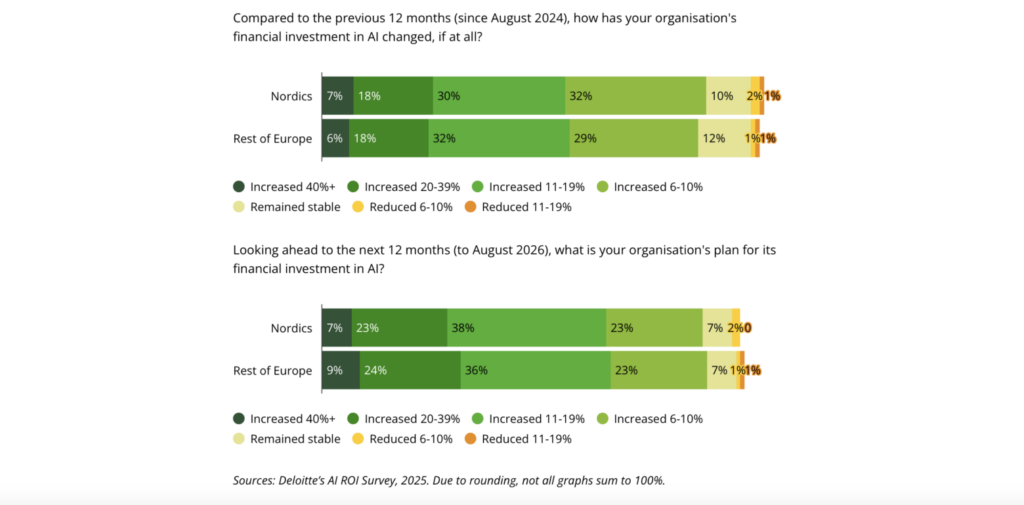
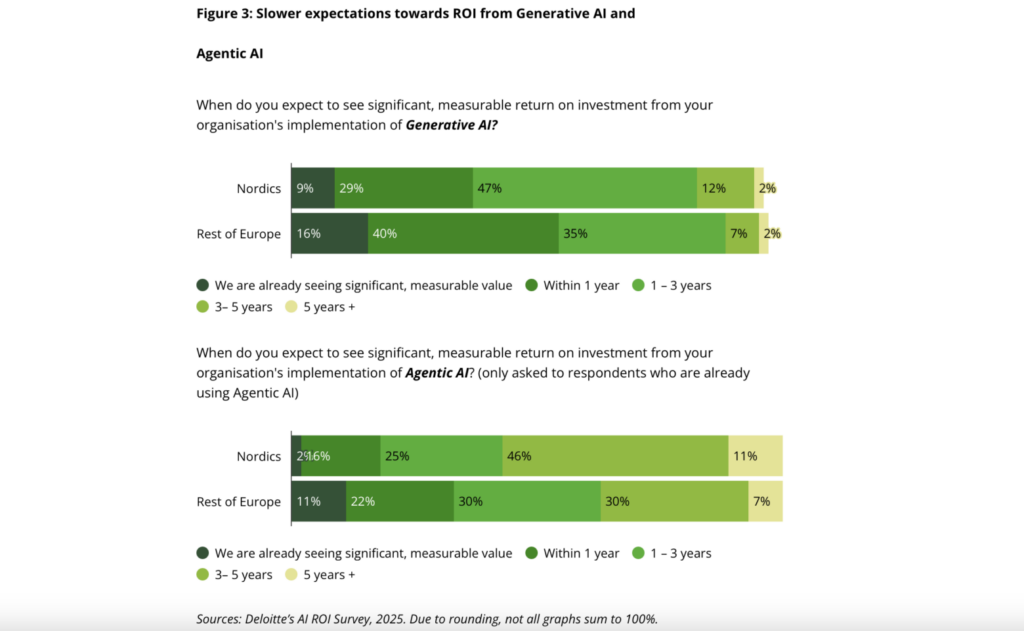
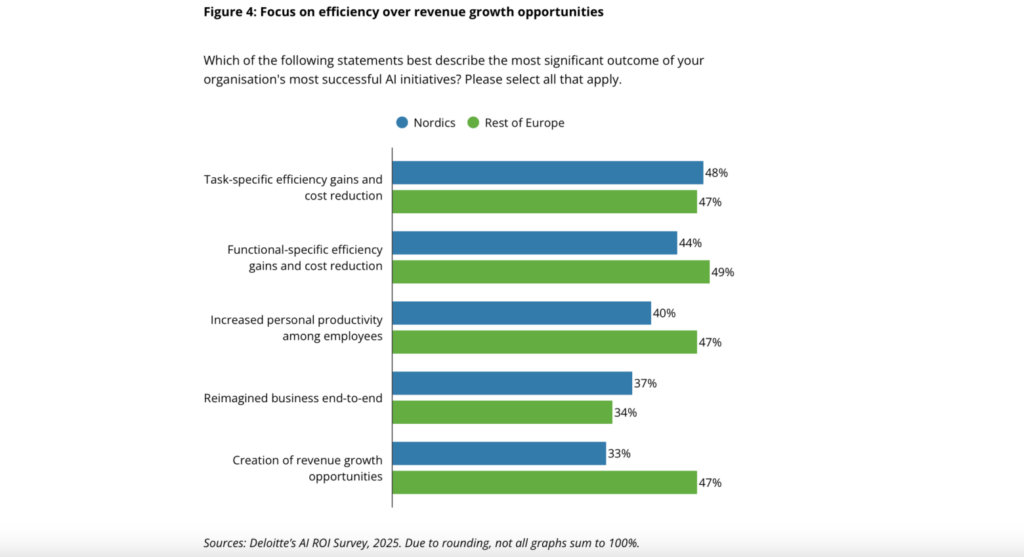
Manufacturers across Sweden, Denmark, Finland, and Norway are putting huge money into AI. A 2026 Deloitte survey found that roughly 70% of Nordic firms now spend 10% or more of their IT budget on AI, with a quarter of them spending over 20%. Yet the returns are thin. Boston Consulting Group's March 2026 report on Nordic AI found that only 4% of companies in the region are earning at least five times their investment.
Part of the problem shows up on the factory floor. Only 2% of Nordic manufacturers have fully integrated AI into operations, compared with 8% across the wider EMEA region, according to research from Tietoevry citing Cision. A lot of pilots look promising, then something happens.
One reason keeps repeating: teams treat data ownership and data operations as the same job. Understanding data governance vs data management is the difference between a pilot that scales and one that quietly dies after the demo. This article breaks down what each covers, why manufacturers need both, and what to check before you scale. Learn more about common data quality problems.
Why manufacturing AI pilots stall after the proof-of-concept stage
The stall is common and well documented. IDC research with Lenovo found that 88% of AI proofs of concept never reach wide deployment. For every 33 pilots a company ran, only four made it to production. A 2025 RAND Corporation analysis put the failure rate at around 80%, with roughly a third of projects abandoned before they ever shipped.
The models are rarely the issue. The data underneath them is. Here are the two failure points that hit manufacturers hardest.
Pilot data looks cleaner than production data
A pilot runs on a tidy slice of data. Someone handpicks a few months of records from a single line or plant, cleans them up, and feeds them to the model. The results look great.
Production is messier. The same model now has to read live shop-floor data from dozens of machines, each with its own format, naming conventions, and quirks. Sensor readings drift, manual entries contain typos, and part numbers don't match across sites. The clean inputs the model was trained on no longer exist.
This is why so much of the work is really about AI data preparation rather than modelling. A 2026 survey of more than 600 manufacturing leaders by L2L found that 87% believe AI can improve productivity, but 79% say integration problems and poor data quality limit what it honestly delivers. The pilot proved the idea but didn't prove the data was ready.
Ownership is unclear across plants and systems
The second problem is about people. When a pilot moves toward production, someone has to answer basic questions. Who owns the definition of "scrap rate"? Which system holds the correct machine ID? Who fixes a bad record, and who is allowed to change it?
In most plants, no one owns these answers. Data ownership is spread across the ERP, the MES, the SCADA system, and a stack of spreadsheets, each maintained by a different team. When definitions conflict, the AI inherits the conflict. The L2L survey found that only 9% of manufacturers can immediately trace a shop-floor issue back to its root cause. If you can't trace a problem in your own data, you can't trust a model built on it. Learn more about automation in manufacturing.
What data governance covers
Data governance is the set of rules, roles, and decisions about your data. It answers the who and the why. Who owns each data domain? What counts as correct? Who can see it, change it, and sign off on it? Governance is strategic. It sets the standard that everything else has to meet.
Roles and accountability
Governance starts by naming owners. Every important data domain: machines, materials, orders, quality results, gets a person or team accountable for it. These owners, often called data stewards, decide what "good" looks like and hold the line when definitions drift.
This is also where master data lives. Master data is the shared reference information every system depends on: the single correct list of products, suppliers, plants, and equipment. When each plant keeps its own version, analytics falls apart. One clear, governed master record means that a report from Gothenburg and a report from Aarhus count the same thing.
Policies and controls
The second half of governance is the rulebook. This covers who can access which data, how sensitive information is protected, and how you meet requirements such as the EU AI Act and GDPR, which matter to any manufacturer operating in the Nordics.
Governance also defines data lineage: a record of where each piece of data came from, how it moved, and what changed along the way. Lineage is what lets you audit a number and prove it's right. Without it, every surprising figure turns into a guessing game. With it, you can trace a metric back through every step and fix the source, not the symptom.
What data management covers
If governance is the who and why, data management is the how. It's the operational work of collecting, moving, storing, and cleaning data so systems can use it. Data management is where the rules and governance set are carried out day to day. Learn more about digital transformation in manufacturing.
Pipelines and connectors
Manufacturing data sits in silos: the ERP, the MES, machine controllers, quality systems, and warehouse tools rarely talk to each other. Data management builds the connections between them.
Data connectors are the components that extract information from each system and move it to a useful destination. This is also where data capture happens.
What is data capture? It's the act of getting information into a digital system in a usable form, whether from a sensor, a scan, a form, or a document. Invoice data capture is a familiar example: instead of staff keying supplier invoices into the ERP by hand, software reads each invoice and automatically extracts the fields. The same idea applies across the plant. Shop floor data integration connects machines and line systems so production numbers flow in without someone retyping them.
Data quality and availability
Moving data is only half the job. It also has to be accurate and available when analytics needs it.
Data management handles the cleaning: removing duplicates, filling gaps, standardizing formats, and validating records against the rules governance defined. It also handles timing. Manufacturing decisions need current information, but data often arrives late, batched overnight or delayed by hours. Poor quality here is expensive. Gartner has estimated that bad data costs organizations around $15 million a year on average. For manufacturing analytics to be worth anything, the numbers feeding it have to be clean and on time.
Here's the split in plain terms:
| Data governance | Data management | |
|---|---|---|
| Question it answers | Who owns it? Why does it matter? | How does it move and stay clean? |
| Focus | Rules, roles, standards, compliance | Pipelines, connectors, storage, quality |
| Owned by | Data stewards, business leads, compliance | Data engineers, IT, operations |
| Output | Clear ownership, definitions, lineage | Usable, integrated, reliable data |
Why manufacturers need both before scaling AI
Governance without management is a rulebook no one can follow. Management without governance is fast, well-built pipelines moving data no one agrees on. You need both, and here's where it bites when you don't.
Production analytics depends on stable definitions
Manufacturing analytics only works when everyone counts the same way. If "downtime" means one thing in the maintenance system and another in the ops dashboard, your reports will disagree, and people will stop trusting them.
Governance sets the stable definition. Management enforces it in every pipeline that touches the number. Together they mean a KPI holds its meaning across plants, shifts, and systems. That stability is what lets you compare sites, spot real trends, and act on them. Without it, analytics becomes a debate over whose numbers are right.
Automation depends on reliable source systems
AI that takes action, reordering stock, flagging defects, scheduling maintenance, is only as safe as the systems feeding it. If the source data is wrong, automation scales the mistake faster than any human could.
Governance decides which system is the trusted source for each fact. Management keeps that source clean, connected, and current. This is the groundwork behind AI readiness: your pilots can only scale if the systems underneath them are dependable. Skip it, and every AI process automation you launch inherits whatever mess was already there.
How Altamira supports AI readiness for operational teams
Altamira has built software for 15+ years and works with clients across more than 50 countries. Its approach to AI starts with a software discovery phase and an AI readiness assessment, not with a model.
The AI readiness assessment reviews your data flows directly. It identifies what's usable, what needs cleaning, and what's missing before any development begins. For a manufacturer, that means an honest look at how your ERP, MES, and machine data connect, where definitions conflict, and where the gaps are, exactly the questions that stall pilots later.
From there, Altamira's AI strategy consulting services deliver a practical output: a decision brief, a workflow automation map, and a pilot plan. It's a low-commitment starting point that tells you where AI fits and where it doesn't.
The team builds against your real data from the first sprint, so most clients see a working pilot within four to six weeks, tested on production conditions rather than a clean sample.
The through-line is simple: start with a real problem and real data, prove its value, then scale. That order is what keeps a pilot from becoming another abandoned proof of concept.
A practical readiness checklist for Scandinavian manufacturers
Before you scale an AI pilot, work through these:
- Name your data owners. Every key domain- machines, materials, orders, quality- has one accountable person. Unclear data ownership is a top reason pilots stall.
- Fix your master data. One agreed list of products, plants, suppliers, and equipment across all sites. No competing versions.
- Map your source systems. Know which system holds the truth for each fact, and connect them with reliable data connectors instead of manual exports.
- Check data lineage. You should be able to trace any number back to its origin. If you can't, you can't audit it.
- Test on production data early. Run the pilot against messy, live data, not a cleaned sample, so surprises show up before scaling.
- Standardize definitions. Agree what each KPI means before automating on it, so manufacturing analytics stays consistent across plants.
- Sort out data capture at the source. Automate entry where you can, from shop floor data integration to invoice data capture, to cut manual errors feeding the model.
- Confirm compliance. Make sure access controls and records meet the requirements of the GDPR and the EU AI Act before you go live.
Conclusion
The gap between Nordic AI spending and returns isn't due to weak models. It's caused by data that wasn't ready to leave the pilot. Governance and management are how you get it ready. Governance decides who owns the data and what counts as correct. Management builds the pipelines, connectors, and cleaning that make it usable. Skip either one, and your pilot stalls where most do, right after the demo.
For Scandinavian manufacturers, the order matters. Get ownership and definitions straight, get your source systems clean and connected, then scale. That's what turns an AI pilot into something production can rely on. To find out where your data stands, start with an AI readiness assessment before you build.
FAQ
What is the difference between data governance and data management?
Data governance is the rules and ownership. It decides who owns each type of data, what counts as correct, and who can change it. Data management is the operational work: collecting, moving, cleaning, and storing data so systems can use it. Governance answers the who and why; management handles the how. You need both.
Why do AI pilots fail without data governance?
Because no one has agreed on what the data means. When "downtime" or "scrap rate" is defined differently across the ERP, MES, and quality systems, the model inherits the conflict. IDC found that 88% of AI proofs-of-concept never reach wide deployment, and unclear ownership is a common reason. A pilot on a clean sample can look fine while the underlying definitions are a mess, and that mess only shows up when you try to scale.
What data problems are most common in manufacturing AI projects?
Four show up again and again: data trapped in silos that don't talk to each other, conflicting definitions across plants and systems, poor data quality from sensor drift and manual entry errors, and unclear ownership of who fixes what. A 2026 L2L survey of over 600 manufacturing leaders found 79% say integration problems and poor data quality limit what AI actually delivers, and only 9% can trace a shop-floor issue straight to its root cause.
Who should own data governance in a manufacturing company?
Ownership should sit with the business, not only IT. Each key data domain, machines, materials, orders, quality, gets a named steward who is accountable for its accuracy and definitions. These are usually operational or business leads who know the data, supported by IT and compliance. The mistake is leaving governance to IT alone, because the people who understand what the numbers should mean work on the floor and in operations.
What should be prepared before scaling an AI pilot?
Get the data foundations in order first. Name your data owners, agree on one set of master data across all sites, and map which system holds the truth for each fact. Confirm you can trace any number back to its source, and test the pilot on real production data instead of a clean sample. Also check that access controls meet GDPR and EU AI Act requirements before you go live.
How do data connectors affect AI readiness?
Data connectors pull information out of separate systems, the ERP, MES, machine controllers, quality tools, and move it where the AI can use it. Without them, data stays siloed and someone ends up exporting and retyping it by hand. Reliable connectors are what make shop floor data integration possible, so live production numbers flow in automatically and stay current. Weak or missing connectors are one of the most common reasons a pilot can't scale.
What is the first step in a manufacturing data governance program?
Name the owners. Before writing policies or buying tools, decide who is accountable for each type of data and what "correct" looks like for it. From there you can fix master data, standardize definitions, and set access rules. Ownership comes first because every other governance decision depends on someone being responsible for the answer.