
Demand for AI features is growing faster than most companies can hire for. According to the World Economic Forum, 94% of C-suite executives report shortages in AI-critical skills, and Deloitte's Global Outsourcing Survey found that 87% of IT leaders now use outsourcing to speed up AI adoption. So the question for most US and UK product teams is no longer whether to bring in external AI engineering capacity. It is where that capacity should sit.
The nearshore vs offshore development decision looks simple on a rate card. Offshore outsourcing teams in India or Southeast Asia cost less per hour. Nearshore outsourcing teams like Latin America for US buyers, Central and Eastern Europe for UK buyers cost more but work your hours. The catch is that AI product development doesn't operate like standard software development, and the cheaper model often hides costs that only surface later: slow feedback loops, security gaps, and product knowledge that leaves when the contract ends. This article lays out where each model wins, what to validate before signing, and a simple matrix for making the call. Learn more about team augmentation.
Why AI product development changes the outsourcing decision
Traditional outsourcing math was built for well-specified software work. You write requirements, the vendor builds to spec, you review the output. AI product development breaks that pattern in two ways.
AI work depends on faster feedback loops
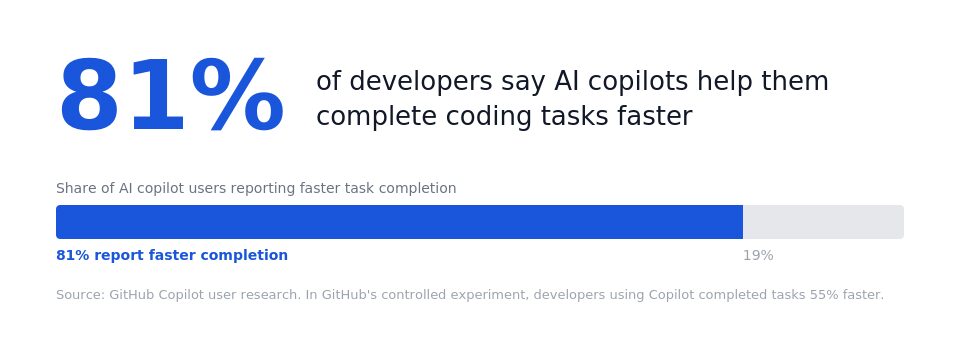
AI features rarely survive contact with real data unchanged. A model that performs well in testing degrades on production inputs. A prompt that works for one customer segment fails for another. Teams building AI products spend far more time evaluating outputs, adjusting, and re-testing than teams building conventional features.
Take a concrete case: a company building a customer interaction analytics product for contact centres. The core pipeline runs automatic speech recognition on recorded calls, then applies conversational analytics to flag churn signals and compliance issues. Every stage needs constant tuning — the speech analytics model mishandles regional accents, the sentiment scoring drifts, the flagging thresholds need adjustment against real complaint data. None of this can wait for an overnight handover cycle. When the product owner in London or New York spots a problem at 10 a.m., the engineer who can fix it needs to be awake.
This is why time zone overlap matters more in AI work than in most software projects. Gartner has reported that fewer than half of AI projects ever reach production, and Pluralsight's 2025 AI Skills Report found that 65% of organisations abandoned AI projects due to skills gaps. Slow iteration compounds both problems. Every day a wrong assumption sits unreviewed, the project drifts further from something shippable. Explore what's dedicated teams.
Data and model access raise governance requirements
AI development also changes what the vendor touches. A conventional outsourced team works with your codebase. An AI team works with your data, often the most sensitive data you hold.
Return to the customer interaction analytics example. Training and evaluating those models means giving engineers access to compliance recording archives: real calls containing names, account numbers, health information, and payment details. For a UK buyer, that access has to survive a GDPR audit. For a US buyer in financial services or healthcare, it triggers sector rules on top. Where the engineers sit, which jurisdiction their laptops fall under, and how access is logged all become part of the security requirements, not an afterthought in the master services agreement.
This is the part of vendor evaluation that rate cards never capture. A team that costs 30% less per hour but cannot pass your client's security review costs you the deal. Discover our custom offshore software development services.
Where nearshore delivery has the edge
Collaboration speed
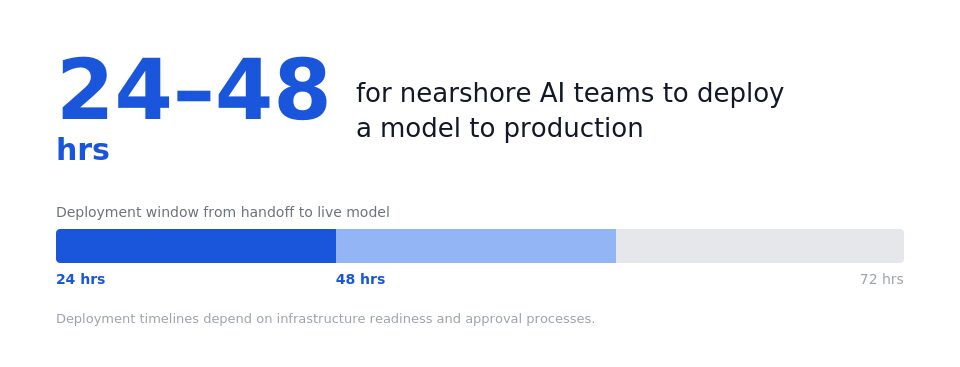
The main nearshore team advantage is simple: shared working hours. A US team working with engineers in Latin America, or a UK team working with engineers in Central and Eastern Europe, gets six to nine hours of overlap per day. Standups happen live. Questions get answered in minutes. An ambiguous requirement gets resolved in a call instead of a three-message, two-day email thread.
For AI product development, that speed converts directly into iteration count. A team that can run three evaluate-adjust-retest cycles per week will find a working approach faster than a team that runs one. Team communication stops being a project risk and becomes a routine.
Product iteration quality
Overlap also changes the quality of decisions, not just their speed. When engineers join sprint reviews and hear customer feedback firsthand, they understand why a model's precision matters more than its recall for this use case, or why a false compliance flag is worse than a missed one. That context is hard to transmit through tickets.
Cultural and linguistic proximity helps here too. Nearshore engineers working with US and UK buyers typically operate in the same business culture: they push back on unclear requirements, flag risks early, and treat disagreement as normal. In iterative AI work, an engineer who says "this approach won't hold up on your data" in week two saves you from discovering it in week ten.
Where offshore delivery has the edge
Cost efficiency at scale
Offshore rates remain the lowest available. Mid-level developer rates in offshore markets can be 30–50% below comparable nearshore rates, and the gap relative to US or UK onshore rates is even larger. For long-running workstreams with stable requirements: data labelling operations, model monitoring, regression testing, support for a mature product, saving is real and repeatable.
The qualifier is that the workload has to tolerate asynchronous work. Deloitte's survey data shows the market has already priced this in: cost reduction as the primary driver for outsourcing fell from 70% of organisations in 2020 to 34% in its latest survey, with talent access and speed taking its place. Buyers have learned that the hourly rate is not the total cost.
Access to broader engineering capacity
The offshore talent pool is simply bigger. India alone holds the world's largest concentration of software engineers, and for narrow specialisations a specific ML framework, a legacy integration skill, large-scale data engineering: offshore markets often have the deepest bench and the fastest ramp-up.
For companies that need to scale AI engineering capacity quickly to 20, 50, or 100 people, offshore delivery may be the only model that can staff it within a quarter. A hybrid structure is common for exactly this reason: a nearshore core team owns architecture and iteration, while an offshore team handles well-scoped, high-volume workstreams behind it.
What US and UK buyers should validate before choosing a model
Whichever direction the rate card points, three areas deserve scrutiny during vendor evaluation. These are where delivery risk actually lives.
Security and access control
Ask the specific questions early. Where will engineers physically work, and under which data protection regime? How is access to production data granted, scoped, and revoked? Can development happen on anonymised or synthetic data, with production access limited to a named few? If your product processes regulated content, the compliance recording archives in our contact centre example are a good test case — can the vendor show evidence of having passed a client security audit in your sector?
Under GDPR and UK GDPR, transferring personal data to engineers outside approved jurisdictions requires legal mechanisms and documented safeguards. A vendor that answers with "we sign NDAs" has not answered the question.
Handover and documentation standards
Every outsourcing engagement ends or eventually changes shape. The handover model determines whether that transition costs you two weeks or two quarters. Before signing, ask to see documentation from a completed complex project: architecture decisions, model training procedures, evaluation datasets, deployment runbooks. For AI products specifically, ask how experiment history is recorded. Knowing which approaches were tried and rejected is worth as much as knowing what shipped — otherwise, your next team will repeat six months of dead ends.
Vendors with a mature handover model can show you these artefacts on request. Vendors without one will promise to "document everything at the end," which in practice means a code dump and a farewell call.
Ownership of product knowledge
The quieter risk in any external engagement is that the understanding of why the product works ends up living entirely in the vendor's heads. Guard against it structurally: keep at least one internal engineer embedded in the delivery team, require decision logs rather than status reports, and schedule knowledge-transfer sessions throughout the engagement rather than saving them for the exit. Contract terms matter here too: IP assignment should cover models, training pipelines, and evaluation data, not just source code.
KPMG's research found that three out of four companies now want outsourcing partners to drive transformational outcomes rather than just savings. That ambition only works if the knowledge those partners build flows back into your organisation. Explore our AI strategy consulting services.
How Altamira supports distributed software delivery
Altamira has worked as a software delivery partner since 2011, with engineering teams in Central and Eastern Europe — a nearshore position for UK and European buyers and a workable overlap window for US East Coast teams. The company runs several engagement models: full-cycle product development, dedicated teams, and outstaffing where Altamira engineers slot into a client's existing processes and stack.
Two practices are relevant to the risks discussed above. First, every project starts with a structured discovery stage that defines scope, architecture, and requirements before development begins, reducing the ambiguity that time zone gaps amplify. For AI work specifically, Altamira runs an AI readiness assessment that reviews data flows and scores use cases by feasibility before any build starts. Second, work is delivered under an NDA with transparent reporting, and clients maintain full visibility into project boards throughout — the access and documentation questions raised earlier are answered in the process, not in the sales deck.
Altamira's engineers hold certifications from Microsoft, AWS, Google, ISTQB, and Scrum.org, and its delivery track record spans healthcare AI, insurance automation, EdTech, and legal AI — sectors where the security requirements described above are the norm rather than the exception.
A simple decision matrix for product leaders
Score your project on five questions. Each answer points toward a model.
| Question | Points to nearshore | Points to offshore |
|---|---|---|
| How often will requirements change? | Weekly or faster | Stable, well-specified |
| How much real-time team communication does the work need? | Daily standups, live debugging | Async handovers acceptable |
| How sensitive is the data the engineers will touch? | Regulated or customer PII | Anonymised or synthetic |
| What matters more right now? | Speed to a working product | Lowest cost per hour |
| How large does the team need to get? | Under ~15 engineers | Rapid scale past 20+ |
If three or more answers land in the left column, nearshore is the safer default — the coordination and delivery risk of offshore will likely eat the rate saving. If your answers split, consider a hybrid: nearshore ownership of the iterative core, offshore capacity for well-scoped volume work. And if every answer lands right, offshore is not a compromise; it is the correct tool for that job.
Conclusion
The nearshore vs offshore question has no universal answer, but AI product development shifts the weighting. Fast feedback loops favour time zone overlap. Sensitive data raises the bar on security requirements. And the value of what gets built lies partly in knowledge that must be deliberately transferred back to you. Price the full engagement: iteration speed, audit readiness, and the handover, not the hourly rate. Buyers who do that tend to find the "expensive" model was the cheaper one all along. Contact us for software development process consulting.
FAQ
What is the difference between nearshore and offshore development?
The difference is distance and working hours. Nearshore means outsourcing to a nearby region in a similar time zone: Latin America for US companies, Central and Eastern Europe for UK companies. Offshore refers to a distant region, typically India or Southeast Asia, with a 5–12-hour time zone difference. Nearshore teams work alongside you in real time; offshore teams work while you sleep. Rates are lower offshore, but coordination takes more effort.
When is nearshore the better choice for AI product development?
Nearshore wins when the work is iterative and the data is sensitive. AI products need constant evaluation and retuning against real data, which requires same-day feedback between product owners and engineers. If requirements change weekly, if engineers need access to regulated data such as compliance recordings or customer PII, or if speed to a working product matters more than the hourly rate, nearshore is the safer default.
When does offshore delivery make more financial sense?
Offshore makes sense for stable, well-specified work at scale. Data labelling, model monitoring, regression testing, and support for mature products all tolerate asynchronous handovers, so the 30–50% rate saving holds. It's also the faster route when you need to scale AI engineering capacity beyond 20 people in a quarter, offshore markets simply have the deepest talent bench.
How should US and UK teams evaluate delivery risk?
Look past the rate card at three areas: security, handover, and knowledge ownership. Check where engineers sit and which data protection regime applies. Ask to see documentation from a completed project, including experiment history for AI work. And confirm the contract assigns IP for models, training pipelines, and evaluation data. Most delivery risk lives in these details, not the hourly rate.
What security questions should buyers ask before signing?
Ask where engineers physically work and under which jurisdiction, how access to production data is granted and revoked, and whether development can run on anonymised or synthetic data. If your product handles regulated content: call recordings, health data, payment details, then ask for evidence the vendor has passed a client security audit in your sector. "We sign NDAs" is not an answer; documented access controls are.
How important is time zone overlap in AI projects?
More important than in standard software work. AI development runs on evaluate-adjust-retest cycles, and each cycle needs a conversation between the person who spotted the problem and the engineer who can fix it. With six to nine hours of overlap, that happens the same day. With a 10-hour gap, each cycle takes a day or more, and given Gartner's finding that fewer than half of AI projects reach production, slow iteration is a real killer.
What delivery model works best for long-term product ownership?
A model with built-in structured knowledge transfer, regardless of geography. Keep at least one internal engineer embedded in the delivery team, require decision logs rather than status reports, and run handover sessions throughout the engagement rather than at the end. Many teams pair a nearshore core that owns architecture and iteration with offshore capacity for volume work, the geography matters less than whether product knowledge flows back to you.