SARS Capital – Customized AI-powered proposal automation solution
Cutting M&A proposal turnaround by over 95%
About SARS Capital
SARS Capital is a private, independent investment banking firm providing corporate finance advisory to governments, multinationals, and public and private corporations globally, with a long-standing focus on Central and Eastern Europe.
Expertise
Scope
Vertical
Challenge
The firm needed proposal speed without sacrificing accuracy and without asking bankers to trust an AI tool that might fabricate deal experience.
Solution
Our solution replaced SARS Capital's manual, spreadsheet-and-memory workflow end to end, from the moment an RFP lands in an inbox to the moment a polished proposal goes out the door.
Results
Full proposal turnaround cut by over 95%
RFP assessment cut by ~89%.
100% of proposal content traceable
Zero fabricated deal experience or credentials.
01 The Challenge
Like most boutique M&A firms, SARS Capital’s proposal process ran on institutional memory and manual labor. Every pitch meant a banker digging through old decks for the right deal case studies, hand-editing CVs to match a mandate’s sector focus, and hoping nothing was misstated about a team member’s deal history or jurisdictional experience. This is a major risk in a regulated, reputation-driven business.
The firm made Go/No-Go decisions on incoming mandates informally, without a consistent framework, which meant partner time was sometimes spent pursuing opportunities the firm was unlikely to win. And because templates lived as static Word / PowerPoint files, even small formatting fixes risked breaking the document entirely.
The firm needed proposal speed without sacrificing accuracy and without asking bankers to trust an AI tool that might fabricate deal experience.
Why SARS Capital chose a customized AI-powered proposal automation solution
The solution was built specifically for professional services firms where a single inaccurate claim in a proposal is a credibility risk. Two things stood out to SARS Capital:
- Anti-hallucination by design – every CV and case study reference is grounded in the firm’s actual library, so the system cannot invent deal experience or credentials.
- Own the platform – unlike incumbent tools, customized AI-powered proposal automation is delivered under an IP-ownership model with no ongoing license fees, aligning with how SARS Capital prefers to invest in its own infrastructure.
02 The Solution
Our solution replaced SARS Capital’s manual, spreadsheet-and-memory workflow end to end, from the moment an RFP lands in an inbox to the moment a polished proposal goes out the door. Below is how each stage of that workflow now works.
-
Mandate intake – from raw RFP to structured workspace
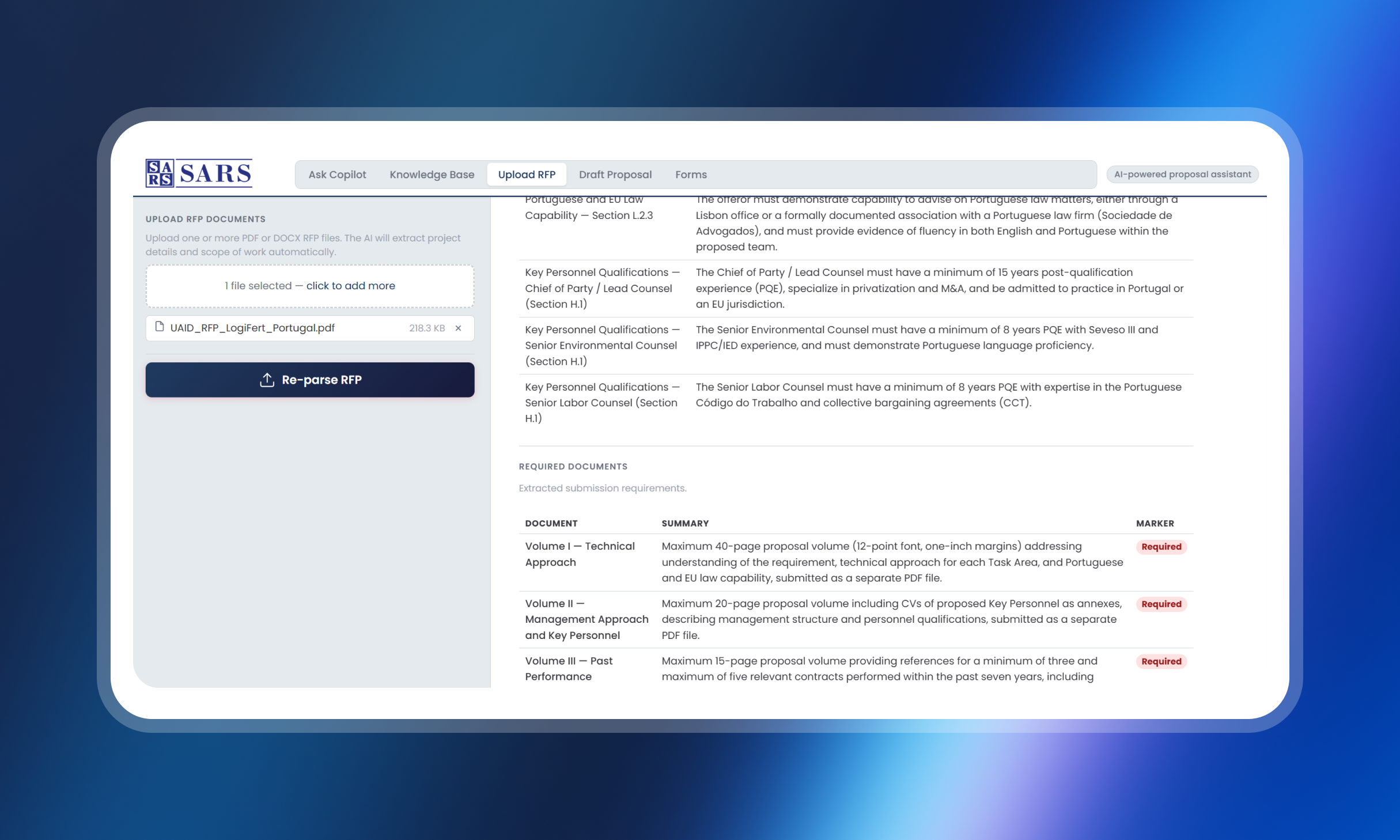
User uploads incoming RFPs as PDF, DOCX, and XLSX files directly into the platform. The solution, powered by Claude LLM parses each document automatically. For shorter mandates, it goes in a single pass, and for longer, complex tender documents (over roughly 60,000 characters) it uses a two-pass extraction: one pass to pull scope, qualification criteria, and required documents, a second to extract metadata and apply taxonomy tags.
The system extracts, structures, and surfaces:
- Project name, client name, issuer, and deadline
- Industry and project type, auto-tagged against SARS Capital’s canonical taxonomy
- A structured scope-of-work table with individually referenced line items
- Qualification criteria, each with a trackable compliance status (Unknown / Compliant / Non-Compliant / Partial) and notes
- Required documents, each with its own status (Not Started / In Progress / Complete) and a mandatory-document flag
- Key contacts – name, role, email, phone – pulled straight from the RFP
Every parsed RFP becomes a persistent RFP Record: a living workspace tracking status (Reviewing RFP → Drafting Proposal → Submitted → Won/Lost), the deadline countdown, internal notes, source files, and a full history of every proposal ever generated against it, each downloadable and previewable in-browser.
-
Go/No-Go – pursuit decisions the partners can defend
Where SARS Capital previously relied on informal judgment calls, every mandate now runs through a structured Go/No-Go framework directly inside its RFP Record. Three knockout checks (conflict of interest, disqualification risk, and fee value below threshold) automatically lock the recommendation to No-Go unless a partner explicitly overrides with a documented rationale.
Beyond the knockouts, six weighted criteria produce a live composite score:
| Criterion | Scoring |
| Relevant experience in library | Auto-scored from the case studies library |
| Qualification compliance | Auto-scored |
| Client relationship strength | Manual |
| Team availability | Manual |
| Commercial attractiveness | Auto-scored |
| Strategic fit | Auto-scored |
Each criterion is rated 1–5 against labeled scoring guidance. The platform combines those ratings, weighted according to SARS Capital’s own priorities, into a single live score out of 100. That score maps to a clear recommendation – Go (≥70), Discuss (45-69), No-Go (<45) – color-coded green/amber/red directly in the firm’s RFP records list.
Partners record a final Go/No-Go/Discuss decision, who made the call, and their rationale, all saved permanently to the record. The result: pursuit decisions that used to live in someone’s head now live in an auditable, consistent framework.
-
Knowledge libraries – the firm’s deal history, structured and reusable
Case studies library. Past deals are uploaded as PDF or DOCX (single files or multi-record documents) and parsed automatically into structured fields: client name, geography, project brief, transaction value, jurisdiction, date of service, role, and scope. Every field is reviewable and editable before saving, and fully editable afterward.
Each case study is tagged by Project Type and Industry via a shared tag-selector component, with tags auto-suggested at parse time, and is bidirectionally linked to the CV library, so it’s always clear which bankers worked which deals.
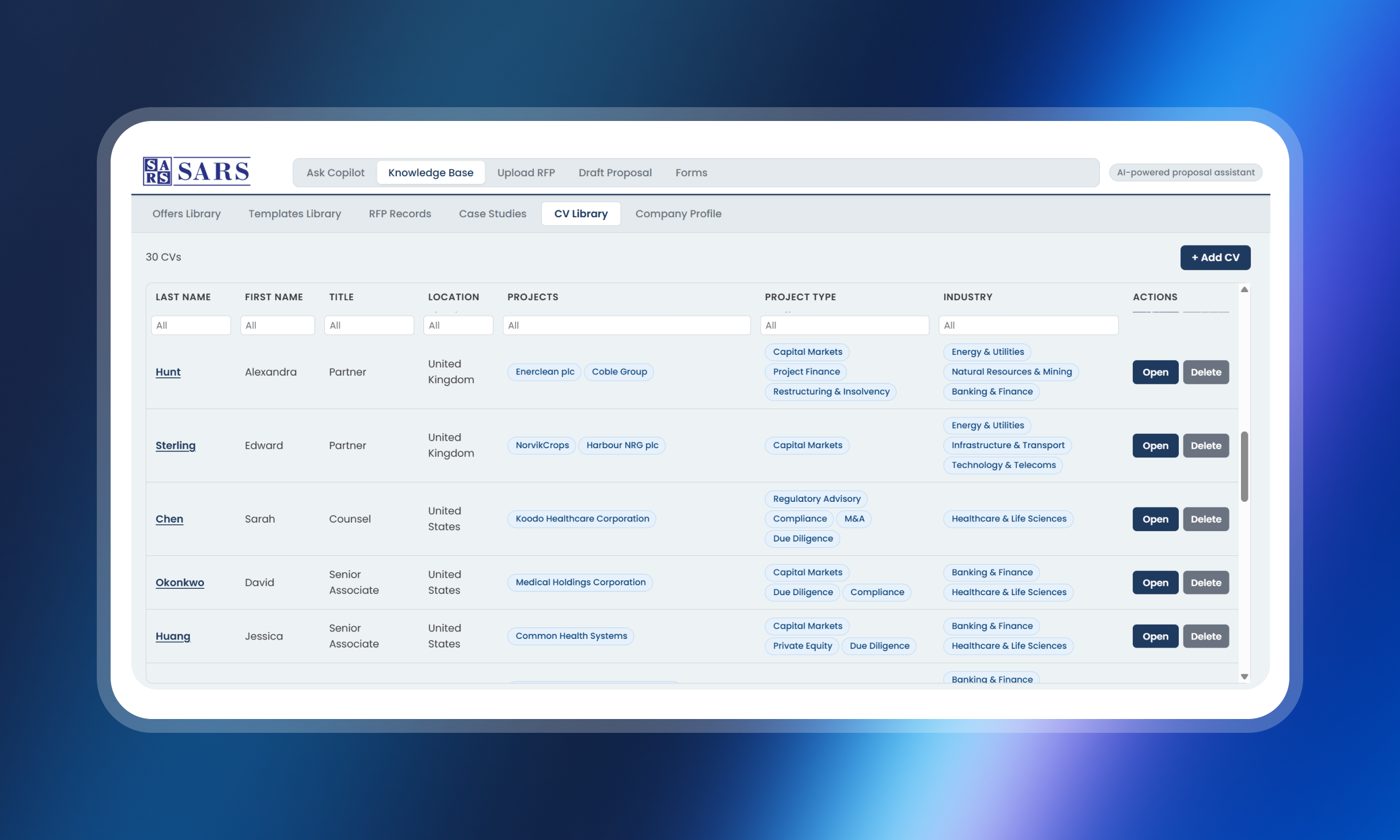
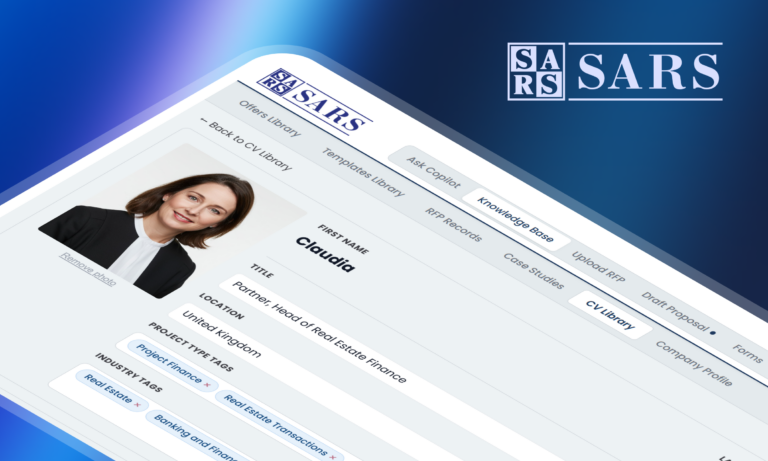
CV Library. Team bios are parsed the same way: name, title, biography, track record, recognition, education, with photo upload so headshots appear directly in generated proposals. CVs carry the same tag structure and library linkage as case studies, and every field remains fully editable after saving.
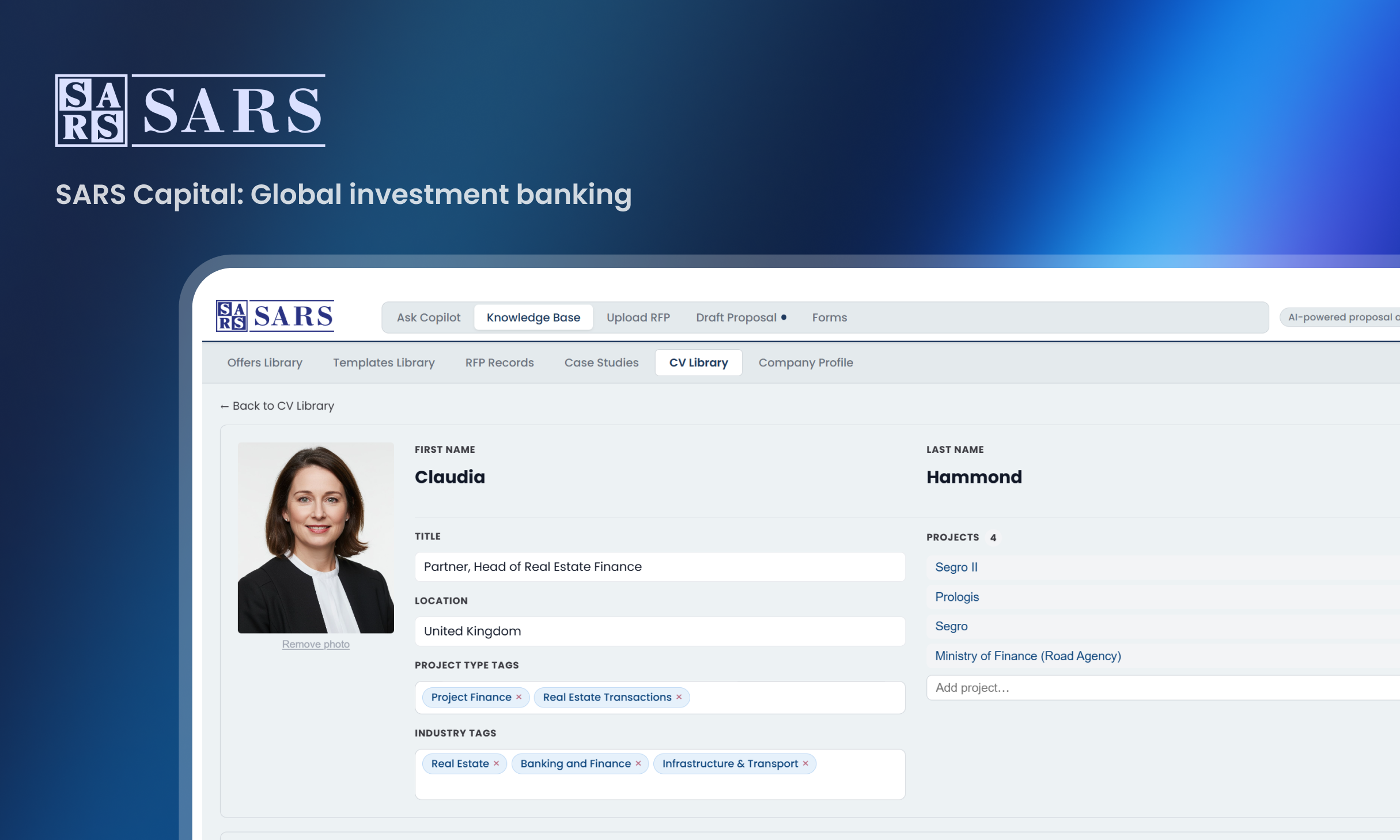
Both libraries are filterable by Project Type and Industry tags, with dropdown or typeahead search on every tag column, so finding “every M&A deal in Energy & Utilities” or “every banker with Capital Markets experience” takes seconds, instead of searching through old folders.
-
Taxonomy – one shared language across the firm
Underpinning both libraries is a canonical taxonomy: 23 project type tags (M&A, Privatization, Joint Ventures, Capital Markets, IPO, Private Equity, Restructuring & Insolvency, Due Diligence, and others) and 19 industry tags (Banking & Finance, Energy & Utilities, Infrastructure & Transport, Natural Resources & Mining, and others). Tags are auto-suggested at parse time across RFPs, case studies, and CVs alike, so the same deal is described the same way everywhere it appears. Custom tags can be added firm-wide instantly, with case-insensitive deduplication to prevent near-duplicate tags from fragmenting the taxonomy over time.
-
Template management – formatting SARS Capital controls, without the corruption risk
SARS Capital’s proposal templates are uploaded as DOCX / PPTX files with placeholder markers for each section. Critically, the underlying file is never edited directly by the AI. Instead, an instruction-only layer stores AI writing guidance for each section in a separate sidecar file, editable in-app. Template fingerprinting flags unauthorized changes to the source file. Users can still download a template and make visual formatting changes in the file at any time, and the firm can maintain multiple templates for different mandate types, all without the file-corruption issues that came with editing DOCX / PPTX content directly.
-
Proposal generation – grounded, tailored, and reviewed before it’s final
When a banker is ready to draft, they select a template and are shown a pre-generation preview before anything is generated. That preview surfaces the firm’s own case studies ranked by relevance – High, Medium, or Low – with the top three auto-selected and the rest available to add manually, each shown with its project type and industry tags. Suggested team members appear the same way, with relevance scoring and the option to manually add anyone via typeahead search (flagged clearly if that person has no bio or tag match on file).
From there, CV tailoring restructures each selected team member‘s bio to lead with the experience most relevant to this specific mandate – entirely on an ephemeral, per-proposal basis; the master CV Library record is never touched. Users can toggle any tailored bio back to the original for a side-by-side check before it goes out. Every piece of content in the final proposal is sourced exclusively from SARS Capital’s own libraries, so the system cannot invent deal experience, credentials, or jurisdictional claims.
The final document is generated as a fully formatted DOCX/PPTX/PDF – custom paragraph styles, embedded photos, tables – previewable in-browser before downloading, and saved with a timestamp to the RFP Record’s proposal history.
-
Relevance scoring – why the “right” case studies surface first
Underneath the case study matching is a transparent scoring model: exact project-type tag matches, industry tag matches, jurisdiction matches (with alias expansion), client geography matches, keyword overlap with the project brief, and a boost when a proposed team member actually worked on that case study.
Exact phrase matching prevents false positives – a mandate tagged “Project Finance” won’t surface irrelevant results just because they mention “finance.” Only case studies clearing a minimum relevance threshold are shown, keeping the shortlist tight and genuinely relevant.
03 The Result
- RFP assessment time cut by ~89% – from 1–2 hours reviewing scope, annexes, Go/No-Go, and qualification fit by hand, down to about 10 minutes to upload, parse, and review a structured summary
- Full proposal turnaround cut by over 95% – from roughly 6-7 hours combined (≈4-5 hours of partner/billable time plus ≈2 hours of junior staff formatting) down to about 20 minutes, including review of the AI-drafted output
- Only one manual step left in the process – pricing. Case study selection, CV tailoring, and offer drafting now run automatically
- Zero template corruption incidents since adoption
- 100% of proposal content traceable back to SARS Capital’s own case study and CV libraries: no fabricated deal experience or credentials
A custom-made AI-powered proposal automation solution didn’t just make us faster, it made our Go/No-Go calls something we can actually stand behind in partner meetings.”— Andrii Sirko, SARS Capital
For M&A boutiques, law firms, and management consultancies alike, the proposal process is a direct extension of the firm’s credibility. AI-powered proposal automation solution is built for that reality: every claim traceable, every template stable, every pursuit decision consistent, with the firm owning its platform rather than renting one indefinitely.