
It's 11 PM, and a senior analyst is still at their desk, because half the day disappeared into pulling filings, reformatting comparables, and building slide templates that should have taken thirty minutes. Across the floor, a due diligence team is manually combing through 800 documents in a virtual data room, flagging risks one by one. Two weeks into a process that should have closed last Friday, the bottleneck is volume.
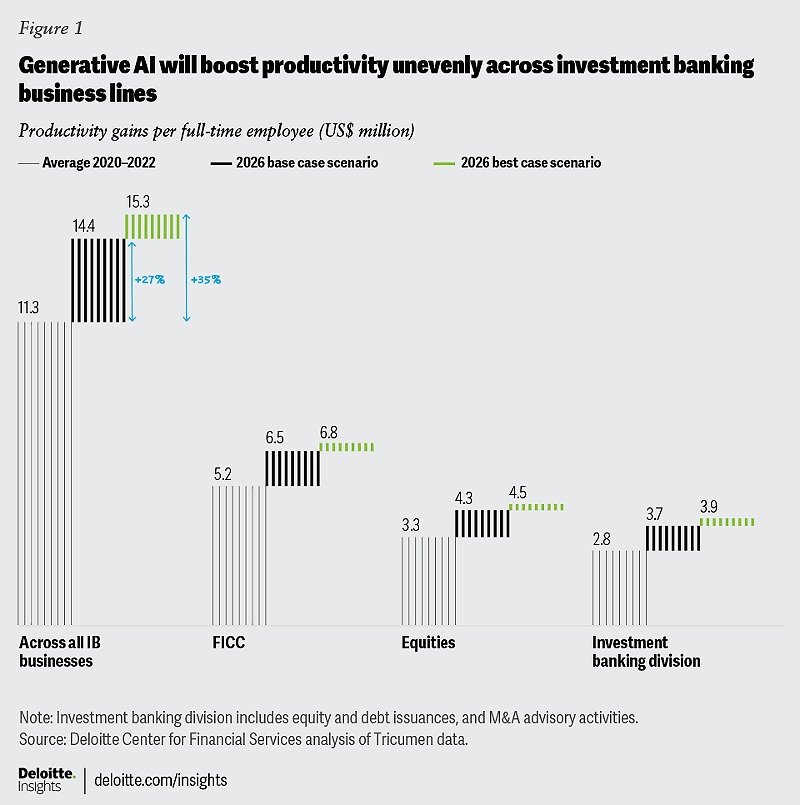
This is the day-to-day reality for most deal teams. Research is slow because sources are fragmented. Due diligence is expensive because it's largely manual. Deal preparation is repetitive because no one has automated the right parts. AI doesn't solve every problem in investment banking, but it directly addresses these three. According to McKinsey, generative AI could automate up to 70% of the time analysts currently spend on data-gathering and formatting tasks: time that could be redirected to higher-value analysis and client work.
In this article, we explore five specific use cases where AI delivers measurable results for research teams, due diligence professionals, and deal execution groups, along with what governance needs to be in place before you deploy anything.
Is your data AI-ready? Double-check with AI Readiness
Where AI helps research teams first
Research is the foundation of every transaction and investment decision, yet it remains one of the most labor-intensive functions in banking. Analysts routinely spend hours aggregating data from earnings calls, SEC filings, news feeds, and third-party databases before producing a single insight. AI changes this equation in two specific areas.
Company screening
Traditional screening tools let you filter by revenue, geography, EBITDA margin, or sector. That's useful, but it's a starting point, not a decision. AI-powered screening goes further: it can process qualitative signals, like management commentary, customer concentration language in 10-Ks, supply chain disclosures alongside quantitative metrics, and surface companies that match a nuanced investment thesis rather than just a numerical threshold.
For M&A origination, this means a banker can define a target profile in plain language and receive a prioritized shortlist within minutes, not days. For buy-side analysts, it means coverage lists that reflect the actual characteristics they care about, not just the ones that happen to be in a spreadsheet column.
Firms using AI-assisted screening report reducing initial target identification time by 60 to 80%. The greater shift, though, is quality: fewer false positives, better alignment with deal criteria, and more time for the analyst to do the actual thinking.
Filings and transcript review
Earnings transcripts, 10-Ks, S-1s, proxy statements, each one contains information that matters. The problem is volume. A thorough review of a single company's annual filings can take four to six hours. Multiply that by twenty targets in a sector scan, and you've consumed a week of analyst time before any synthesis has happened.
AI document analysis tools can read, extract, and summarize material across large document sets in a fraction of the time. More importantly, they can answer specific questions - "Has management changed its language around margin guidance over the last four quarters?" or "What risks does this company cite most frequently?", rather than just producing generic summaries.
Bloomberg's AI capabilities allow analysts to query earnings transcripts using natural language and receive structured outputs tied to specific passages. This shift from document reading to document querying is one of the more practical gains AI brings to research work.
Where AI helps due diligence teams
Due diligence is where AI arguably has the clearest near-term return on investment. Data rooms routinely contain hundreds or thousands of documents. Teams under time pressure read what they can and flag what they find, but coverage is never complete. AI addresses both the speed and consistency problems.
Document extraction
The first challenge in any data room is simply knowing what's there. Contracts, leases, employment agreements, customer service contracts, compliance filings: each category has specific clauses that matter to a buyer or investor.
Finding them manually is painstaking. AI document extraction tools can ingest an entire data room, classify documents by type, and pull structured information: key dates, counterparty names, termination clauses, and renewal terms into a format the deal team can actually use.
Hebbia allows teams to run multi-step queries across large document sets and receive answers with precise citations back to the source. This means a lawyer or analyst can verify every extraction rather than trusting a black-box summary. For financial due diligence specifically, AI can read hundreds of contracts and produce a structured exceptions report in hours rather than the days it would take a junior team.
| Due Diligence Task | Traditional Approach | AI-Assisted Approach | Time Saved |
|---|---|---|---|
| Contract review (200 docs) | 4–6 days, 2 associates | AI extraction + human review, same day | ~70–80% |
| Risk clause identification | Manual read-through, spot checks | Automated flagging across all docs | ~65% |
| Transcript/filing review | 4–6 hours per company | Query-based retrieval, minutes | ~75% |
| Buyer/target matching | Manual research, relationship-based | AI scoring against defined criteria | ~50–60% |
Risk flagging
Extraction is only part of the due diligence problem. The harder part is knowing which findings actually matter. AI risk-flagging systems go beyond identifying what's in a document to assessing its materiality relative to the transaction.
A change-of-control clause in a major customer contract, for instance, is far more significant than the same clause in a low-value supplier agreement. AI can be trained to weigh and prioritize findings based on deal-specific criteria.
This is where the technology moves from a productivity tool to judgment support. A system that surfaces the top fifteen risk items across a 600-document data room, ranked by materiality, gives a senior banker or lawyer exactly the right starting point for a conversation rather than a stack of reading.
Deal teams using AI-assisted risk flagging have reported reducing diligence timelines by 30 to 40% without reducing coverage and, in some cases, increasing it.
Where AI helps deal teams
Beyond research and diligence, AI is beginning to reshape how deal teams manage execution, especially in the two areas that consume disproportionate time: finding the right counterparties and preparing the documents that support a transaction.
Explore our AI Strategy Consulting Services!
Buyer matching
Identifying potential acquirers or investors for a mandate is a combination of relationship knowledge, market awareness, and systematic analysis. Most of the systematic analysis still happens through manual research: bankers building lists, checking past transactions, reviewing sector activity. AI can formalize and accelerate this process significantly.
AI-powered buyer matching tools analyze historical transaction data, strategic priorities disclosed in earnings calls and annual reports, balance sheet capacity, and sector fit to score potential counterparties against a deal's specific characteristics. Rather than a list built on relationships and recollection, the deal team gets a data-supported ranking that can be reviewed and refined.
Memo preparation
Confidential Information Memorandums, management presentations, and investment committee memos are among the most time-consuming deliverables in banking. They require consistent structure, precise language, and accurate financial data—but much of the underlying work is repetitive: pulling the same financial metrics, reformatting the same exhibits, writing the same boilerplate sections.
AI memo preparation tools can generate first drafts of standard sections: business description, industry overview, and financial summary by pulling from diligence documents, financial models, and approved templates. This doesn't replace the banker's judgment on positioning and narrative. It eliminates the hours of mechanical work that precede that judgment.
Teams using AI-assisted memo preparation report cutting initial draft time by 40 to 60%. More importantly, when the draft is done faster, there's more time for the review and refinement that actually determines quality.
Governance requirements before rollout
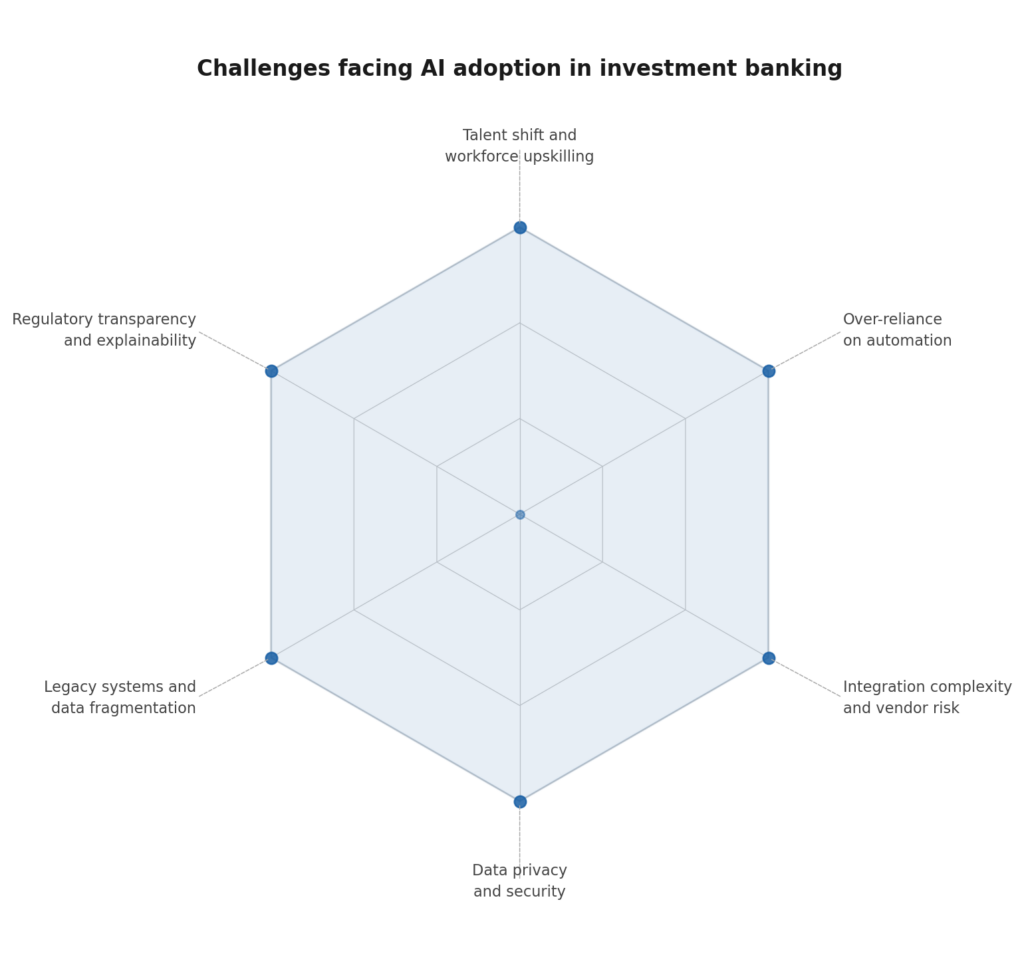
AI in investment banking is not a plug-and-play deployment. The data involved is sensitive, the regulatory environment is demanding, and the consequences of errors: hallucinated financial figures, missed risk flags, data leakage, are serious. Before any AI tool goes into production on a deal team, the following need to be addressed:
- Data security and confidentiality: Deal data cannot flow through third-party AI systems without explicit controls. Deployment architecture must ensure that client information stays within a secure environment, typically a private cloud or on-premises setup. This means evaluating each tool's data-handling practices before signing a contract.
- Model accuracy and hallucination risk: Large language models can generate plausible-sounding errors. Any AI used for financial data extraction or document analysis must have human review checkpoints, and its outputs must be traceable to the source documents. Tools that cite their sources address this more directly than those that produce standalone summaries.
- Regulatory compliance: Depending on jurisdiction, AI use in financial services may trigger requirements under MiFID II, SEC guidance on technology risk, or local data protection law. Legal and compliance teams need to be part of the evaluation process, not brought in after deployment.
- Change management: Analysts and associates need to understand what the tools do, where they're reliable, and where they're not. An untrained user who trusts AI output without verification is a liability, not an asset. Structured onboarding and clear protocols matter.
- Vendor due diligence: The same rigor you'd apply to a portfolio company applies to your AI vendor. Assess their security certifications, data retention policies, model provenance, and financial stability before committing.
How Altamira can support secure implementation
Deploying AI in investment banking requires more than selecting the right Custom Software Development. It requires implementation expertise, secure infrastructure, integration with existing systems, and ongoing support as the tools evolve. For many firms, building this capability internally isn't realistic, which is where a specialist implementation partner becomes valuable.
Altamira works with financial institutions to design and deploy AI systems that meet the security and compliance standards required by investment banking. This includes secure cloud architecture, integration with data room platforms and financial databases, custom model configuration for specific deal workflows, and structured rollout programs that bring teams up to speed without disrupting active mandates.
The firms that implement AI most effectively in banking tend to follow a consistent pattern: they start with one well-defined use case, typically document extraction or transcript review, prove the value within a single deal team, and expand from there. This approach avoids the governance risk of broad deployment before controls are in place, and it builds internal confidence based on real results rather than vendor promises.
What Altamira provides across implementation engagements:
- Discovery and scoping: Mapping existing workflows to identify the highest-impact automation opportunities before any technology is selected.
- Secure deployment: Private cloud or on-premises architecture that keeps deal data inside the firm's control perimeter.
- Integration: Connecting AI tools to existing platforms: data rooms, CRM systems, financial databases, rather than creating parallel workflows.
- Training and change management: Structured onboarding so teams understand what the tools do, how to verify outputs, and how to escalate when something looks wrong.
- Ongoing support: Monitoring, model updates, and performance reviews as deal volumes and requirements evolve.
The final word
The real blocker in investment banking has never been access to information; it's always been the cost of processing it. Analysts are expensive, trained for judgment, and routinely spend half their time on work that doesn't require judgment.
That's the problem AI actually solves, not by replacing the banker, but by eliminating the hours between receiving a mandate and doing something meaningful with it.
What makes the five use cases in this article worth paying attention to is that they attack different parts of the same bottleneck. Screening compresses origination. Transcript review compresses research. Document extraction and risk flagging compress diligence. Buyer matching and memo preparation compress execution.
Together, they shorten the entire deal lifecycle, which is where the competitive advantage actually shows up.
The firms getting the most out of this aren't the ones that ran the biggest AI pilots. They're the ones who picked one workflow, got it right, and built from there. A due diligence team that trusts its AI-extracted contract data because it's verified across 50 deals is in a fundamentally different position from a team still evaluating vendors. That gap is already opening.
Governance isn't a prerequisite to slow things down as it's what makes the speed sustainable. Firms that deploy without it create liability. Firms that use it as an excuse to delay create a different kind of risk: watching competitors execute faster, cover more ground, and win mandates they used to compete for equally.
The technology works. The implementation is the hard part, and it's the part that determines whether AI becomes a durable capability or just an expensive experiment. Contact us to learn more!
FAQ
What is nearshore outsourcing?
Nearshore outsourcing is the practice of contracting with businesses in neighboring countries, rather than your own, to handle specific work or services. Unlike offshore outsourcing, which can involve any country worldwide, nearshore outsourcing specifically targets countries in close geographic proximity or with similar time zones to the client organization. Common examples include a US company working with teams in Mexico or Colombia, or a Western European firm partnering with teams in Eastern Europe.
When is nearshore outsourcing the better choice?
Nearshore outsourcing tends to be the stronger option when time zone alignment and communication quality matter as much as cost savings. If a company's primary goal is to ensure proper communication, fewer mistakes, and quality project outcomes, nearshore outsourcing to a nearby country is a better choice than offshoring to a more distant location.
It's particularly well-suited to software development, technical support, and any function that requires frequent real-time collaboration between the outsourced team and the in-house team. When your team needs daily standups, fast feedback loops, or close integration with internal workflows, an eight-hour time difference creates friction that proximity eliminates.
What is offshore development?
Offshore development involves employing or contracting services in countries that are farther away, often on a different continent entirely. Unlike nearshore outsourcing, offshoring is primarily driven by cost savings resulting from currency differences between countries. A US company building a software team in India or the Philippines, for instance, is offshoring. The trade-off is straightforward: greater potential cost reduction, but also greater distance, larger time zone gaps, and more coordination overhead.
What are the benefits of nearshore outsourcing?
The main advantages come from proximity, both geographic and cultural. Key considerations include geographic proximity, access to a broad talent pool, and cultural and linguistic similarities. A strong nearshore partner can deliver quality service at a lower cost while adopting the client organization's business processes and protocols, thereby minimizing friction between the partner team and the in-house team and increasing the likelihood of successful outcomes.
In practice, this translates to easier onboarding, fewer miscommunications, faster iteration cycles, and a team that feels like a natural extension of your own rather than a separate operation you have to manage around the clock.
What is the difference between nearshore and offshore outsourcing?
The core difference is distance, and distance affects more than just travel time. While nearshore outsourcing involves hiring services in nearby countries with similar time zones, offshoring involves contracting services in countries that are farther away.
Both contrast with onshore outsourcing, which means contracting services within the same country, where cost savings are rarely the primary goal. In practice, offshore arrangements typically offer lower hourly rates but require more structure to manage the time zone gap and potential communication barriers. Nearshore arrangements cost somewhat more but allow for real-time collaboration, faster response times, and closer cultural alignment, making them better suited to projects where speed and communication quality directly affect outcomes.